Identity and access management (IAM) tools quietly decide who gets into your systems, what they can touch, and how long they can stay there. Picking the right platform can mean the difference between smooth, secure access and a messy, over-permissioned nightmare.
What IAM Really Does
IAM combines two things:
- Authentication: Proving the user is who they say they are (password, MFA, biometric, etc.).
- Authorization: Deciding what that user can access once they’re logged in (apps, data, actions).
Good IAM tools help you:
- Use single sign-on (SSO), so users log in once and open many apps.
- Add multi-factor authentication (MFA) and conditional access for extra security.
- Follow least privilege so users only get the access they actually need.
- Keep clear logs for audits and investigations.
1. Auth0
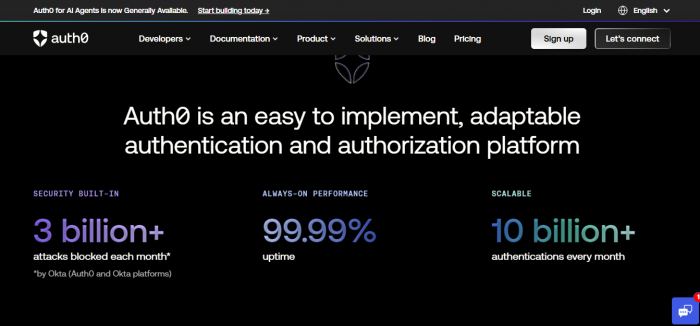
Auth0 is made for developers who want to drop in secure login flows for web, mobile, or API-based apps instead of building everything from scratch.
What it is: An identity platform for customer-facing apps (CIAM) that handles signup, login, MFA, and tokens.
What it does: Supports passwords, social logins, enterprise SSO, and passwordless login like magic links and FIDO2/WebAuthn.
Pros:
- Very developer-friendly with strong docs and SDKs.
- Supports modern standards (OAuth 2.0, OIDC, SAML).
Cons:
MAU-based pricing can get expensive at high user volumes.
Pricing (check their site for the latest):
- Free for up to 7,500 monthly active users (MAU) with limited features.
- Paid B2C plans start around $35/month for 500 MAU, scaling up with usage and features.
2. CyberArk Workforce Identity
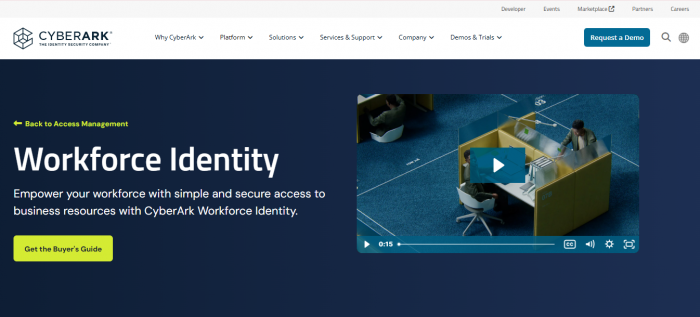
CyberArk Workforce Identity is a cloud IAM platform with a heavy focus on security and privileged access.
What it is: A workforce IAM and SSO/MFA solution that fits well with CyberArk’s privileged access tools.
What it does: Adds SSO, adaptive MFA, and behavior-based access controls across apps and infrastructure.
Pros:
- Very focused on security and risk-based access.
- Good for enterprises that care about privileged accounts.
Cons:
Licensing and editions can be confusing.
Pricing:
Typically, per user per month, many details are quote-only, but third-party ranges are around a few dollars per user, depending on edition.
3. IBM Security Verify
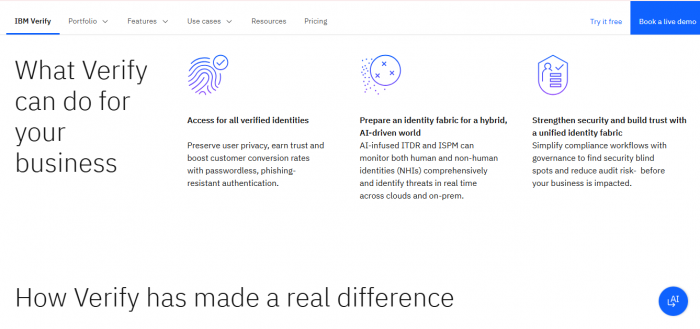
IBM Security Verify is often used by bigger companies with hybrid environments and strong compliance needs.
What it is: An IAM platform with SSO, MFA, adaptive access, and identity governance.
What it does: Connects cloud and on-prem apps, supports standards like SAML and OAuth, and adds access reviews and lifecycle workflows.
Pros:
- Flexible for complex, mixed environments.
- Governance and reporting are strong for audits.
Cons:
The pricing model is not very clear and is often quote-based.
Pricing:
Uses a Resource Unit model, roughly translating to low per-user-per-month costs per capability in sample scenarios, but real pricing is always via IBM sales.
4. JumpCloud
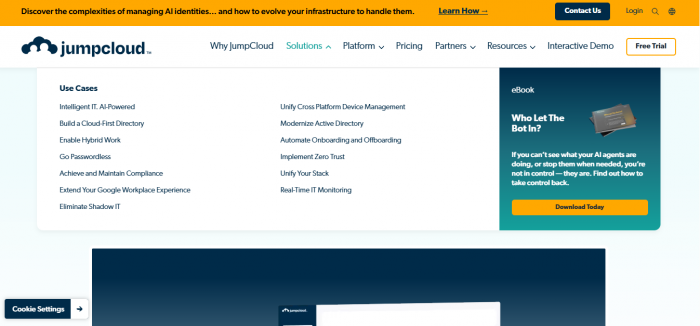
JumpCloud helps smaller and mid-sized organizations replace on‑prem Active Directory and manage identities plus devices from one place.
What it is: A cloud directory and IAM platform with built-in device management.
What it does: Provides SSO, MFA, conditional access, and device policies for Windows, macOS, and Linux.
Pros:
- Good “all-in-one” option for lean IT teams.
- Works well in mixed OS and cloud environments.
Cons:
Pricing and modules can feel a bit fragmented.
Pricing:
Third-party breakdowns show IAM-focused tiers around $13/user/month and full platform options around $19/user/month, but you should confirm current rates on their site.
5. Microsoft Entra ID
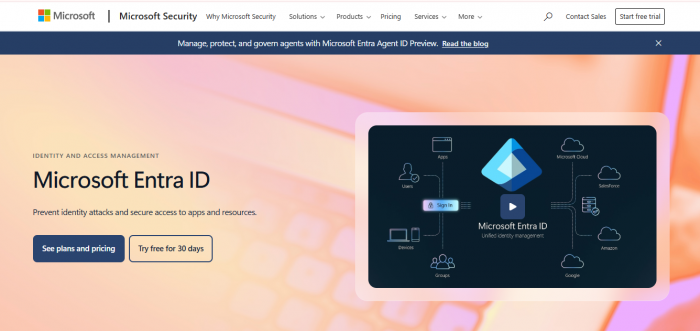
Microsoft Entra ID (formerly Azure AD) is usually the default IAM choice if you already live in Microsoft 365 and Azure.
What it is: Microsoft’s cloud identity service for workforce access and governance.
What it does: Offers SSO, MFA, passwordless, conditional access, and identity governance across Microsoft and integrated third-party apps.
Pros:
- Deep integration with Windows, Microsoft 365, and Azure.
- Some features are included with existing Microsoft subscriptions.
Cons:
Advanced features often need additional SKUs.
Pricing:
- Entra ID P1: about $6 per user/month.
- Entra ID P2: about $9 per user/month for advanced governance and PIM.
6. Okta

Okta is a popular cloud IAM platform known for its large integration ecosystem and vendor-neutral approach.
What it is: A cloud identity service for SSO, MFA, lifecycle management, and governance.
What it does: Connects thousands of apps with prebuilt integrations and automates user onboarding and offboarding.
Pros:
- Very large app catalog and integration marketplace.
- Good for multi-cloud and mixed environments.
Cons:
Modular pricing can get expensive when you add many features.
Pricing:
Individual features cost a few dollars per user/month; full bundles can go up to around $15 per user/month, depending on the mix, with many customers on custom quotes.
7. SailPoint IdentityIQ
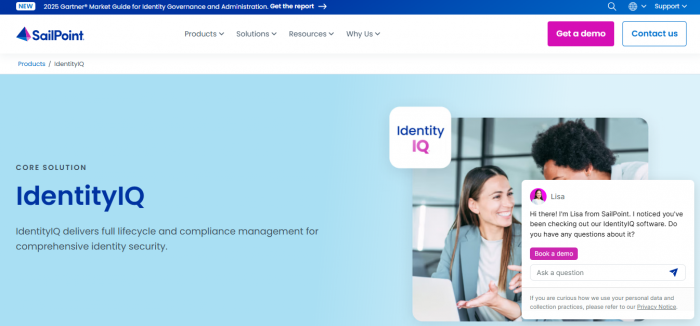
SailPoint IdentityIQ is built mainly for identity governance rather than everyday SSO/MFA.
What it is: An identity governance and administration (IGA) platform for large, regulated organizations.
What it does: Handles access certifications, separation of duties, policy enforcement, and joiner–mover–leaver workflows.
Pros:
Very strong for audits, certifications, and least-privilege enforcement.
Cons:
Complex, expensive, and usually too heavy for smaller companies.
Pricing:
Guides suggest roughly $10–$20 per user/month for certain editions plus significant implementation costs; real pricing is almost always custom.
8. SentinelOne Singularity Identity
SentinelOne Singularity Identity focuses on protecting identity systems (like Active Directory), not managing daily logins.
What it is: An identity threat detection and deception module inside the SentinelOne platform.
What it does: Uses decoys and telemetry to catch credential abuse, lateral movement, and privilege escalation.
Pros:
Great add-on security layer if you already have IAM and want to harden AD.
Cons:
Not a full IAM tool; you still need a main SSO/MFA platform.
Pricing:
SentinelOne lists pricing mostly for broader bundles (e.g., Core from around $69.99 per endpoint/year); Identity features are usually part of enterprise quotes.
Simple Comparison Table
| Tool | Best for | Main strength | Key drawback | Pricing snapshot* |
|---|---|---|---|---|
| Auth0 | Developer and product teams building customer-facing apps | Flexible, developer-first app login and CIAM | MAU-based pricing can climb with big user bases | Free up to 7,500 MAU; paid B2C plans from ≈$35/month for 500 MAU, scaling by MAU and features |
| CyberArk Workforce Identity | Security-focused enterprises with privileged access needs | Strong security, good tie-in with PAM | More complex and “heavy” than basic IAM tools | Per-user/month; typically a few dollars per user in practice, but mainly quote-based |
| IBM Security Verify | Large, regulated, hybrid enterprises | Hybrid flexibility plus governance and compliance features | Opaque RU-based pricing and higher complexity | RU-based; effective per-user cost depends on features and usage, quote-only |
| JumpCloud | SMBs/mid-market replacing on-prem AD | All-in-one cloud directory + IAM + device management | Modular pricing can feel confusing | Indicative ≈$13/user/month for IAM-focused tiers; ≈$19/user/month for full platform |
| Microsoft Entra ID | Microsoft 365/Azure-centric organizations | Deep integration with Microsoft stack | Requires multiple SKUs for full feature set | P1 ≈$6/user/month, P2 ≈$9/user/month, Entra Suite ≈$12/user/month (plus bundled basics) |
| Okta | Multi-cloud and mixed environments | Huge integration catalog and strong SSO/MFA | Modular pricing can become costly | Several dollars per user/month per feature; richer bundles up to ≈$15/user/month, many custom deals |
| SailPoint IdentityIQ | Big, regulated enterprises that live in audit mode | Deep identity governance and access certification | Complex and pricey to deploy and maintain | Often ≈$10–$20/user/month plus large setup projects; quote-based |
| SentinelOne Singularity Identity | Security teams protecting AD and identity infra | Identity threat detection and deception | Not a standalone IAM solution | Part of SentinelOne bundles; Core from ≈$69.99/endpoint/year, Identity via custom quote |
*Always re-check each vendor’s official pricing page before you publish, as numbers and plans change regularly
How to Pick the Right One for Your Stack
When you strip it down, choosing an IAM tool is really about matching it to your world, not chasing some “best overall” winner. If you live mostly in Microsoft 365 and Azure, Entra ID tends to feel the most natural because it plugs straight into what you already use. If your stack is more mixed and spread across different clouds and vendors, something neutral like Okta or JumpCloud usually works better as the central identity hub. Teams that care most about smooth, modern login for customers usually lean toward Auth0 because it saves them from building that whole flow from scratch. When audits and regulations are your biggest headache, SailPoint is what people bring in to tighten governance and keep compliance happy. And if you’re already worried about attackers poking at Active Directory or abusing credentials, that’s when an identity-focused security layer like SentinelOne is added on top of whatever IAM you already run.
Post Comments
Be the first to post comment!
Related Articles


Millions Still Use Softonic But Should You?
Corey Robson . Feb 27, 2026