Table of Content
- A deep dive into poly ai's Features, Enterprise Use Case, Real User Insights & Latest Updates (https://poly.ai/)
- User-Centric Insights : Why PolyAI Appeals to Enterprise Users
- Top Praised Features – What Matters Most to Users
- Major Complaints – Where Users Want More
- User-Focused Competitive Comparison
- What’s Changed for PolyAI Users in 2025
- Should You Choose PolyAI?
A deep dive into poly ai's Features, Enterprise Use Case, Real User Insights & Latest Updates (https://poly.ai/)
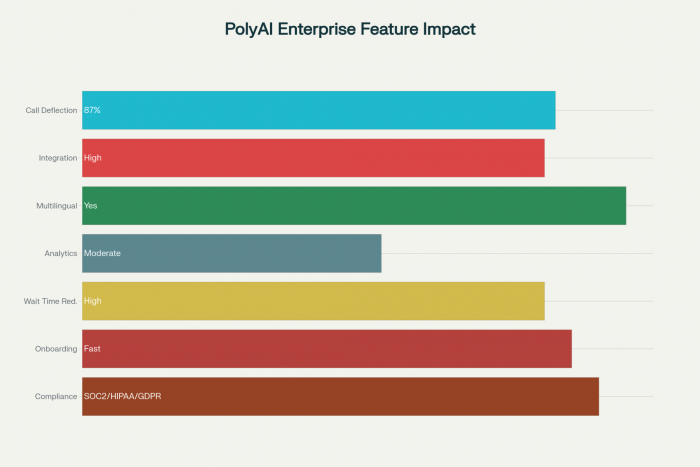
PolyAI stands out in 2025 as an enterprise-grade voice AI platform designed for large organizations seeking to automate routine calls, improve customer satisfaction, and minimize operational costs. This hands-on review unpacks PolyAI’s strengths and weaknesses across real user testimonials, highlights comparison data against top competitors, and visualizes the experience with actionable, easy-to-read charts.
User-Centric Insights : Why PolyAI Appeals to Enterprise Users
- PolyAI’s human-like voice agents excel at deflecting up to 87% of transactional calls, freeing human staff for high-value, complex scenarios.
- It integrates deeply with existing telephony, CRM, and workflow tools, ensuring rapid and compliant implementation for sectors like banking, healthcare, and hospitality.
- Recent updates deliver 24/7 multilingual support, rapid client onboarding, and robust compliance guardrails (SOC 2, HIPAA, GDPR).
- PolyAI’s session analytics help managers spot trends, boost satisfaction scores, and track containment improvements over time.
- Natural voice synthesis and conversational intelligence have notably reduced wait times, boosted guest satisfaction, and enabled instant call routing for global clients.
Top Praised Features – What Matters Most to Users
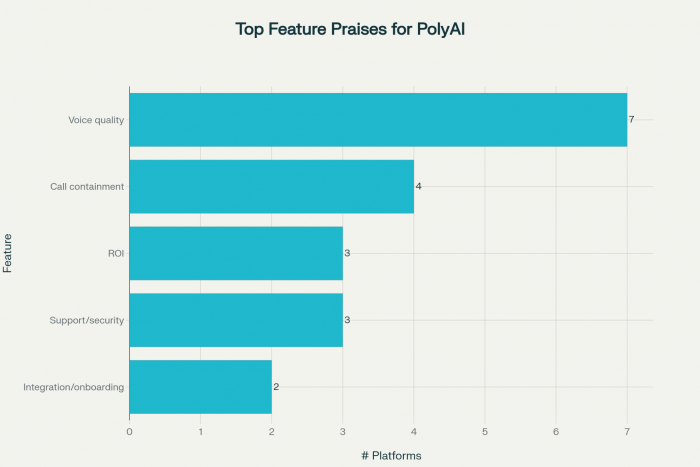
Voice quality, call containment, and rapid ROI are most frequently cited, especially the ability to automate high call volumes and deliver superior CX at scale
Major Complaints – Where Users Want More
Constructive criticism focuses on slower iteration, limited analytics, occasional voice glitches, and tuning options locked behind enterprise contracts.
User-Focused Competitive Comparison
PolyAI is compared with leading platforms in its class (Kore.ai, NICE CXone, Retell AI, Robylon AI, Smallest AI):
| Platform | Best For | Multilingual | Customization | Analytics | Uptime | Latency | Integration | Pricing |
| PolyAI | Enterprise/Compliance | Yes | High | Moderate | 99.5% | 750ms | Deep | Custom (Enterprise) |
| Kore.ai | Large/Complex Orgs | Yes | Very High | Advanced | 99.7% | 550ms | Broad | Tiered |
| Retell AI | Analytics/Monitoring | Yes | Moderate | Advanced | 99.9% | 400ms | Broad | Usage-based |
| Robylon AI | Omnichannel/User-friendly | Yes | Mid-High | Good | 99.8% | 600ms | Wide | Flexible |
| Smallest AI | Real-time/Modular | Yes | Very High | Good | 99.6% | 100ms | Modular | Developer |
PolyAI is most attractive for organizations needing industrial-grade security, deep integrations, and proven containment rates, but competitors shine for small teams needing nimble customization or real-time analytics.
What’s Changed for PolyAI Users in 2025
- Customer containment and automation: Jumped from 72% to >80% in key sectors over past 12 months, reducing real agent demand.
- Multilingual support: Expanded for global audiences, keeping PolyAI competitive.
- Complaint areas: Many users want more rapid prototyping, open API access, and deeper analytics, which competitors supply.
Should You Choose PolyAI?
PolyAI’s strengths lie in delivering reliable, scalable voice AI for enterprises. The recent feedback and visualized data show that if your user needs match its operational scope—especially call automation and compliance—PolyAI delivers real results, with top-tier voice quality and substantial business impact.
For more personalized recommendations, explore your team’s workflow, regulatory demands, and integration needs before choosing the best fit.
Post Comments
Be the first to post comment!
Related Articles



Best Alternatives to Dopple AI
Danny Hamilton . Mar 10, 2026