Let’s be honest for a moment.
Most companies are not falling behind because of major strategic failures. They are bleeding time through small, repetitive tasks that quietly consume hours every week. Manual data entry, lead handoffs, report creation, support sorting, and internal approvals still slow down far too many teams.
That is exactly why AI-driven business automation has shifted from a nice-to-have experiment to a core operational priority.
In 2026, modern automation platforms do far more than link apps with simple rule chains. The newest generation embeds AI decision-making directly into workflows. These systems can interpret messy data, predict next steps, and continuously optimize processes across departments.
But there is an important nuance many surface-level lists ignore.
Business automation is not a single category. Some platforms are lightweight connectors. Others are AI-native workflow engines. A few are full enterprise orchestration layers. The smartest operators are not chasing hype. They are identifying where manual friction exists and automating that specific layer first.
So instead of buzzwords, here is a grounded look at the most effective AI tools for business automation in 2026 and where each one truly fits.
What AI Business Automation Means in 2026
Before diving into tools, it helps to understand what has actually changed.
Traditional automation depended on rigid if-this-then-that logic. Modern AI automation platforms go further by learning from data, predicting outcomes, and adapting workflows dynamically. This shift allows businesses to automate messy, real-world processes rather than only clean, structured tasks.
When implemented well, automation typically delivers:
- Reduced manual busywork
- Faster task turnaround
- Fewer operational mistakes
- Stronger cross-team visibility
The key is selecting the right level of automation for your organization’s complexity.
Gumloop
Best AI-native workflow automation platform
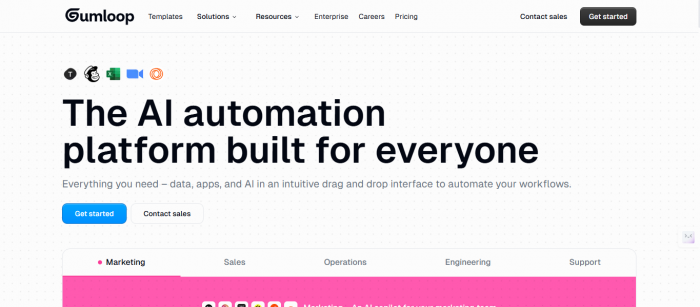
Gumloop has quickly become one of the most interesting entrants in the AI-first automation wave. Unlike legacy tools that mainly move data between apps, Gumloop is designed to inject AI reasoning directly into workflow logic.
The platform uses a visual canvas where teams can connect data sources, applications, and large language models within the same flow. This makes it particularly effective for processes involving unstructured inputs such as emails, documents, and support tickets.
Where Gumloop stands apart is flexibility. Automations can do more than transfer data. They can classify content, extract insights, generate summaries, and automatically route work based on AI judgment. According to many practitioners, this decision layer is what separates modern AI automation from traditional connectors.
Gumloop is especially useful for automating:
- Email triage and routing
- Document processing
- AI content pipelines
- Intelligent data extraction
Verdict: One of the strongest platforms for AI-first automation use cases.
Zapier
Best for simple no-code automation
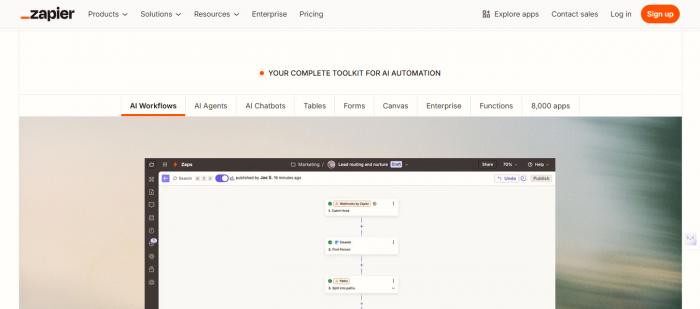
Zapier remains one of the most widely used automation tools, and its popularity is not accidental. The platform connects thousands of apps through simple trigger-action workflows, making it extremely accessible for non-technical teams.
Its biggest strength is speed. Businesses can automate routine tasks like syncing leads, sending alerts, or updating spreadsheets without writing code. Tools in this category are particularly effective at eliminating repetitive app-to-app work.
However, Zapier’s traditional strength is also its ceiling. It excels at structured automation but is less suited for workflows that require deep AI reasoning or complex data interpretation.
Zapier works best when you need to automate:
- Lead routing
- CRM updates
- Form-to-database syncing
- Basic notifications
Verdict: Still the easiest on-ramp into business automation.
Microsoft Power Automate
Best for Microsoft-centric organizations
For companies deeply embedded in the Microsoft ecosystem, Power Automate often becomes the natural automation layer.
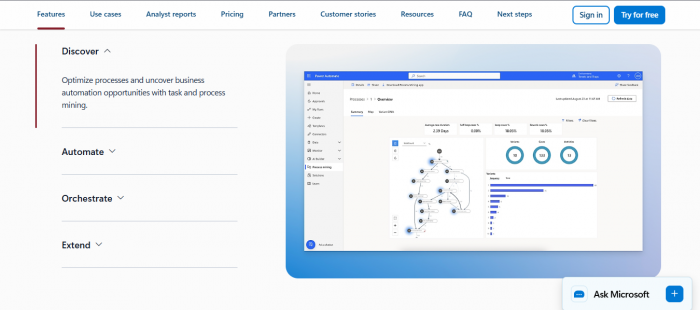
The platform integrates tightly with Microsoft 365, Dynamics, Teams, and Azure, enabling businesses to automate internal workflows without heavy custom development. Its expanding AI features also support document processing and intelligent workflow routing inside enterprise environments.
Power Automate becomes especially valuable when most processes already live within Microsoft tools. In those cases, the integration depth significantly reduces friction.
It is strongest for:
- Enterprise workflow automation
- Microsoft 365 processes
- Document approvals
- Internal operations
Verdict: A practical and efficient choice for Microsoft-heavy environments.
n8n
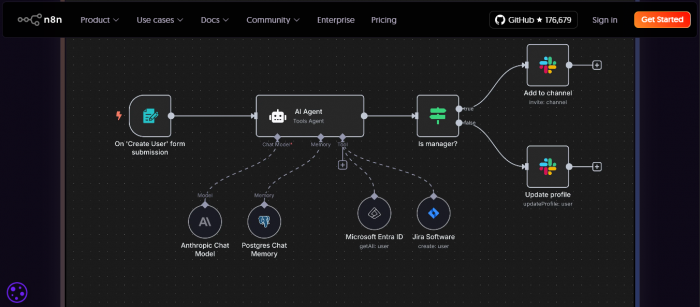
Best open-source automation platform
n8n has quietly developed a strong following among technical teams that want more control than typical no-code tools provide.
As an open-source platform, n8n allows organizations to self-host and deeply customize workflows. This makes it attractive for companies with strict data governance requirements or highly specialized automation needs.
Compared with plug-and-play tools, n8n requires more setup and technical comfort. But the tradeoff is ownership and flexibility. Teams can build highly tailored workflows and integrate niche systems without being locked into a closed ecosystem.
n8n works best when you need:
- Self-hosted automation
- Developer-level flexibility
- Custom integrations
- Cost control at scale
Verdict: Ideal for technical teams that want full control.
Workato
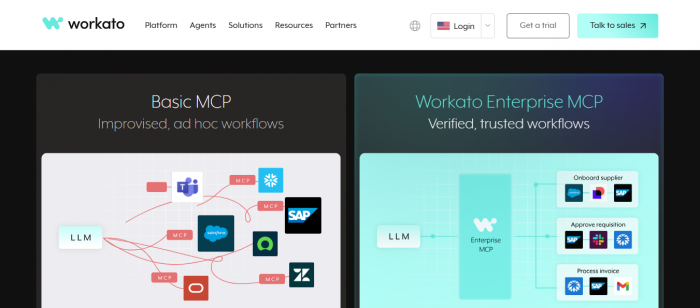
Best for enterprise automation orchestration
Workato sits firmly in the enterprise automation tier. It is designed for organizations that need to coordinate complex workflows across multiple departments and systems.
Unlike lighter tools, Workato focuses on large-scale process automation, combining integrations, workflow logic, and AI assistance in a single platform. Enterprise teams often use it to unify marketing, sales, finance, and support workflows under one automation strategy.
The platform is powerful but often excessive for small teams. Its real value emerges when automation becomes a cross-functional initiative rather than a single-team project.
Workato is strongest for:
- Enterprise process automation
- Cross-system orchestration
- Large integration environments
- Scalable automation programs
Verdict: Built for organizations with mature automation needs.
Vellum
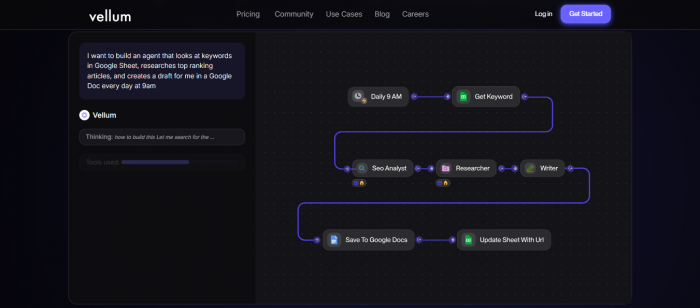
Best for LLM-powered product workflows
Vellum approaches automation from the AI product development angle rather than pure internal operations.
The platform focuses on building, testing, and deploying LLM-powered workflows in production. This makes it particularly relevant for companies embedding AI directly into customer-facing products or internal AI features.
Teams can manage prompts, evaluate outputs, and monitor model performance within structured pipelines.
Compared with general automation platforms, Vellum is more specialized. It shines when AI is part of the product experience itself rather than just an efficiency layer.
It performs best for:
- AI feature development
- Prompt management
- LLM evaluation pipelines
- Production AI monitoring
Verdict: Best suited for product and AI engineering teams.
How to Choose the Right Automation Tool
The biggest mistake businesses still make is asking, “Which automation platform is best?”
The more useful question is simpler and more practical: where is manual work still slowing your team down?
If your workflows involve messy data and AI reasoning, Gumloop is often the strongest starting point. If you mainly need to connect apps quickly, Zapier remains the fastest win. If your company runs heavily on Microsoft tools, Power Automate usually fits naturally. Technical teams that want ownership often gravitate toward n8n, while large enterprises typically require orchestration platforms like Workato.
There is no universal winner because automation maturity varies widely between organizations.
Final Thoughts
Business automation is entering a new phase.
The first wave eliminated repetitive clicks. The current wave is beginning to eliminate repetitive thinking. AI-powered platforms can now classify information, prioritize tasks, and route work dynamically instead of following rigid rules.
However, the companies seeing real ROI in 2026 are not trying to automate everything at once. They start with high-friction workflows and expand gradually as systems prove their value.
Because in modern operations, the real competitive advantage rarely comes from working harder.
It comes from quietly removing the work that never needed to be manual in the first place.
Post Comments
Be the first to post comment!