Table of Content
- My First Impressions of Pink Video Chat
- How It Actually Works When You Use It
- What the Experience Feels Like
- How the Money Side Looks From the User’s Seat
- Safety, Privacy, and Trust: How It Feels When You’re Inside
- How Pink Compares to Other Random Video Chat Apps (From a User View)
- My Personal Pros and Cons as a User
- How I Keep Myself Safe When Using Pink
- My Final Verdict as a User
Pink Video Chat feels exciting at first glance: open the site, tap a button, and within seconds I’m face‑to‑face with a stranger somewhere in the world. It gives me that raw, unfiltered “Omegle‑style” experience, no long signup, no endless forms, just straight into a live conversation.
My First Impressions of Pink Video Chat
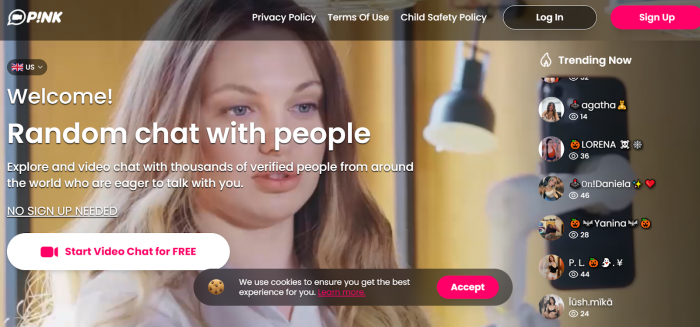
The first thing I notice as a user is how little effort it takes to get started. I don’t have to build a profile, upload photos, or verify my email. I simply allow camera and microphone access and hit “Start,” and the system instantly connects me to someone random. That instant gratification is one of Pink’s biggest hooks.
At the same time, that simplicity cuts both ways. The platform feels fun and accessible, but it also reminds me that I’m stepping into a completely unpredictable environment with people I know nothing about. There’s a sense of thrill, but also a clear need to be careful.
How It Actually Works When You Use It
From a user journey perspective, Pink is very straightforward:
● I open the site (or a partner page that offers Pink Video Chat).
● My browser asks for camera and mic permissions.
● I tap a “Start” or “Video Chat” button and I’m matched with a stranger.
● If the vibe is off, I just hit “Next” and I’m instantly connected to someone new.
This loop is fast and addictive. I can meet several people in a few minutes, and there’s almost no delay between one chat and the next. If I’m bored and just want to talk to someone, anyone, Pink does that job well.
What the Experience Feels Like
Instant Random Matching
As a user, the “Next” button is my best friend. If the other person is quiet, rude, or just not my type, I don’t have to explain anything—I just skip. That makes the platform feel very empowering in the moment.
But it also means conversations can become shallow and disposable. People know they can skip at any time, so some users are rude, some don’t bother saying hello, and some clearly come with adult intentions that I may not be comfortable with.
Anonymity and Camera‑First Design
One of the things I appreciate about Pink is the anonymity. I don’t need to share my real name or put my personal details on display. The focus is on my camera feed and my voice, not on a detailed profile.
However, that same anonymity applies to the person on the other side. I have no idea who they are, how old they really are, or what their intentions might be. That makes every call a gamble: sometimes I meet genuinely interesting people, sometimes I encounter content or behavior I would rather not see.
Filters and Controls
As I explore, I see basic controls like:
● Disconnect / Next
● Report
● Block
These tools give me minimal control over my experience. If someone is offensive, I can cut the call or report them. In some versions or partner platforms, I may see options like gender or country filters, often tied to premium access.
From a user standpoint, these filters are useful, but I also know they are not bulletproof. A filter won’t guarantee respectful behavior, and I have to rely mostly on my own judgment and quick reactions.
Performance and Accessibility
On the technical side, Pink generally feels lightweight. It loads quickly in the browser, works decently on mobile, and the video and audio quality are acceptable as long as both sides have a decent internet connection.
Because it’s so easy to access, no complicated app install required, it’s tempting to use when I’m bored. But again, that easy access also means anyone, including minors, can stumble into it, which is worrying from a safety point of view.
How the Money Side Looks From the User’s Seat
Free vs Paid Experience
As a regular user, I can do quite a bit for free:
● Join random 1‑on‑1 video chats.
● Skip people with the “Next” button as often as I want.
● Accept ads as part of the experience.
At some point, I’m nudged toward premium or extra features: more control over who I meet, fewer ads, or better filters. That’s pretty standard for these kinds of platforms.
The Confusing Part: Pricing Transparency
What doesn’t feel very user‑friendly is how unclear the overall pricing structure can be. Instead of one crystal‑clear pricing page, information appears fragmented: “coins,” “VIP,” special access, all referenced in different ways depending on where I encounter Pink.
From my perspective, this means:
● I don’t always know exactly what I’m paying for.
● It’s not immediately obvious whether charges are one‑time, per‑minute, or recurring.
● I need to be extra careful before buying anything, especially if I’m using a card or digital wallet.
As a cautious user, I would avoid spending money until I fully understand what each package or feature unlocks and whether I can easily cancel.
Aggregate Pricing Overview
| Plan / Item | Reported Price Range | What It Typically Includes |
| Free entry | 0 | Basic random 1‑on‑1 video chat, limited continuity, ads |
| Weekly subscription | 7.99 USD | Ad‑free use, some premium perks (better continuity, possibly filters) |
| Monthly subscription | 9.99–19.99 USD | Extended access, fewer limits, premium features like filters/priority |
Safety, Privacy, and Trust: How It Feels When You’re Inside
This is the area where my emotions as a user are strongest—both positive and negative.
What Makes Me Feel Safer
On paper, Pink suggests that it cares about privacy and safety: things like anonymity, encrypted streams, and tools to report or block problematic users. These elements do help and give me at least some sense that I’m not completely unprotected.
Knowing that I don’t have to share personal details and that I can instantly leave a call makes me feel more in control than on some social platforms where content is permanently visible.
What Makes Me Hesitate
On the other hand, there are several things that keep me on my guard:
● I don’t see deeply detailed, prominent information about how moderation really works.
● I’m not always sure who runs the platform or what their policies are in practice.
● I know from experience and stories that random video chats can involve nudity, harassment, or aggressive behavior.
So even when I see buttons like “Report,” I’m left asking myself: What happens after I press it? Is anyone actually reviewing this in real time? Will anything change?
Risks I Have to Accept as a User
Just by joining Pink, I’m accepting a few realities:
1. I will probably see explicit content at some point.
2. I might run into people who are there to troll, harass, or shock others.
3. I cannot reliably tell who is an adult and who might be underage.
4. Scammers or people trying to push me to external sites or apps may appear.
If I’m an adult, I can decide whether I’m okay with these risks. But if I imagine a teenager or child landing here, it becomes obvious that this environment is not designed with them in mind and could expose them to harmful situations very quickly.
How Pink Compares to Other Random Video Chat Apps (From a User View)
If I’ve used other random video chat apps before, Pink feels familiar: the same quick matching, the same camera‑first interactions, the same unpredictability.
Where Pink feels strong to me:
● Very low friction to start chatting.
● Simple interface—almost no learning curve.
● Anonymity is built in, which some users want.
Where it feels weaker compared to some bigger or more established platforms:
● Less visible information about the company and moderation policies.
● Vague pricing and premium feature structure.
● No obvious, robust age‑gating system to keep minors away from adult content.
So if I’m the kind of user who cares more about safety, transparency, and clear company backing, I might gravitate toward better‑documented alternatives. If what I care about is pure spontaneity and I’m willing to manage my own safety, Pink can still be appealing.
My Personal Pros and Cons as a User
What I Like
I can go from feeling bored to talking to someone live in seconds, making it incredibly easy for me to find instant connection whenever I want. I don’t have to expose my real identity or share personal information, so I can stay completely private while I chat.
If a conversation isn’t working for me, I can leave at any time without needing to explain myself. Plus, there’s a free way for me to experience the core feature set, so I can try it out and see how it works before committing to anything.
What I Don’t Like
The constant uncertainty bothers me because I never know what I’ll see next, and sometimes it can be disturbing. I also notice the lack of clearly visible, detailed information about moderation and enforcement, which makes me feel uneasy.
On top of that, the pricing and premium options feel a bit messy and unclear. I’m also concerned that minors could easily access the platform and end up seeing things they shouldn’t.
Who I Think Pink Video Chat Is Really For
From a user’s perspective, Pink makes the most sense for:
● Adults who want spontaneous, anonymous conversations and fully understand the risks.
● People who have used random chat platforms before and know how to protect themselves online.
● Users who prioritize quick entertainment over stability, structure, or deep community features.
It’s absolutely not a platform I would recommend for:
● Teenagers or children, even if they’re just “curious.”
● Anyone who is easily upset by explicit content or aggressive behavior.
● Users who need strong verification, curated communities, or professional networking.
How I Keep Myself Safe When Using Pink
If I decide to stay on Pink, I’ve learned to follow some simple rules to protect myself.
I never share personal information like my full name, address, school, workplace, or phone number. I keep my background neutral so people can’t guess where I live or work, and I’m mindful of anything visible on my camera that could reveal clues about my location. I also avoid clicking on suspicious links or quickly moving to private messaging apps with strangers. Before engaging too much, I take a moment to gauge whether the other person seems genuine and respectful.
If someone makes me uncomfortable, I leave immediately and use the report or block tools without hesitation. I treat the entire platform as adults-only and make sure to warn younger people in my life not to experiment with it. I also limit how long I stay on the platform and remind myself not to get emotionally invested in random chats. Overall, I approach the experience cautiously and prioritize my privacy and safety at all times.
These steps don’t make Pink “safe,” but they make my time there much less risky.
My Final Verdict as a User
If I describe Pink Video Chat honestly from my perspective, I’d say this:
It does a good job at giving me what it promises-fast, random, anonymous video chats with strangers. When I’m in the mood for pure spontaneity, it can be fun, surprising, and occasionally even meaningful.
But it’s also a space where I’m constantly aware of risk. The lack of deep transparency and the nature of random video chat mean I never truly relax about safety, privacy, or who might appear on my screen next. For me, Pink is a “use with caution” platform: enjoyable in short bursts if I’m careful, but not something I would treat like a safe, everyday social app.
Post Comments
Be the first to post comment!
Related Articles