Why Practices Look Beyond Valant.io
Valant has earned a long-standing place in behavioral health software thanks to features like AI Notes Assist, group therapy management, and support for higher levels of care including IOP and PHP. The platform still earns a 4.1 rating on GetApp across more than three hundred verified reviews. Recent review patterns, however, surface two consistent frustrations: frequent technical disruptions reported by a clear majority of users covering bugs in the last year, and pricing that the vendor does not publish openly, which complicates side-by-side comparison for buyers. For a deeper breakdown of these strengths and trade-offs, our full Valant.io review looks at how the platform performs for behavioral health practices in real-world use.
Practices that have outgrown a single solo clinician, that bill heavily through insurance, or that prefer a more polished modern interface increasingly evaluate four alternatives that consistently appear in switch-from comparisons. Each one occupies a distinct niche rather than competing on the same axes, which is why this review covers them alphabetically rather than ranking them. The right platform depends on practice size, payer mix, prescribing volume, and tolerance for documentation versus interface trade-offs.
Below is the snapshot view, followed by detailed coverage of each platform with honest commentary on the limitations every buyer should plan for.
Pricing And Capability Snapshot
| Platform | Starting price | Strongest for | Signature capability |
|---|---|---|---|
| ICANotes | $35 to $213 per clinician monthly | Psychiatry and prescribing teams | Menu-driven content engine with 75,000+ clinical phrases |
| SimplePractice | $49 Starter monthly | Solo and small private-pay practices | Modern client portal with integrated website builder |
| TheraNest (Ensora Mental Health) | $29 monthly entry tier | Budget-aware solo and small group practices | Built-in Wiley Treatment Planner library |
| TherapyNotes | $59 solo, $79 + $50 per added clinician | Insurance-heavy group practices | Structured progress notes with seven-day clinician-staffed phone support |
4 alternatives covered, alphabetically | $29 lowest entry tier in this comparison | 200K+ providers across SimplePractice and TheraNest combined |
ICANotes
A behavioral health EHR built around a menu-driven content engine.
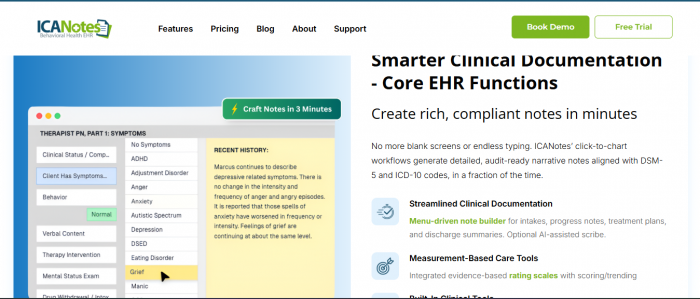
At a glance Founded by a psychiatrist and built specifically for behavioral and mental health workflows. Starting price ranges from $35 to $213 per clinician monthly depending on role and prescribing status. Activation fee of $99 applies to prescribing plans. Strongest fit for psychiatry, psychiatric nursing, and documentation-heavy outpatient practices. |
What Makes It Different
The signature feature is a proprietary content engine containing over seventy-five thousand pre-written clinical phrases organized by topic. Instead of free-typing notes or selecting from basic templates, clinicians click through structured menus to assemble thorough, audit-ready documentation. Reported time savings of thirty to sixty minutes per clinician per day are common in independent review coverage.
Beyond the content engine, ICANotes includes integrated controlled substance prescribing through EPCS, more than one hundred built-in rating scales such as PHQ-9 and GAD-7, structured treatment planning, telepsychiatry, and AI Readability Enhancement for session transcription. The platform also supports inpatient settings and higher levels of care, which sets it apart from lighter outpatient-only competitors.
Pricing Structure
| Plan | Monthly cost | What it covers |
|---|---|---|
| Notes only | $35 part-time, $55 full-time | Documentation plus core charting modules |
| Non-prescribing clinician | $45 part-time, $75 full-time | Adds scheduling, patient portal, secure messaging, billing |
| Prescribing clinician | $138 part-time, $213 full-time | Adds EPCS, lab integration, prescriber workflows. $99 activation fee applies |
| Telehealth add-on | $10 per user monthly | Optional across all tiers |
| Text reminders | $0.05 per text | Pay-per-use messaging |
| Additional admin users | First free, $25 monthly each after | Schedulers, billers, intake coordinators |
Verdict
Strengths worth keeping • Fastest path to thorough psychiatric documentation in the behavioral health EHR market. • Independently owned, which provides stability missing from private-equity-acquired competitors. • Strong fit for prescribers thanks to native EPCS and lab integrations. • Supports outpatient as well as IOP and PHP, unlike most lighter alternatives. • Behavioral-health-specific content was authored by a practicing psychiatrist. | Trade-offs to weigh • Interface design feels dated compared with SimplePractice and newer entrants. • Steep learning curve reported by clinicians switching from minimalist platforms. • Pricing climbs quickly for full-time prescribers, particularly with telehealth and claims volume add-ons. • Mobile experience lags the polished apps from SimplePractice and TherapyNotes. • Three-month minimum commitment on subscription plans reduces flexibility. |
Ideal Practice Profile
Outpatient psychiatry practices, group practices with at least one prescriber, and behavioral health organizations running structured programs that value documentation depth over interface polish. Practices that bill heavily through Medicare or Medicaid benefit most from the audit-ready charting and self-coding features.
SimplePractice
A modern practice management platform with polished client experience and the strongest mobile app in this comparison.

At a glance Used by over two hundred thousand health and wellness professionals. Three published tiers from $49 to $99 monthly for solo practitioners. Includes integrated website builder, online booking, and Webby-nominated TherapyFinder directory. Strongest fit for cash-pay solo therapists and small practices that prioritize client experience. |
Standout Capabilities
The client-facing experience is the most refined in the behavioral health EHR space. The mobile apps for iOS and Android cover nearly the full feature set including scheduling, note-writing, telehealth, secure messaging, billing, and client management. Online booking and a customizable client portal handle intake, payment, and document collection with minimal manual intervention.
Built-in marketing capabilities differentiate the platform from competitors. The integrated website builder produces a responsive, professional site without separate hosting, and the TherapyFinder directory contributed an additional discovery channel that pure EHR competitors lack. E-prescribing including controlled substances is available as a paid add-on.
Cost Breakdown
| Plan | Monthly cost | What it covers |
|---|---|---|
| Starter | $49 monthly | Solo practitioner, calendar, basic notes, billing. Telehealth not included |
| Essential | $79 monthly | Adds telehealth, advanced billing, secure messaging, outcome measures |
| Plus | $99 monthly | Adds multi-clinician support, custom branding, insurance billing automation |
| Additional clinicians | $59 monthly each on Plus | Required for any group practice configuration |
| E-prescribe add-on | $49 monthly per clinician | Plus a one-time $89 setup fee per clinician |
| AI Note Taker add-on | $35 monthly | Optional documentation assistant |
| Annual CPT code fee | $20 per clinician per year | Required across all plans |
Verdict
Strengths worth keeping • Best-in-class mobile experience with feature parity across iOS, Android, and web. • Integrated website builder and directory listing add genuine marketing value beyond core EHR features. • Clean, modern interface reduces onboarding friction for newer clinicians. • Strong client portal experience improves intake completion and payment collection. • Thirty-day free trial without credit card required, allowing genuine evaluation. | Trade-offs to weigh • Starter plan excludes telehealth, which post-pandemic is essential for most therapists. • Pricing rose roughly sixty-nine percent on the entry plan in early 2025, sparking user backlash. • Group practices over ten clinicians pay materially more than equivalents on TherapyNotes. • Insurance billing carries additional per-claim fees layered on top of subscription cost. • Not appropriate for substance use disorder programs or higher levels of care. |
Where It Fits Best
Solo therapists running cash-pay or hybrid practices, small group practices with three to nine clinicians, and any clinician who values a polished client experience above pure documentation speed. Practices where more than sixty percent of revenue comes from private pay typically prefer SimplePractice over the insurance-heavy alternatives.
TheraNest (Ensora Mental Health)
Rebranded under Ensora Health in 2025, the platform retains a strong reputation for affordability and group practice workflows.

At a glance Founded in 2013, rebranded from TheraNest to Ensora Mental Health under parent Ensora Health in 2025. Entry plan starts at $29 monthly, scaling with active clients rather than per-clinician. Includes Wiley Treatment Planner content library across plans. Strongest fit for solo and small-to-mid group practices that need group telehealth. |
Capabilities Worth Knowing
The platform combines clinical documentation, insurance billing with clearinghouse integration, scheduling, e-prescribing, telehealth, and a client portal. Two features set it apart from SimplePractice and TherapyNotes for group practices specifically: secure group telehealth sessions for up to twenty participants and the integrated Wiley Treatment Planner library, which auto-inserts evidence-based goals and objectives into treatment plans.
An AI-enhanced documentation tool launched after the Ensora rebrand assists with session note generation. Automated appointment reminders, customizable progress notes, a searchable DSM and CPT code database, and unlimited document storage round out the practice management side. Pricing transparency is better than most competitors, with publicly listed tier structures rather than quote-only access.
Subscription Tiers
| Plan | Monthly cost | What it covers |
|---|---|---|
| Starter tier | $29 monthly | Solo practitioner, limited active client count, core scheduling and notes |
| Growth tier | Custom by client count | Higher active client cap, telehealth, billing tools |
| Group practice tier | Custom by clinician count | Multi-provider scheduling, supervision tracking, Wiley plans |
| Ensora RCM | Custom quote | Optional managed billing service handling claims end-to-end |
| Fusion (rehab therapy) | From $119 monthly | Sister product for physical and occupational therapy, separate from TheraNest |
Verdict
Strengths worth keeping • Lowest entry price in this comparison, with transparent published tier pricing. • Group telehealth for up to twenty participants supports therapy groups and supervision. • Wiley Treatment Planner content saves real time on treatment plan creation. • Multi-provider scheduling and supervision tracking built for group practices. • Active client pricing aligns cost with caseload rather than seat count. | Trade-offs to weigh • Private equity ownership under KKR since 2021 has introduced support quality concerns in user reviews. • Active client pricing structure can climb unexpectedly for practices with high client turnover. • Customization options remain limited compared with ICANotes content engine. • Not built for Applied Behavior Analysis workflows or IOP and PHP programs. • Mobile app trails SimplePractice and TherapyNotes in feature parity and polish. |
Best Suited For
Solo therapists on a tight budget, growing group practices that run therapy groups or need supervision tracking, and practices that value Wiley Treatment Planner content. The platform fits practices where caseload is relatively stable and per-client pricing remains predictable.
TherapyNotes
A behavioral health EHR built around structured progress notes, with the most clinician-friendly support model in this comparison.
At a glance Founded in 2010 in Horsham, Pennsylvania, by clinical psychologist Dr. Debra Pliner. Pricing starts at $59 monthly for solo practitioners, $79 plus $50 per added clinician for groups. Non-clinical staff seats are free across all plans. Strongest fit for insurance-billing group practices and clinicians who value reliable phone support. |
Key Strengths
Where competing platforms treat notes as a secondary concern behind scheduling and billing, TherapyNotes puts structured documentation at the center of the product. The platform integrates with the Wiley Practice Planners library, auto-inserts evidence-based content into treatment plans, and offers DAP, SOAP, and BIRP note structures that follow behavioral health compliance norms.
Support is a genuine differentiator. Live phone and email support runs seven days a week, answered by staff with clinical backgrounds rather than tier-one call center agents. The platform holds HITRUST certification, which exceeds standard HIPAA requirements, and ranked twelfth in Newsweek's America's Best Online Platforms 2025 evaluation. Iframe-free telehealth, integrated billing with ERA posting, and credit card processing complete the core offering.
Plan Pricing
| Plan | Monthly cost | What it covers |
|---|---|---|
| Solo | $59 monthly | One clinician, full feature set, free non-clinical staff seats |
| Group | $79 monthly first clinician, $50 each added | Multi-clinician scheduling, free non-clinical staff seats |
| Enterprise (30+ users) | $79 monthly first clinician, $50 each added | Same per-seat pricing as Group, scales linearly |
| Implementation | $0 for standard setup | Roughly $1,000 to $5,000 for complex data migrations |
| Telehealth | Included | No add-on charge across plans |
| E-prescribing add-on | Available as separate fee | Not bundled with base subscription |
Verdict
Strengths worth keeping • Materially cheaper than SimplePractice at scale for any group practice over five clinicians. • Telehealth bundled into every plan rather than gated to higher tiers. • Seven-day phone support staffed by clinicians remains rare in this category. • Free non-clinical staff seats reduce total cost for practices with billers and front-desk staff. • Strong reliability track record with consistent five-star Trustpilot ratings across thousands of reviews. | Trade-offs to weigh • Customization options for note templates are more limited than SimplePractice or ICANotes. • Interface looks less modern than competitors built after 2018. • Mobile app, while functional, trails SimplePractice in feature parity. • Not designed as a prescriber-first platform, so psychiatrists may prefer ICANotes or Valant. • Not appropriate for substance use disorder programs at any level of care. |
Recommended Fit
Solo therapists who anticipate growing into a group practice within twelve to twenty-four months, established group practices billing primarily through insurance, and any clinician who values responsive clinical-grade support over interface polish. Practices where more than sixty percent of revenue comes from insurance typically prefer TherapyNotes over SimplePractice.
Head-To-Head Capability Comparison
Practices that get the most from this review should weigh capabilities against the specific clinical and operational gaps they want to close. The matrix below maps the features that most commonly appear in evaluations after Valant.
| Capability | ICANotes | SimplePractice | TheraNest | TherapyNotes |
|---|---|---|---|---|
| Behavioral-health-specific templates | ✓ | ✓ | ✓ | ✓ |
| Built-in telehealth | ✓ | ✓ | ✓ | ✓ |
| E-prescribing with EPCS | ✓ | Add-on | ✓ | Add-on |
| Wiley Treatment Planner content | ○ | ○ | ✓ | ✓ |
| Group telehealth sessions | ○ | ○ | ✓ | ✓ |
| Integrated website builder | ○ | ✓ | ○ | ○ |
| Outcome measures (PHQ-9, GAD-7) | ✓ | ✓ | ✓ | ✓ |
| IOP and PHP workflow support | ✓ | ○ | ○ | ○ |
| Phone support seven days a week | ○ | ○ | ○ | ✓ |
| Free non-clinical staff seats | ○ | ○ | ○ | ✓ |
Add-on indicates the capability is available but billed separately on top of the base subscription.
Choosing The Right Fit By Practice Profile
The four platforms above are not directly substitutable. The right call depends on practice size, payer mix, prescribing volume, and how much value documentation depth provides relative to interface polish. The matrix below maps common practice profiles to the platform that fits best, alongside the reason each pairing works.
| Practice profile | Recommended platform | Why it fits |
|---|---|---|
| Solo psychiatrist or NP prescribing controlled substances | ICANotes | Integrated EPCS, rating scales like PHQ-9 and GAD-7, audit-ready charting |
| Cash-pay therapist focused on client experience and marketing | SimplePractice | Polished portal, integrated website builder, strong mobile app |
| Group practice with two to fifteen clinicians and tight margins | TheraNest | Lowest entry tier, group telehealth, Wiley plan library included |
| Insurance-billing group practice scaling past ten clinicians | TherapyNotes | $50 per added clinician scales cheaper than per-seat competitors |
| Large outpatient practice running IOP or PHP programs | Stay with Valant or evaluate Behave Health | None of the four lighter alternatives cover IOP/PHP workflows natively |
Three Quick Filters Before A Final Shortlist
• Payer mix. Practices where insurance covers more than sixty percent of revenue lean toward TherapyNotes or ICANotes. Cash-pay practices lean toward SimplePractice.
• Prescribing volume. Any practice with one or more prescribers handling controlled substances should weight EPCS depth heavily, which favors ICANotes and Valant over SimplePractice or TherapyNotes.
• Level of care. IOP and PHP programs are not supported well in SimplePractice, TheraNest, or TherapyNotes. Practices running those levels of care should keep Valant on the shortlist or evaluate purpose-built platforms like Behave Health or AZZLY Rize.
Bottom Line
None of the four platforms above wins on every axis. ICANotes leads on documentation speed and prescribing depth but feels dated. SimplePractice leads on client experience and mobile but charges a premium that compounds quickly for group practices. TheraNest leads on price transparency and group practice workflows but carries private equity ownership risk. TherapyNotes leads on group practice economics and clinical support but offers less customization.
The honest recommendation for most practices evaluating a Valant alternative: shortlist two of the four based on payer mix and prescribing volume, run thirty-day trials in parallel on real workflows, and decide based on whether documentation speed or client experience matters more. The decision rarely comes down to feature checklists; it comes down to which platform reduces friction on the workflow that consumes the most clinician time.
Post Comments
Be the first to post comment!
Related Articles