Table of Content
- Why Many Businesses Look for Mailchimp Alternatives
- Quick Comparison of Popular Mailchimp Alternatives
- ActiveCampaign
- MailerLite
- Brevo (formerly Sendinblue)
- Constant Contact
- HubSpot Email Marketing
- My Experience Testing Several Mailchimp Alternatives
- Choosing the Right Mailchimp Alternative
- Final Thoughts
Mailchimp has long been one of the most recognizable names in email marketing. For years it served as the default platform for startups, creators, and businesses that wanted to build email lists, send newsletters, and automate campaigns. Its drag-and-drop email builder and simple onboarding helped make email marketing accessible to beginners.
However, the email marketing ecosystem has expanded rapidly. Many businesses eventually explore alternatives because of pricing increases, limited automation capabilities, or the need for features that Mailchimp does not provide. Some users also find that Mailchimp’s pricing structure becomes expensive as contact lists grow because the platform charges based on the number of contacts stored in an account.
The good news is that there are now dozens of strong competitors that offer similar or even more advanced features. Some platforms focus on automation, others specialize in ecommerce email marketing, and some provide a simpler and cheaper alternative for small businesses.
This guide explores some of the most popular Mailchimp alternatives and explains what makes each platform different.
Why Many Businesses Look for Mailchimp Alternatives
Mailchimp remains a capable platform, but there are several reasons why businesses eventually start looking at alternatives.
One of the most common complaints involves pricing. As email lists grow, costs can increase quickly because Mailchimp charges for every contact stored in the database.
Another issue is automation. While Mailchimp offers basic automation workflows, some competitors provide more advanced features such as behavioral triggers, complex customer journeys, and deeper segmentation tools.
Deliverability is also occasionally mentioned in user reviews. Studies of email marketing tools have shown that inbox placement rates can vary between providers, and businesses often experiment with alternative platforms to improve campaign performance.
Because of these limitations, many companies explore tools that provide stronger automation, better pricing, or features tailored to specific industries such as ecommerce or creator newsletters.
Quick Comparison of Popular Mailchimp Alternatives
| Tool | Best For | Standout Feature | Starting Price |
| ActiveCampaign | Marketing automation | Advanced customer journeys | ~$15/month |
| MailerLite | Small businesses and creators | Simple interface and affordable pricing | Free plan available |
| Brevo (Sendinblue) | Multi-channel marketing | Email plus SMS campaigns | Free plan available |
| Constant Contact | Beginners | Large template library | ~$12/month |
| HubSpot Email Marketing | Businesses using CRM | All-in-one marketing platform | Free plan available |
These tools address different use cases. Some prioritize advanced automation while others focus on simplicity and affordability.
ActiveCampaign

ActiveCampaign is widely considered one of the strongest alternatives for businesses that want advanced marketing automation.
The platform combines email marketing with CRM features, customer segmentation, and automated campaign workflows. Instead of sending simple newsletters, businesses can build multi-step campaigns triggered by user behavior such as website visits or purchase activity.
For example, an ecommerce store could automatically send follow-up emails to customers who abandoned a shopping cart. Marketing teams can also build detailed automation journeys that adapt based on how users interact with previous messages.
Because of these capabilities, ActiveCampaign is often used by companies that rely heavily on marketing automation and personalized email campaigns.
MailerLite

MailerLite has become one of the most popular Mailchimp alternatives for small businesses and creators. The platform focuses on simplicity and affordability while still offering a full set of email marketing features.
Users can build campaigns using a drag-and-drop editor, create landing pages, and automate email sequences. MailerLite also includes tools for subscriber forms, pop-ups, and audience segmentation.
One advantage frequently mentioned by users is pricing. MailerLite offers a free plan and relatively low costs for growing email lists compared with many competitors.
Because of its balance between simplicity and features, MailerLite is often recommended for entrepreneurs and creators who want a straightforward email marketing platform.
Brevo (formerly Sendinblue)
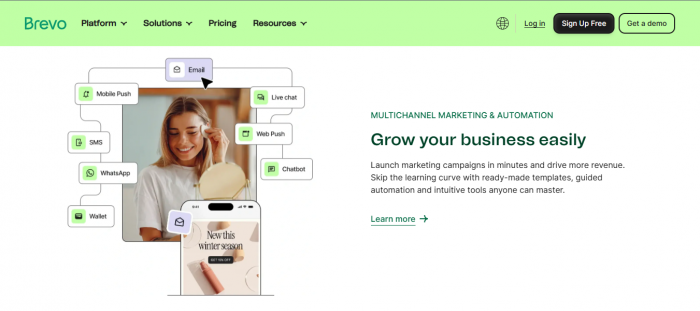
Brevo takes a broader approach to digital marketing. Instead of focusing only on email campaigns, the platform supports multiple communication channels including email, SMS, and customer messaging.
This multi-channel strategy allows businesses to reach customers through different communication methods within a single platform. For example, a company could combine email campaigns with SMS alerts or transactional messages.
Brevo also includes automation tools that help businesses build customer journeys across multiple channels. These capabilities make it a strong option for businesses that want more than basic email marketing.
Constant Contact

Constant Contact is another well-known email marketing platform that often appears in comparisons with Mailchimp. The tool is particularly popular among beginners and small businesses.
One advantage is its extensive template library. The platform includes hundreds of email templates designed for different types of campaigns such as newsletters, promotions, and event announcements.
The interface is also designed to be beginner friendly. Many users choose Constant Contact because they want a simple way to start sending professional emails without dealing with complex automation systems.
HubSpot Email Marketing

HubSpot approaches email marketing differently from most standalone platforms. Instead of focusing only on newsletters, HubSpot integrates email campaigns into a full marketing ecosystem that includes CRM tools, landing pages, and customer tracking.
This integration allows businesses to connect marketing campaigns directly with customer data. For example, a company can track how email campaigns influence website activity or sales conversions.
While HubSpot can become expensive as features are added, it remains a popular option for organizations that want a unified marketing platform rather than a standalone email tool.
My Experience Testing Several Mailchimp Alternatives
While researching alternatives, I spent time exploring several platforms to see how they actually compare in everyday use.
The biggest difference I noticed was how each platform approaches automation and campaign building.

When testing MailerLite, the setup process felt extremely straightforward. Creating a campaign or building a simple automation sequence took only a few minutes, and the interface was clean enough that most features were easy to find. It felt very similar to Mailchimp in terms of usability but slightly simpler.
ActiveCampaign felt more powerful but also more complex. When I experimented with building automation workflows, the platform offered significantly more control over triggers and customer segmentation. However, it took more time to understand the automation builder compared with simpler platforms.
Brevo stood out because of its multi-channel capabilities. Instead of limiting campaigns to email only, the platform allows messaging through SMS and other communication tools, which could be useful for businesses that want a broader marketing strategy.
After testing several tools, the biggest takeaway is that the best alternative depends heavily on how you plan to use email marketing. Some businesses only need simple newsletters, while others rely on automation and customer segmentation.
Choosing the Right Mailchimp Alternative
Different platforms solve different marketing problems, so the best alternative depends on your business needs.
If you want advanced automation and customer journeys, ActiveCampaign is often considered one of the strongest options.
If affordability and simplicity are more important, MailerLite provides many essential features at a lower cost.
Businesses that want to combine email with SMS or other messaging channels may find Brevo more suitable.
And companies already using CRM platforms may prefer HubSpot because it integrates email marketing with customer data.
The most important step is understanding how email marketing fits into your broader marketing strategy.
Final Thoughts
Mailchimp helped define modern email marketing, but it is no longer the only option available. Over the past decade, many platforms have emerged that offer better automation, more flexible pricing, or features tailored to specific industries.
Tools like ActiveCampaign, MailerLite, Brevo, Constant Contact, and HubSpot each approach email marketing differently. Some prioritize automation, others focus on affordability, and some provide complete marketing ecosystems.
For businesses evaluating alternatives, the best approach is to test a few platforms and see which one aligns with your workflow. Email marketing tools are most effective when they fit naturally into the way your team plans and executes campaigns.
In the end, the goal is not simply replacing Mailchimp but finding a platform that helps you build stronger relationships with your audience and run more effective marketing campaigns.
Post Comments
Be the first to post comment!
Related Articles