AI companion chat platforms have grown far beyond simple chatbot experiments. What once started as novelty interactions has evolved into a category of conversational AI where personalities, storytelling, and roleplay are the primary focus.
SpicyChat AI became well known because it leaned directly into this idea. Instead of functioning like a question answering assistant, the platform allows users to interact with AI characters designed to simulate personality, emotional tone, and narrative dialogue.
While experimenting with SpicyChat, I enjoyed the immersive conversations it offers. However, after spending more time on the platform, I became curious about how it compares to other tools in the same category. The AI companion ecosystem has expanded quickly, and several platforms now offer stronger conversational memory, deeper customization, and more immersive character experiences.
To understand which alternatives actually perform well, I spent time testing a range of platforms using similar conversation scenarios.
How I Tested These SpicyChat Alternatives
Before recommending any alternatives, I wanted to see how these platforms behave in real conversations rather than relying on feature lists.
I created custom characters on each platform and defined personality traits, tone, and fictional backstories. After that, I ran extended conversations lasting between thirty and fifty messages to see how well the AI maintained personality and conversational context.
Finally, I tested storytelling prompts. I asked each AI to continue fictional scenes and react emotionally to different scenarios. Some platforms produced surprisingly immersive narrative responses, while others quickly drifted into generic chatbot behaviour.
These tests made it much easier to see which platforms actually deliver convincing character conversations.
CrushOn AI
Also read this: CrushOn AI

The first alternative I explored was CrushOn AI, which is frequently mentioned when people discuss platforms similar to SpicyChat.
After several hours of testing, it became clear why the platform has gained popularity. CrushOn AI performs well in extended roleplay conversations. Characters tend to maintain their personality across long exchanges without suddenly switching to generic responses.
During one of my test conversations, I deliberately shifted the dialogue from casual interaction to a fictional narrative scene. The AI adapted smoothly and continued the scenario without breaking character. That consistency makes conversations feel much more immersive.
Another advantage is the large community character library. Users can browse personalities created by others, which means it is easy to jump into conversations without designing a character from scratch.
The main limitation appears in the free version. Message limits are fairly restrictive, and longer conversations quickly push users toward the paid plans. Pricing usually begins around ten dollars per month and increases depending on message limits and model access.
Based on my experience testing the platform, CrushOn AI felt like one of the closest alternatives to SpicyChat. Conversations were stable and immersive, which is why I would personally rate the platform around 8.7 out of 10 after multiple long sessions.
Joyland AI
Also read this: Joyland AI

Joyland AI feels noticeably different from most AI companion platforms because it behaves more like a storytelling engine than a standard chat system.
During testing, the AI often generated longer responses that included descriptions of actions, emotions, and environment details. Conversations felt closer to collaborative storytelling rather than simple message exchanges.
For example, when I prompted the AI to continue a fictional scene, it expanded the narrative with dialogue and descriptive context instead of responding with short messages. This style works particularly well for users who enjoy roleplay storytelling.
One drawback is that these longer responses slow down the pacing of conversations slightly. The platform also has a smaller community compared to some larger competitors.
Joyland offers a free tier with limited usage and premium subscriptions that typically start around ten dollars per month.
Overall, Joyland impressed me with its narrative capabilities. After experimenting with several storytelling prompts, I would personally rate the platform around 8.4 out of 10, particularly for users who enjoy creative roleplay.
Talkie AI
Also read this : Talkie AI

Talkie AI stands out immediately because it introduces voice interaction into AI companion conversations.
Instead of typing messages, users can speak directly to AI characters and receive spoken responses. During testing, this feature made interactions feel significantly more immersive than text based chat.
Hearing a character respond out loud changes the experience. Conversations feel more like voice chats than messaging threads, which makes the interaction surprisingly engaging.
Talkie also supports character creation and includes a library of personalities created by the community. Conversations behave similarly to other platforms, but the voice element adds a new dimension.
Voice responses take slightly longer to generate, and some advanced voice features require a subscription. The platform offers a free version with limited voice usage, while premium plans generally begin around ten dollars per month.
From my testing sessions, Talkie AI felt like one of the most unique platforms in this category. The voice interaction alone made it stand out, and I would personally rate the experience around 8.2 out of 10.
Character.AI
Also read this : Character.AI
Character.AI is arguably the most recognizable platform in the AI companion space.
The main reason is scale. The platform hosts millions of user generated personalities, which means there is always something new to explore. During testing, I was able to interact with dozens of characters ranging from fictional personalities to original creations.
Conversation quality was consistently strong. Characters usually stayed in role and responded creatively to prompts. Even during longer interactions, the AI maintained context fairly well.
The platform does have stricter moderation rules than some alternatives, which may limit certain roleplay scenarios. However, for many users this is not a major issue.
Character.AI offers free access to most features. Its premium subscription, called c.ai+, costs roughly ten dollars per month and provides faster response speeds along with priority server access.
Overall, Character.AI felt like the most polished and stable platform during my testing. Because of its large community and reliable conversation quality, I would personally rate it around 8.8 out of 10, making it one of the strongest options available.
Janitor AI
Also read this : Janitor AI
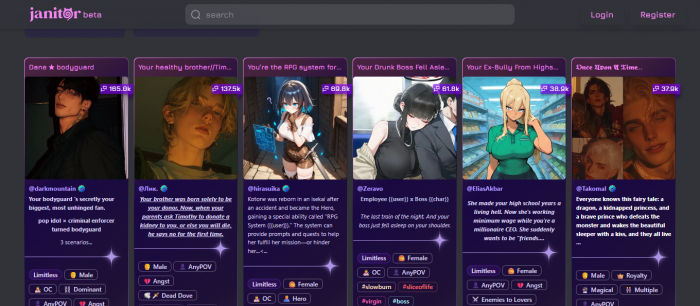
Janitor AI is slightly different from the other platforms because it offers deeper character customization.
Instead of writing a short personality description, users can create detailed prompts that define how the character behaves, speaks, and reacts. During testing, this allowed for much more unique personalities.
With carefully written prompts, the AI could maintain very specific behavior patterns during conversations. This flexibility makes the platform particularly popular among experienced roleplay writers.
However, the setup process can feel more technical than other platforms. Janitor AI often requires connecting external AI models, which adds an additional layer of configuration.
The platform itself is free to use, but depending on the external model chosen, users may incur API costs from providers such as OpenAI.
From my perspective, Janitor AI is one of the most powerful tools for people who want detailed control over AI personalities. After testing several characters, I would personally rate it around 8.3 out of 10, especially for advanced users.
Dream Companion
Also read this : Dream Companion
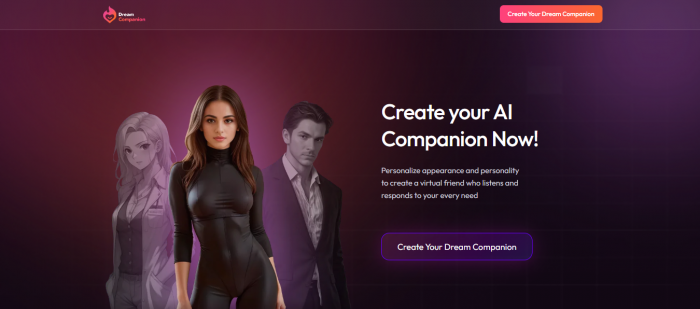
Dream Companion introduces an interesting concept by combining AI conversation with image generation.
During conversations, users can generate images that represent characters or scenes described in the dialogue. This visual element adds another layer of immersion.
When I tested this feature during storytelling prompts, it made the interaction feel more dynamic. Seeing a visual representation of the narrative adds a creative dimension that text only platforms lack.
The tradeoff is that image generation can slow conversation speed slightly. The platform also has a smaller community compared with more established AI chat platforms.
Dream Companion offers limited free usage and premium plans that generally range between twelve and twenty dollars per month depending on generation limits.
While still developing its ecosystem, the platform shows interesting potential. Based on my experience, I would rate Dream Companion around 7.9 out of 10
Quick Comparison
| Platform | Best For | Personal Rating |
| CrushOn AI | Roleplay conversations | 8.7 |
| Joyland AI | Storytelling | 8.4 |
| Talkie AI | Voice interaction | 8.2 |
| Character.AI | Large community | 8.8 |
| Janitor AI | Customization | 8.3 |
| Dream Companion | Visual storytelling | 7.9 |
Who Should Use Which Platform
Different platforms serve different types of users.
- People looking for the closest experience to SpicyChat will probably find CrushOn AI the easiest transition.
- Users who enjoy narrative driven conversations may prefer Joyland AI because of its storytelling style.
- If discovering a massive library of characters is the priority, Character.AI remains the strongest ecosystem.
- Advanced users who want deep personality customization may find Janitor AI the most powerful option.
- Meanwhile, people interested in voice conversations might find Talkie AI the most immersive experience.
Expert Insight
The growth of AI companion platforms reflects a broader shift in conversational AI. Instead of focusing purely on productivity tasks, developers are exploring systems that simulate personality and emotional interaction. As language models improve, these platforms are gradually becoming better at maintaining character consistency and narrative context.
FAQ
What is the closest alternative to SpicyChat AI?
CrushOn AI is often considered the closest alternative because it supports similar roleplay conversations and flexible dialogue interactions.
Are SpicyChat alternatives free?
Many AI chat platforms offer free tiers with limited message usage. Premium subscriptions typically unlock higher message limits and faster responses.
Which AI chat platform has the most characters?
Character.AI currently hosts one of the largest communities and the biggest library of user generated personalities.
Post Comments
Be the first to post comment!
Related Articles