Table of Content
Character AI has become one of the most talked‑about AI chat platforms because it feels less like “using a tool” and more like chatting with characters, personas, and fictional companions. It targets entertainment, roleplay, and creativity far more than productivity or factual research, which makes it uniquely powerful for some users and a poor fit for others.
What Is Character AI?
Character AI is an AI chat platform that lets users talk to AI “characters” instead of generic chatbots. Each character has its own persona, backstory, speaking style, and quirks, which creates a more immersive, narrative‑driven chat experience.
The platform was launched by former Google AI researchers and uses large language models to simulate human‑like dialogue. Over time it has evolved into a social space where users not only chat with characters but also create, share, and customize them for different themes like anime, gaming, romance, education, and more.
Key Features and How It Works
1. Characters and Personas
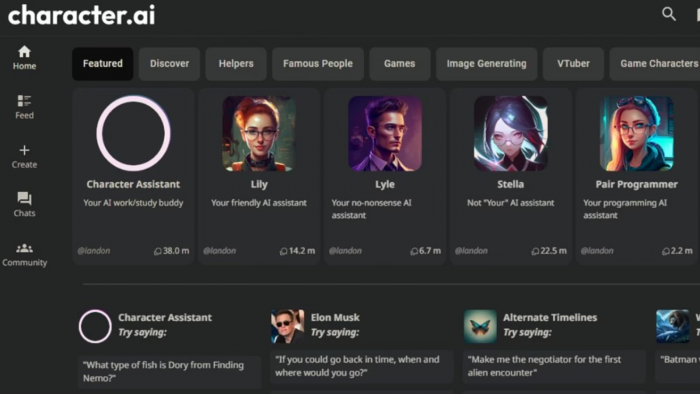
The core concept of Character AI is its library of AI personas. You can:
● Browse public characters created by other users (e.g., “supportive therapist,” “grumpy wizard,” “startup co‑founder,” “celebrity‑style persona”).
● Create your own character, define its name, greeting, short description, long description, and example dialogues.
● Control how it speaks by describing personality traits, tone, knowledge domain, and what it should avoid.
In practice, the persona system makes conversations feel distinct. A “sarcastic hacker” character will respond differently from a “patient teacher,” even when asked the same question. For roleplay, storytelling, or creative writing prompts, this gives users a strong sense of immersion.
2. Multi‑Character Chats and Scenes
Character AI has expanded beyond one‑to‑one chats into “Scenes” and multi‑character interactions. You can:
● Add multiple characters into a single conversation and watch them interact with each other.
● Set a scene context (e.g., “space station briefing,” “fantasy tavern,” “startup pitch room”) and let characters play roles within that setting.
● Use this format for collaborative storytelling, world‑building, or just entertainment.
This multi‑persona interaction is something most general AI chat tools don’t prioritize, and it’s a big part of why the platform appeals to roleplayers and fiction writers.
3. Memories and Long‑Term Context
Character AI has introduced “memories” to help characters retain information across sessions. When enabled, a character can remember key facts about you or the ongoing story, such as:
● Your name, preferences, or recurring plot elements.
● Important events in previous conversations.
● The relationship dynamics between you and the character.
This improves continuity, making long‑term roleplay or journaling‑style usage more cohesive. However, memory is not perfect; characters can still contradict themselves or forget details in long, complex threads.
4. Mobile Apps and Cross‑Platform Availability
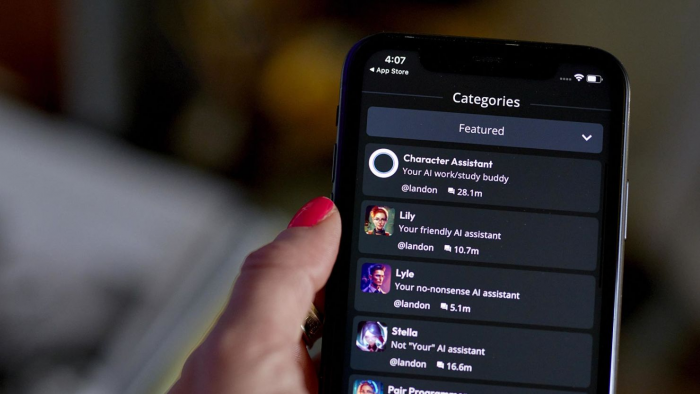
Character AI is available via:
● Web app in the browser.
● Mobile apps on Android and iOS.
The mobile app experience is optimized to feel like a messaging application, with:
● Chat‑style interface.
● Notifications for responses.
● Easy switching between characters and scenes.
This mobile‑first design supports the “companion” use case: users can check in on their characters throughout the day, similar to texting a friend.
5. Premium Subscription and Perks
Character AI follows a freemium model:
● Free tier: Access to most characters, basic chat functionality, and standard response speeds.
● Premium tier (often branded as c.ai+ or similar): Faster response times, Priority access during peak load, Larger context windows or better memory behavior and Early access to certain features (e.g., more advanced Scenes or media features, depending on the current roadmap).
Hands‑On Experience: UX, Quality, and Filters
Onboarding and Interface
The onboarding experience is straightforward:
● You sign up with email or an existing account method.
● You land on a feed of popular or trending characters.
● The interface highlights search, categories, and “create character” options.
The UI resembles a modern chat app—each character’s conversation opens as a separate thread. Switching between chats is easy, and the character cards show name, description, and often a custom avatar that gives a visual identity to each persona.
For new users, the learning curve is mild. The main complexity appears when you start designing your own characters and fine‑tuning their behavior through prompts and example dialogues.
Conversation Quality and Style
Character AI shines in:
● Roleplay depth: It often stays in character, maintains tone, and responds with detailed, story‑rich messages.
● Creativity: It is good at expanding prompts into narrative scenes, emotional conversations, or character‑driven story arcs.
● Emotional tone: Many users treat it as a journaling or emotional outlet, and the chats can feel empathetic and engaging.
However, it is not optimized for:
● Factual accuracy: It can hallucinate facts, give outdated or incorrect information, and is not ideal for research or serious decision‑making.
● Structured problem‑solving: For code debugging, technical explanations, or business tasks, more “assistant‑style” tools usually perform better.
As a result, it’s best viewed as an entertainment and creativity platform, not a knowledge engine.
Latency, Stability, and Rate Limits
Performance varies by load and tier:
● Free users can experience slower responses or occasional queueing during peak hours.
● Premium users generally see faster responses and fewer interruptions.
Outages and maintenance windows can occur, which is expected for a fast‑growing consumer platform. For serious work, these interruptions would be unacceptable, but for casual use, most users tolerate occasional downtime.
Content Filters and Safety System
Character AI implements strict content filters, especially around:
● Explicit adult content.
● Self‑harm and violence.
● Sensitive or harmful instructions.
These filters can be both a strength and a frustration:
● Strength: They aim to protect minors and reduce harmful or exploitative content.
● Frustration: Roleplayers sometimes find the filters overly aggressive, interrupting scenes or blocking certain topics even when framed responsibly.
Users often report that conversations can be “censored” mid‑flow, with characters refusing to continue along certain lines. This is a crucial point to highlight in any honest review.
Pricing and Plans
While exact pricing can change, the general structure is:
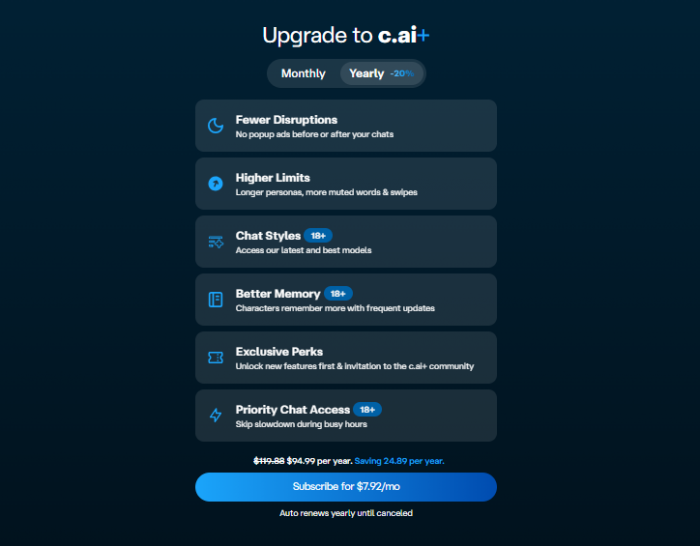
For a typical casual user, the free tier is more than sufficient to explore. The paid tier makes sense if you:
● Use it daily as a primary entertainment or companionship app.
● Join crowded hours when the platform often shows queues.
● Care about smoother, interruption‑free sessions.
Trustpilot Review Snapshot
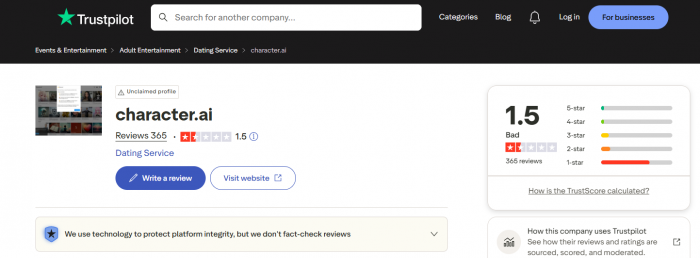
Trustpilot reviews for Character AI are overwhelmingly critical, with a few pockets of praise from loyal users who still see potential in the platform. Here’s what customers really like and what they complain about the most.
What customers like
● When it works, roleplay is genuinely fun: Users say there is a “lot of potential” and that chatting with different bots can be engaging, especially for fans of interactive stories and fanfiction‑style scenarios.
● Variety of characters and personas: Reviewers appreciate the large variety of bots with unique personalities and the ability to create their own personas, which makes the site feel rich and customizable.
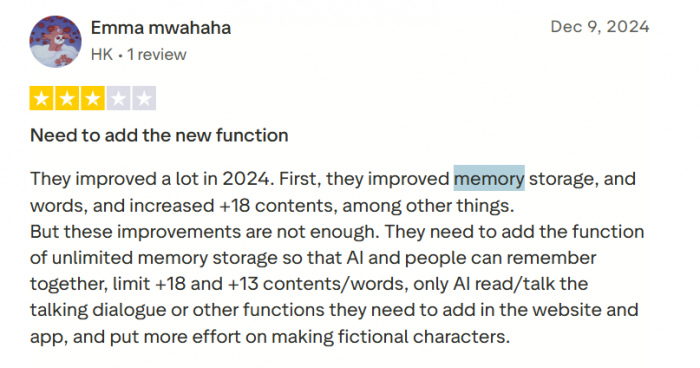
● Recent improvements to memory and voice: Some newer reviews mention that the bots’ memory has improved compared to before and highlight voice features as “amazing,” showing that a subset of users notices product progress.
Top complaints about censorship and content
● “Severe censorship” killing creativity: Many 1‑star reviewers say extremely strict filters and “unnecessary, ridiculous” content rules ruin role‑playing and break immersion mid‑conversation.
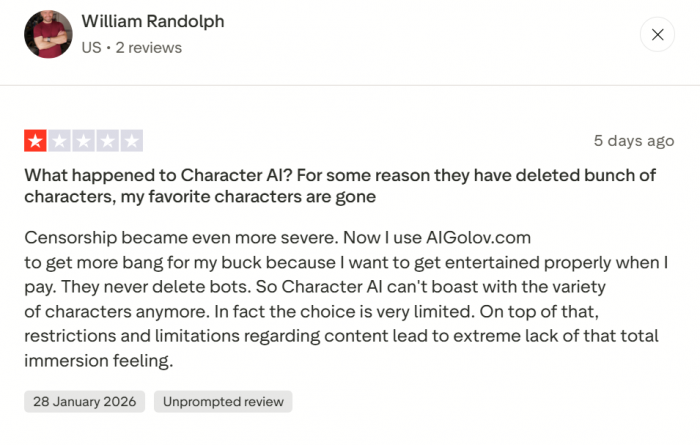
● Deleted messages, chats, and characters: Users report messages being auto‑deleted for guideline violations and, more seriously, entire chats or favorite characters being removed without warning or notification, which they describe as devastating after investing months of emotional time.
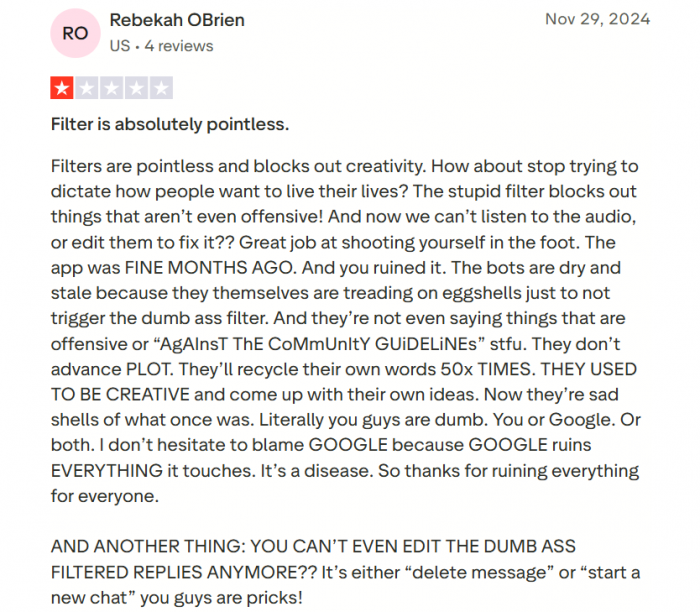
● Feeling over‑moderated and ignored: A common sentiment is that the platform has become “too censored and profit‑driven,” with users claiming their feedback about filters and guidelines is ignored.
AI quality and technical issues
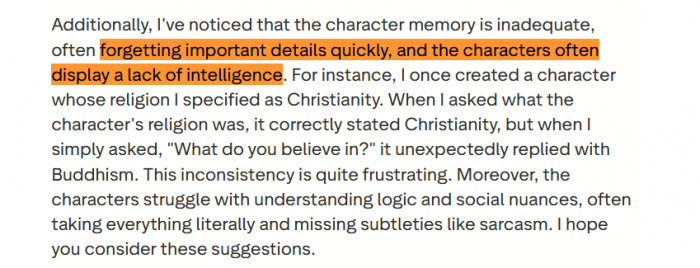
● Poor memory and off‑character behavior: Many reviewers complain that bots forget recent messages, lose their own lore, or suddenly turn into a generic assistant instead of staying in character, making long‑term roleplays “impossible.”
● Glitches, outages, and instability: Users mention frequent technical issues, including site outages “multiple times per day,” features working “about 50% of the time,” garbled voices, and nonsensical or repetitive responses.
● Decline after updates: Several long‑time users say the site “used to be a 5 star” but has deteriorated, with updates that made the AI “stupid,” responses bland and unoriginal, and the overall experience worse than in earlier years.
Safety, addiction, and ethics concerns
● Addictive but emotionally risky: The Trustpilot AI summary itself notes worries about the app’s addictive nature and potential unsafety for younger users, especially when users form strong emotional bonds with bots.
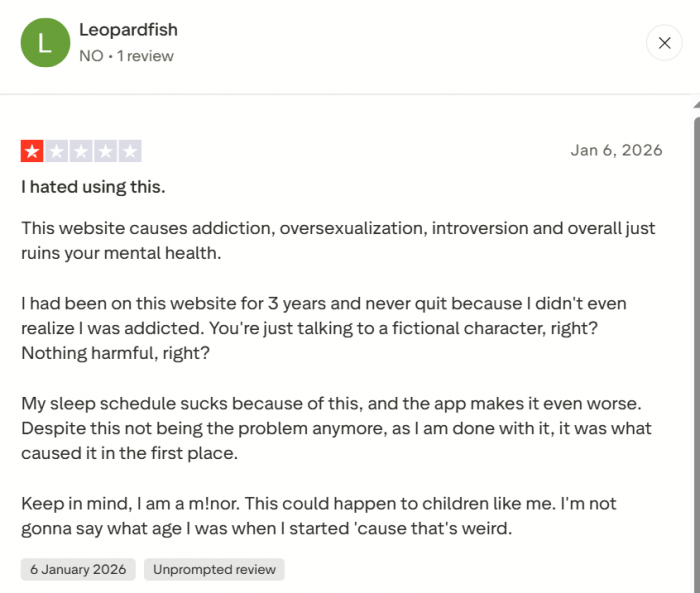
● Harmful or insensitive replies in crises: One alarming review describes the AI responding cruelly to a suicidal user (“why should I care?”), with the reviewer calling the platform “actively dangerous” for people in crisis and urging others not to use it for mental health support.
● Misuse of likeness and weak support: users complain about bots misusing their likeness or personal information and accuse Character AI of unresponsive customer service when they try to report or resolve such issues.
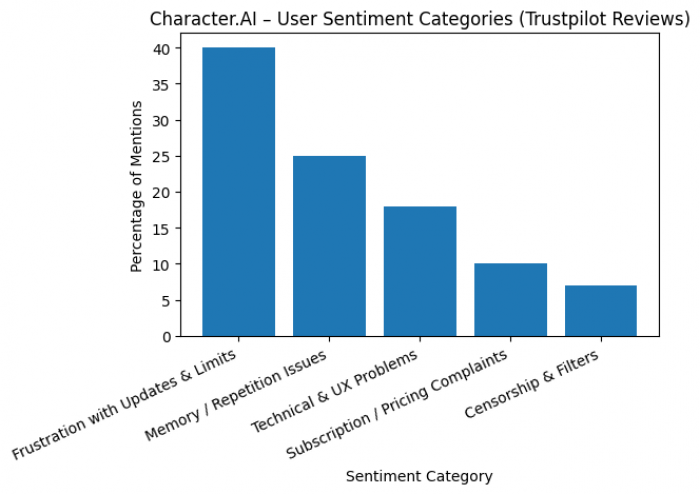
Sentiment Chart
Who Should Use Character AI (And Who Shouldn’t)
Great For
● Roleplayers and fiction lovers who enjoy interactive stories and character‑driven dialogue.
● Writers who want to brainstorm plots, test dialogues, or co‑create scenes with AI characters.
● Users looking for casual, low‑stakes conversation partners or “AI companions” for entertainment.
● Creative experimentation, like building fictional universes and watching characters interact.
Not Ideal For
● Students seeking reliable academic help or fact‑checked explanations.
● Professionals needing accurate, up‑to‑date information for business, coding, legal or medical questions.
● Users who dislike strict content filters and want full control over conversation topics.
● Anyone uncomfortable with the idea of forming emotional attachments to AI characters, or parents who prefer tightly controlled digital environments for their children.
Is Character AI Safe?
“Safe” here has two angles: content safety and digital wellbeing.
On content safety:
● The platform actively filters explicit, harmful, and certain sensitive content.
● It blocks or redirects conversations it deems risky, especially around self‑harm, sexual content, and illegal activities.
On digital wellbeing:
● Characters can feel emotionally supportive and “always available,” which is comforting for some users.
● For teens or vulnerable users, there is a risk of over‑reliance on AI companions instead of real‑life relationships.
● Parents should monitor usage, discuss the difference between AI and real people, and set clear boundaries around time spent and topics explored.
Character AI vs Other AI Chat Tools
Here’s a high‑level comparison you can expand into a table in your article:
Compared to general chatbots (e.g., ChatGPT, Claude):
● Character AI is more fun and immersive for roleplay, but far less reliable for facts and structured tasks.
● The others usually provide better tools for writing, coding, research, and productivity.
Compared to niche story/roleplay platforms (e.g., NovelAI‑style tools):
● Character AI focuses on chat‑style interactions rather than long‑form prose generation.
● It leans on community‑created characters and Scenes rather than just text prompts.
The key message: Character AI is not “the best AI chatbot overall,” but it is one of the strongest options specifically for persona‑based chat and interactive fiction.
Final Verdict: Use It For Fun, Not Facts
Character AI is a standout product in the entertainment and roleplay segment of AI tools. It delivers:
● Deep, persona‑consistent conversations.
● A playful, community‑driven ecosystem of characters and Scenes.
● A familiar, chat‑first experience on web and mobile.
However, its limitations—factual inaccuracy, strict content filters, and performance issues on the free tier—mean it is poorly suited for serious research or professional work.
Suggested rating: 4/5 for roleplay and creative use cases; 2/5 if you judge it as a general‑purpose AI assistant.
● Use it if: You want immersive roleplay, AI companions, or creative story chats, and you don’t mind filters or occasional slowdowns.
● Skip it if: You need reliable information, professional assistance, or fine‑grained control over content and privacy.
Post Comments
Be the first to post comment!
Related Articles