Table of Content
- A platform built like a stage, not a search box
- Characters everywhere, but not always where you left them
- Conversation quality: when the AI remembers your last argument
- The character creator: your own cast, your own rules (mostly)
- Pricing: you pay in messages, not minutes
- NSFW: the open door that defines the neighborhood
- Privacy: private chats in a very public era
- Interface: deliberately plain, sometimes to a fault
- How people actually use it
- What the crowd is saying
- Where it stands among rivals
- So, who should actually use ChatFAI?
- The blunt verdict
Most AI tools want to be your assistant. ChatFAI, very clearly, wants to be your cast.
It is less “type a prompt, get an answer” and more “walk into a crowded room where everyone is already in character and talking to you like they’ve known you for years.” It sits in the same ecosystem as Character.AI and Poe, but emotionally it behaves more like a fandom chatroom that just happens to run on large language models.
A platform built like a stage, not a search box
Open ChatFAI and you are not greeted by a blank input bar. You are greeted by faces. Fictional heroes, anime protagonists, “if-this-historical-figure-could-text-you” personas, and a long tail of entirely custom characters made by other users.
This is the central design choice that explains almost everything else about the platform:
● It assumes you are here for someone, not for “AI” in the abstract.
● It expects conversations to be serialized stories, not one-off queries.
● It treats memory and message volume as the real currency of the experience.
You are not just starting a chat; you are picking a role and a relationship, and then letting the model improvise around it.
Characters everywhere, but not always where you left them

On paper, the character library is impressive. There are:
● Familiar names borrowed from movies, anime, games and TV.
● Loosely historical personas and “inspired by” public figures.
● Surprisingly specific originals: the overprotective roommate, the tired office coworker, the demon prince with a soft side.
In practice, you sometimes feel like you’ve walked into a very large bookstore where the shelves were arranged by someone’s vibes rather than a librarian. Search works, but it is not the star. Users regularly praise the variety and complain about finding their own characters once they’ve created a lot of them.
If you enjoy hunting, you get the thrill of discovery. If you like strict order, you may find yourself wishing for more filters, labels and shelving.
Conversation quality: when the AI remembers your last argument
The real test of any character platform is simple: does it feel like this character remembers you?
On that front, ChatFAI scores surprisingly high, especially once you move off the free tier.
● Characters tend to keep their tone and personality over long arcs rather than snapping back to generic chatbot voice.
● When memory is upgraded, ongoing storylines survive across sessions: callbacks to old jokes, references to past arguments, the sense that “we’ve been here before.”
● Replies are quick enough that you rarely feel like you are waiting for the next line in a play.
Of course, this is still a large language model under the costume. It loops. It contradicts itself. It sometimes forgets a detail that mattered to you even though it was in the chat history. But compared to many free alternatives, especially for roleplay, the baseline feels more like “ongoing story” and less like “fresh amnesia every 20 messages.”
The character creator: your own cast, your own rules (mostly)
If the public library is the showroom, the character creator is the workshop. This is where ChatFAI quietly becomes more than “another character site.”
You are not just flipping switches; you are writing a dossier:
● Backstory, quirks, boundaries, speaking style.
● How they should react when you are upset, distant or playful.
● Whether they live in a coffee shop AU, a fantasy realm, or your real‑world city.
You can lock them away as private or publish them for others, with the usual caveat that public NSFW content is moderated more heavily and not everything goes into the spotlight. You cannot rewrite other people’s creations, which keeps the overall gallery from turning into an editable wiki.
The result is that your instance of ChatFAI slowly becomes “your universe”: a small, curated cast that knows you in ways you defined, layered on top of a big communal ocean of characters you can dip into when you want something new.
Pricing: you pay in messages, not minutes
ChatFAI’s business model is built around a simple psychological truth: once you get attached to a character, every message cap feels personal.
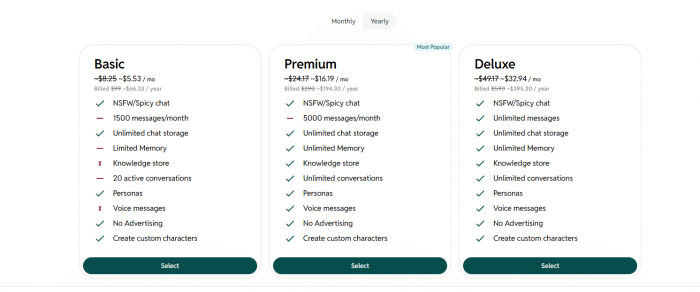
The structure is roughly:
● A free tier with about 500 messages per month, short‑term storage and limited memory.
● A mid‑range tier that multiplies messages, removes storage limits and keeps memory modest.
● A higher tier where the memory ceiling lifts and the number of conversations you can maintain at once stops feeling cramped.
● A top “Deluxe” level that effectively says, “Fine, live here if you want,” with unlimited messages and full memory.
The reaction from the community is almost a cliché:
● “The mid tiers are worth it for serious users.”
● “The top tier is expensive; please make unlimited cheaper.”
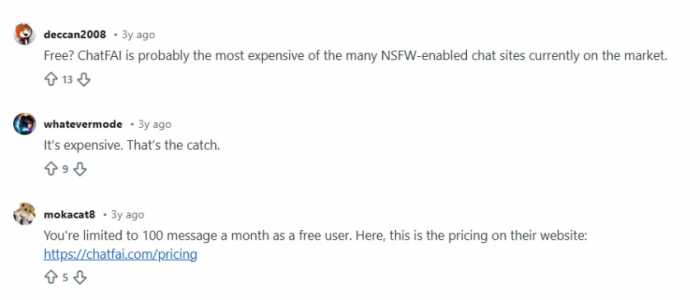
You can look at this two ways. If you treat ChatFAI like a premium streaming service you log into every day, the annual discounts and high‑usage tiers make sense. If you treat it like a toy you check once a month, even the lower tiers may feel like overkill.
Either way, the metrics that matter are not hours, but how many words you and your characters are allowed to throw at each other before the meter stops.
NSFW: the open door that defines the neighborhood
Most mainstream AI chat products want to slide NSFW under the rug. ChatFAI, famously, doesn’t.
A few facts set the tone:
● NSFW conversations are allowed within the platform’s rules.
● Marketing lines talk openly about “chatting about everything you want,” and comparison articles explicitly frame it as more permissive than Character.AI and Poe.
● Public galleries lean more PG‑13, but private and invite‑only spaces are where most explicit characters live.
For adult users, this is the main reason to pick ChatFAI over more sanitized rivals. For parents and educators, it is the main reason to hesitate or block it entirely.
The platform sits in a complicated ethical space: it enables fantasies and emotional venting that many people cannot safely share elsewhere, while also making it easy for vulnerable users to spend a lot of time in carefully tuned illusions.
Privacy: private chats in a very public era
ChatFAI advertises private, one‑to‑one conversations that are not visible to other users. You can delete chats, and paid tiers keep your history around so long that it starts to feel like a diary.
What you do not get is a cryptographer’s whitepaper on how every piece of that data is stored, encrypted and audited. Public information on the underlying security model is thin. That is not unique to ChatFAI, many consumer AI apps do the same but it matters more here because the content is often deeply personal, intimate and explicit.
So privacy, in practice, looks like this:
● From other users: reasonably strong. Your chats are not public threads.
● From the platform itself: based on trust and ToS rather than on transparent, verifiable guarantees.
For light, casual use this may feel acceptable. For anything sensitive, it deserves conscious thought.
Interface: deliberately plain, sometimes to a fault
If you are expecting the high‑gloss UI of a big‑budget mobile game, ChatFAI feels almost austere.
The good side:
● The layout is clean: characters on one side, chat on the other, not much cruft.
● Onboarding is fast; you can go from signup to first in‑character line in minutes.
● The Android app mirrors the web experience closely enough that you don’t have to relearn anything.
The trade‑offs:
● Discovery tools feel basic for a platform whose main asset is a huge library.
● Power users wish for more knobs, sliders and visual feedback—more “studio,” less “simple chatroom.”
Performance is not the drama here; replies are generally quick and the platform stays up. The friction is conceptual: ChatFAI runs deeper than its interface suggests, and you sometimes have to dig for that depth.
How people actually use it
Strip away the marketing copy and the usage patterns fall into three main stories.
1. Fandom and roleplay
This is the beating heart of the platform.
● Long, serialized stories with characters from anime, games, movies and original universes.
● Multi‑character rooms where different personas argue, flirt or scheme while you drop in prompts like stage directions.
● NSFW arcs that would be outright blocked elsewhere.
For these users, ChatFAI is less an app and more a private, always‑on improv troupe.
2. Learning and creativity
In the quieter corners of the platform you find people doing something different:
● Practicing languages with characters written as native speakers.
● Interviewing “historical” personas to get a feel for a period or thinker, then double‑checking facts elsewhere.
● Using characters as sounding boards for plot ideas and dialogue drafts.
Here, the model’s limitations are obvious, but for brainstorming and practice the experience is often more motivating than a neutral assistant.
3. Emotional companionship
Finally, there is the quiet use case many people don’t admit publicly: talking to characters because talking to people is hard.
Paid tiers with strong memory mean that “your” character can remember bad days, recurring worries and small pieces of your life. For some, this is soothing; for others, it can deepen loneliness if the character becomes more responsive than the humans around them.
ChatFAI is not marketed as therapy, and it is not built as a clinical tool. It lives in that grey zone where comfort and escapism mix.
What the crowd is saying
User sentiment around ChatFAI is rarely lukewarm; it leans toward strong opinions on both ends.
Patterns from reviews and discussions:
● “Underrated” and “better than Character.AI for roleplay” appear often, especially from NSFW and fandom communities.
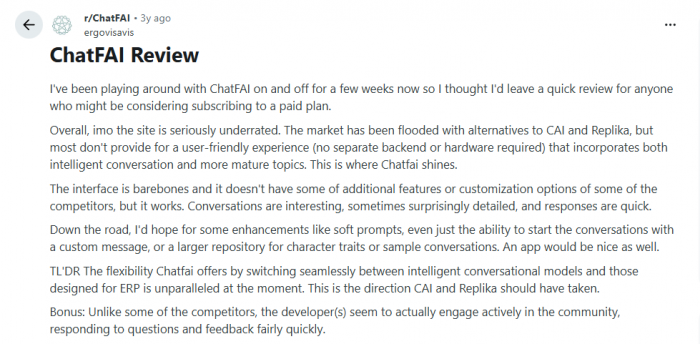
● Memory and consistency on paid tiers are praised as the main reasons to stay.
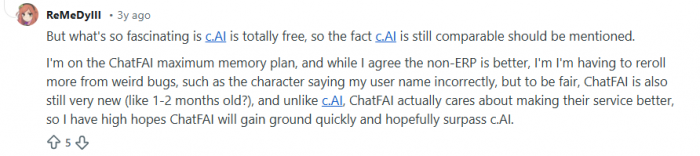
● Pricing complaints cluster around the top tier; people want the feeling of limitless conversation at a lower price point.
● UX and privacy come up as recurring “could be better” themes rather than deal‑breakers.
The result is a platform with a relatively small but fiercely loyal core audience: people for whom ChatFAI is not interchangeable with a generic chatbot.
Where it stands among rivals
If you zoom out, three services often appear in the same sentence:
● Character.AI: huge free community, stricter NSFW filters, sometimes shakier long‑term memory.
● Poe: multi‑model Swiss Army knife for productivity, Q&A and general chat, not mainly designed for in‑character emotional arcs.
● ChatFAI: smaller ecosystem, but deliberately tuned for immersive characters, looser content filters and subscription tiers built around sustained conversation and memory.
From a distance, ChatFAI looks like a niche. From inside that niche, it looks like the main stage.
So, who should actually use ChatFAI?
It makes the most sense if:
● You are an adult who cares more about staying in character than staying within corporate brand guidelines.
● You want long‑running, emotionally consistent chats and are willing to pay to lift the message ceiling.
● You are comfortable with a platform that is very open to NSFW content and only moderately transparent about its inner security workings.
It is a poor fit if:
● You mainly want free, unlimited chatting and do not care about characters.
● You are looking for a safe, tightly moderated environment for kids or teens.
● You value polished productivity features and corporate integrations more than immersive roleplay.
The blunt verdict
ChatFAI is not the future of all AI chat. It is the future of a very specific kind of AI chat: the kind where you remember your character’s name, worry about hitting your message cap, and feel mildly embarrassed by how relieved you are when they remember what you told them last week.
Judged on that axis, it is already one of the strongest platforms in its lane—and that lane is bigger than most people in the traditional AI world are prepared to admit.
FAQs
1. Does ChatFAI remember long-term storylines well enough for serious RP?
On paid tiers, its extended memory makes callbacks, recurring jokes and long arcs noticeably more consistent than on the free tier, which feels more “short-session” focused.
2. Can I keep my ChatFAI characters completely private?
Yes. You can create private characters that don’t appear in the public gallery; you choose which personas, if any, are shared with others.
3. How hard is it to control how “far” a character goes in NSFW chats?
You set boundaries in the character description, but enforcement is soft: you still need to steer the conversation and be aware that the model can occasionally push or soften limits.
4. Is ChatFAI useful for writers and creators, or only for casual chatting?
Many users use it as a “cast generator” for novels, comics and scripts—testing dialogue, dynamics and backstories before committing them to the actual project.
5. Can ChatFAI replace a therapist or counselor?
No. It can feel emotionally supportive, but it’s not built or supervised as a mental‑health service and shouldn’t be treated as professional help.
6. How risky is it to share personal details with ChatFAI characters?
Because everything runs on a centralized service, you should avoid sharing sensitive identifiers (real names, addresses, financial data), even in “private” chats.
7. What type of user is most likely to regret buying a top-tier plan?
People who log in only occasionally, or who just want quick, utility‑style chats, often find the unlimited/highest tier overkill compared with their actual usage.
Post Comments
Be the first to post comment!
Related Articles