Table of Content
- How I Use Chub Venus AI
- Website Structure Through My Eyes
- Key Features I Actually Rely On
- Pricing From a User’s Wallet
- Transparency, Safety & How Comfortable I Feel
- Performance Quality: What It Feels Like In Chat
- Pros & Cons After Months of Use
- User Reviews That Match My Experience
- Sentiment Trend of Chub Venus AI
- Alternatives I Tried
- Final Conclusion
How I Use Chub Venus AI
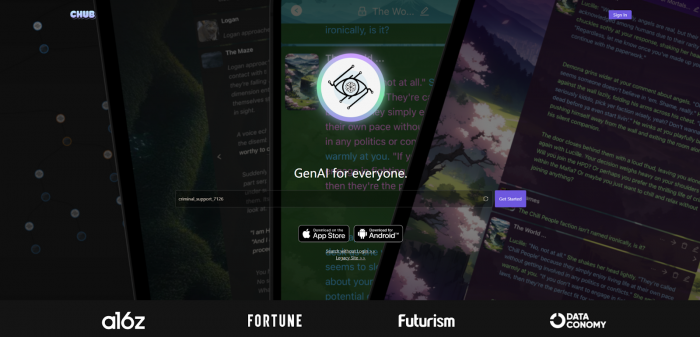
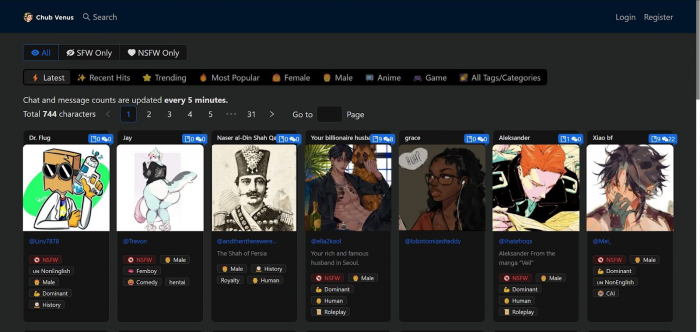
When I first landed on venus.chub.ai, it looked like a character hub: a wall of avatars, tags like romance, fantasy, yandere, furry, plus a search bar. I started out just clicking random popular characters and chatting, but quickly realized the real fun is when you tune the bots yourself using its character editor, lorebooks and model choices.
● I pick one or two characters from my favorites and continue long‑running storylines that already span tens of thousands of words.
● I tweak their “personality” and “dialogue style” fields if the tone starts drifting or they become too submissive/too dominant for the scenario.
● If I want something more emotional and less smut‑driven, I switch the underlying model to a higher‑end one (usually what Venus labels for premium tiers) and lengthen the context.
The platform absolutely leans adult: even when I try to play it slow, characters tend to escalate intimacy quickly, though swiping or regenerating responses reins that in.
Website Structure Through My Eyes
The website is structured in a way that makes sense after a week, but felt busy on day one.
What I interact with most:
● Explore / Home: This is where I browse trending characters, filter by NSFW/SFW, or search for specific archetypes like “tsundere teacher” or “demonic CEO.”
● Character pages: Each character has a short description, tags, NSFW flag, and a huge “Chat” button, along with creator notes that often hint at the best way to prompt them.
● Chat view: Simple left‑right chat bubbles, swipe regeneration, message editing, and a side panel for memory and system prompts if I want to dig deeper.
● Creator dashboard: Where I manage my own bots, attach lorebooks, and adjust macros; it feels almost like a config panel for a small game NPC rather than a casual toy.
The learning curve is real. At first the interface feels like it was designed by power users: lots of switches and text boxes, not many hand‑holding tooltips. But once I understood the flow, it became one of the few sites where I actually enjoy the “advanced settings” tab rather than avoid it.
Key Features I Actually Rely On
There are a lot of bullet‑point features, but only a handful changed my experience day to day.
1. Memory button and long‑term context
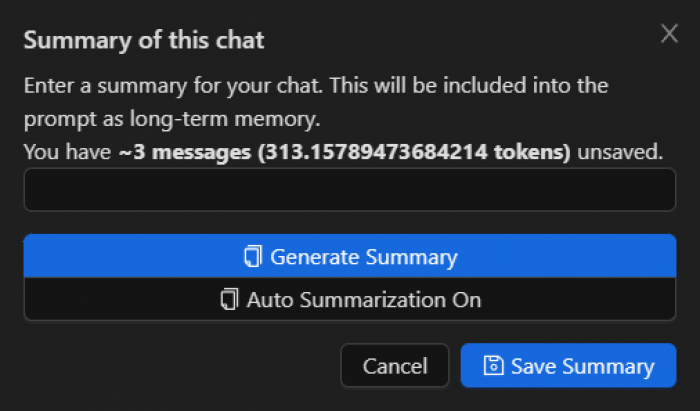
a. I can trigger a memory summary so the character condenses the session into a compact description that persists between chats.
b. The effect is noticeable: characters remember prior relationship beats, inside jokes, or trauma arcs instead of “resetting” every time.
2. Lorebooks and macros
a. For serious worldbuilding, I keep a lorebook with locations, factions, and recurring side characters; the model keeps that world surprisingly consistent over weeks.
b. Macros let me auto‑insert things like my character’s physical traits or secrets into the prompt so I don’t re‑explain them every session.
3. Model flexibility
a. On my Mercury/Mars‑style subscription, I can switch between cheaper models for fast, light chats and stronger ones for slow‑burn, emotionally heavy scenes.
b. When I brought my own OpenAI‑style key during testing, the combination delivered some of the most coherent long RPs I have had, easily beating vanilla Character.AI.
4. Group chats
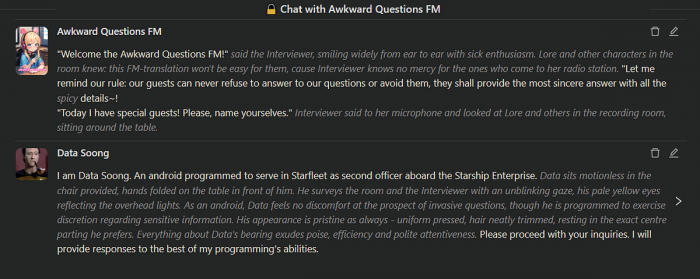
a. Multi‑character roleplays (love triangles, party adventures) are genuinely fun here; Venus lets several bots talk to each other and to me in a single thread.
These tools make Venus feel less like chatting with a single bot and more like DM‑ing a campaign with AI actors that can improvise.
Pricing From a User’s Wallet
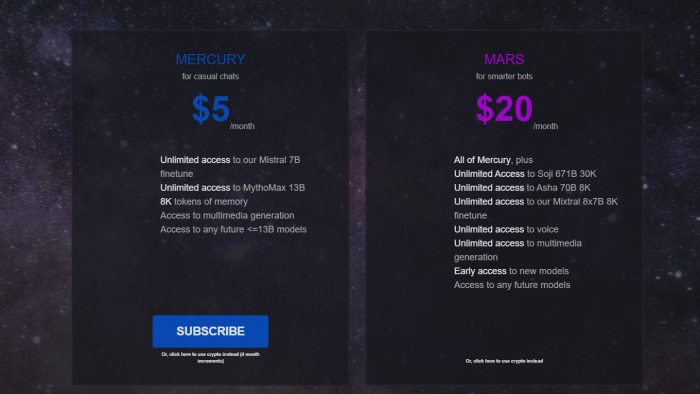
From my side, the money question boiled down to: is it worth paying monthly for what is essentially an AI roleplay playground?
According to recent breakdowns, the structure looks like this:
| Plan | My impression | Who it suits |
| Free | Decent for testing, but I hit message limits fast and models feel mid‑tier | Curious newcomers, light users. |
| Mercury / Venus Lite | The “I actually use this” entry point; enough messages and quality for ongoing RPs. | Regular roleplayers who don’t need the very best model. |
| Mars / Venus Pro | What I use when I binge; premium models make complex emotional scenes shine. | Heavy users and creators. |
There is also a “Chub Venus” style tier around $9.99 in some breakdowns that basically unlocks unlimited NSFW and removes most message pressure. Crypto payments and cancel‑anytime billing make it less risky to experiment for a month. Overall, I personally feel the value is high if you use it several times a week, and not great if you only log in once or twice a month.
Transparency, Safety & How Comfortable I Feel
Venus is surprisingly open about two things I care about: what I am paying for and what models I am hitting. I can see which model is running a chat, which helps explain why some threads are slower but smarter than others.
On the other hand, safety is a mixed bag:
● NSFW and kink content is very present and explicitly supported, which is a plus for adult users like me but clearly not a space for minors.
● The site still applies basic legal/abuse filters, but compared to Character.AI it feels “no‑filter” in practice, so I consciously treat it as entertainment, not therapy.
● Privacy‑wise, chats are stored for memory and debugging; this is not end‑to‑end encrypted, and I always assume staff and underlying model providers could, in theory, access logs.
Before subscribing I checked scam‑analysis tools, which flag venus.chub.ai as a legitimate domain rather than some impersonation trap, but data security is still the standard “trust a small dev team plus big LLM vendors” trade‑off. Personally I am comfortable using it, but I avoid sharing real‑life identifiers or details I would be devastated to see leaked.
Performance Quality: What It Feels Like In Chat
From my own sessions, Venus sits in a strange middle ground: when it is good, it blows away most free RP bots; when servers are unhappy, it can be rough.
What stands out:
● With a Mars‑type plan and a strong model, characters stay in‑character, remember past scenes, and handle complex emotional beats better than anything I got from stock Character.AI.
● Long, multi‑turn conversations feel surprisingly coherent, especially when a lorebook is doing some heavy lifting in the background.
● The downside is consistency: during peak hours I have seen slow responses and occasional “Venus not working” episodes that completely kill the mood mid‑scene.
Quality also varies by character. Some bots feel like fully written interactive novels; others are clearly low‑effort templates that spam generic porn dialogue. Over time I learned to follow specific creators and bookmark bots that match my tastes.
Pros & Cons After Months of Use
What I Genuinely Like
● Serious control over characters: Between the editor, lorebooks, macros and model choices, I can sculpt very specific personalities instead of fighting a generic assistant vibe.
● NSFW without a hard corporate wall: Adult and taboo content for consenting adults is actually allowed instead of being shut down by filters every other message.
● Strong memory for relationships: Long‑term RP relationships feel continuous: bots recall confessions, breakups, injuries and promises in a way that makes arcs feel “real enough.”
● Active, nerdy community: The Reddit/Discord crowd digs deep into promptcraft, worldbuilding tips, and new features, so I never feel like I am the only power user pushing it.
● Flat pricing for heavy use: I do not have to watch tokens; if I am on a paid tier, I can binge entire weekends of roleplay without worrying about burning through a budgeted credit pool.
What Frustrates Me
● Overwhelming at first: The interface and advanced settings are intimidating for casual users; you have to be willing to tinker to get the best out of it.
● Site reliability: Occasional outages, bugs and weird behavior after updates mean I always keep a backup platform in mind for those nights.
● Uneven character quality: The huge library is a blessing and a curse; sifting through low‑effort bots to find gems takes time.
● Ethical and emotional grey zones: Because filters are looser, it is easy to wander into content that might feel uncomfortable or unhealthy if you are in a fragile mental state.
● Extra complexity for “best quality”: To truly max it out, bringing your own OpenAI‑style key or understanding model quirks is almost required, which is more technical overhead.
User Reviews That Match My Experience
Reading other users’ posts was weirdly validating. People describe exactly the same trade‑offs I feel:
● Some say “it blows CAI out of the water” for NSFW roleplay and memory, especially when paired with a good external model.
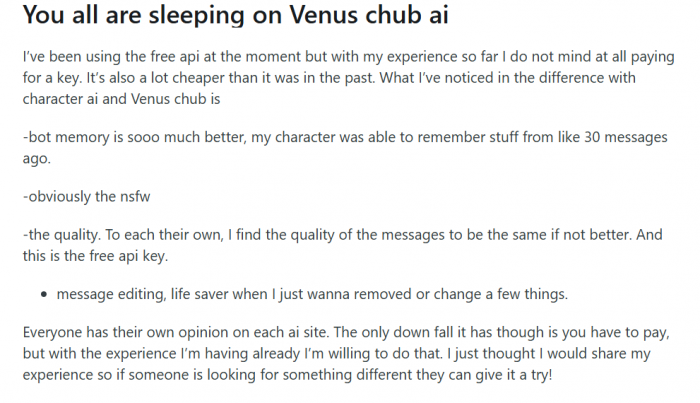
● Mars‑tier subscribers talk about how the newer large model is “significantly better” and that group chat support is a game changer for drama‑heavy RPs. Reddit
● On the flip side, there are threads complaining about slowdowns, odd response changes after updates and moments where Venus simply fails to load. Reddit
So my personal impression is not unique: if you go in expecting a polished Silicon Valley product, you will be annoyed; if you go in as a power user willing to tune prompts, it is a playground.
Sentiment Trend of Chub Venus AI
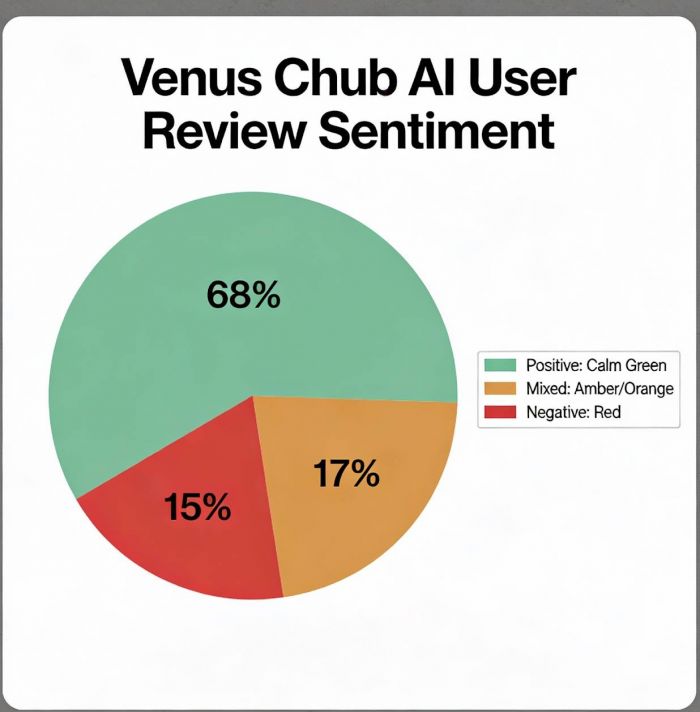
Overall sentiment from recent public reviews and discussions is roughly 65–70% Positive, 15–20% Mixed, 10–20% Negative.
Alternatives I Tried
Here is how Chub Venus AI stacks up against the other tools I considered for similar use.
| Platform | How it felt to me | NSFW / filters | When I would pick it instead |
| Chub Venus AI | Deep, messy, highly customizable RP sandbox with strong memory and adult focus. | Permissive with some hard boundaries. | When I want long‑running romantic/NSFW stories with real control over the bots. |
| Character.AI | Polished, accessible, but feels like it fights me whenever I push boundaries. | Very strict; NSFW blocked heavily. | When I want safe, SFW fun and don’t care about deep memory or kink. |
| Janitor AI | Powerful with BYO‑API, but more technical to set up. | Permissive; depends on model. | When I want maximum flexibility and I am okay juggling API costs. |
| Reelmind.ai | More for visual storyboards and video; not a text RP replacement | Less explicit chat‑focus; more creative visuals. | When my priority is visual narrative rather than pure text conversations. |
Final Conclusion
Chub AI feels less like a polished product and more like a toolbox for people who already know what they’re doing. Its real value is the character database, many bots are clearly written by experienced users who understand long-term memory, personality anchoring, and jailbreak-style prompting. When paired with the right backend, some characters deliver surprisingly consistent roleplay and tone retention. The platform rewards users who actively edit prompts, swap models, and curate their own setup rather than relying on defaults.
That said, Chub AI demands patience. Discovery quality is uneven, UI quirks are noticeable, and results can swing wildly depending on character design and model choice. It’s not beginner-friendly and doesn’t try to be. If you want a guided, stable experience, it will frustrate you, but if you want maximum control, community-made depth, and zero hand-holding, Chub AI earns its place as a serious niche platform rather than a casual one.
Post Comments
Be the first to post comment!
Related Articles



Best Alternatives to Dopple AI
Danny Hamilton . Mar 10, 2026