Table of Content
- What Class Companion Actually Does
- Instant Grading Without Losing Teacher Control
- Personalized Feedback for Every Student
- Meet Ditto: The Built-In AI Tutor
- Supporting Mastery-Based Learning
- Custom Rubrics Keep Teachers in Charge
- Data and Insights for Teachers
- Pricing Structure
- Key Advantages
- Limitations to Consider
- Real-World Reception
- Final Perspective
Teaching has always involved far more work than what happens inside the classroom. For many educators, the most time-consuming responsibility begins after the lesson ends: grading written assignments. Essays, short responses, and analytical answers can pile up quickly, especially for teachers managing multiple classes. What should ideally be thoughtful evaluation often becomes a race against time.
This is the problem Class Companion was built to address.
Founded in 2023 in San Francisco, Class Companion is an AI-powered teaching assistant built on GPT-4 technology. The platform is designed specifically for educators who assign written responses and want faster feedback cycles without sacrificing grading control. Instead of replacing teachers, the system focuses on automating repetitive grading tasks while allowing educators to maintain full authority over rubrics, scoring, and final evaluations.
In a world where AI tools often promise automation at the expense of professional oversight, Class Companion takes a different approach. It positions AI as a support system rather than a replacement, helping teachers manage workload while improving the feedback students receive.
What Class Companion Actually Does
At its core, Class Companion is an AI grading and feedback platform for written assignments. Teachers create assignments within the platform and define the grading rubric or evaluation criteria. Once students submit their responses, the system immediately analyzes the work using those predefined standards.
The result is instant scoring accompanied by structured feedback.
Instead of waiting several days—or sometimes weeks—for graded papers to return, students receive responses almost immediately. Teachers can review the AI evaluation, modify it if necessary, or override it entirely. This ensures that human expertise remains the final authority while the AI handles the repetitive evaluation work.
For educators managing dozens or even hundreds of student responses, this process can eliminate a significant portion of grading time.
Instant Grading Without Losing Teacher Control
The most recognizable feature of Class Companion is its AI-powered grading engine. When a student submits a short answer or essay response, the system evaluates it against the teacher’s rubric instantly.
Traditional grading workflows often create delays. Students complete assignments, teachers spend days reviewing them, and feedback arrives long after the learning moment has passed. Class Companion shortens this cycle dramatically.
However, the platform avoids fully automated grading decisions. Teachers remain in charge of defining criteria and reviewing results. The AI simply applies those rules consistently across submissions.
This balance between automation and professional oversight is one of the main reasons educators have been willing to experiment with the tool.
Personalized Feedback for Every Student
One of the most significant advantages of AI grading systems is their ability to generate detailed feedback quickly. Instead of returning a paper with only a numerical score, Class Companion produces individualized comments explaining the strengths and weaknesses of each response.
Students receive guidance on what worked well, what needs improvement, and how they can revise their answers. This approach turns grading into an ongoing learning process rather than a final judgment.
For teachers, generating this level of detailed feedback manually would require a large amount of time. AI makes it possible to deliver the same level of explanation at scale.
Meet Ditto: The Built-In AI Tutor
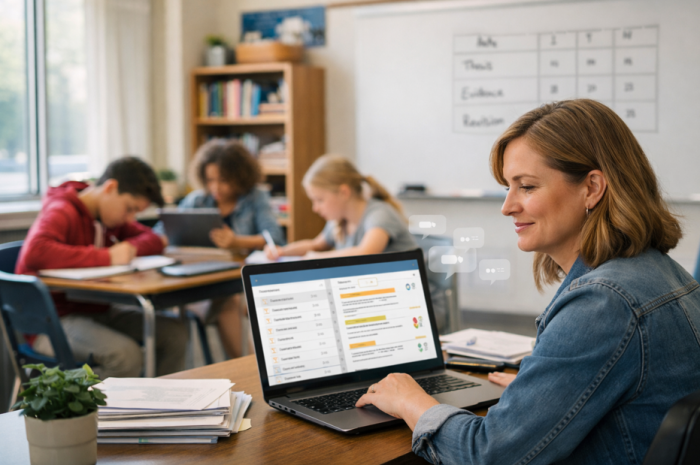
Another distinctive feature of Class Companion is Ditto, the platform’s integrated AI tutoring assistant.
While working on assignments, students can interact with Ditto to ask questions, request hints, or receive explanations about the material. Teachers can customize how Ditto behaves so that its tone and instructional approach match their classroom style.
Many educators report that students are often more comfortable asking questions through the AI tutor than speaking up in class. This can help quieter learners participate more actively in the learning process.
Instead of replacing teacher instruction, Ditto acts as a supplementary support tool that helps students progress through assignments independently.
Supporting Mastery-Based Learning
Class Companion also supports mastery-based learning models, which emphasize improvement through revision rather than one-time grading.
Students are typically allowed to revise their responses based on feedback and resubmit them. The system evaluates the revised work again and updates the score accordingly. This creates a feedback loop where students refine their answers until they demonstrate a stronger understanding of the material.
This approach aligns with modern educational practices that prioritize learning progression rather than simply recording grades.
Custom Rubrics Keep Teachers in Charge
A common concern about AI grading systems is the possibility of losing professional control over evaluation standards. Class Companion addresses this directly by requiring teachers to define their own grading criteria.
Educators can upload existing rubrics or create new ones inside the platform. These rubrics guide how the AI evaluates student responses. Teachers also have the ability to edit or override any AI-generated grade or comment.
The AI therefore functions as a grading assistant, not an autonomous decision-maker. The accuracy of the system depends largely on how clearly teachers define their evaluation criteria.
Data and Insights for Teachers
Beyond grading, Class Companion provides analytics that help teachers understand how students are performing.
The platform can track metrics such as:
- Student score averages
- Number of revision attempts
- Time spent on assignments
- Usage of the AI tutor
At the class level, these insights help teachers identify patterns in student understanding. For example, educators can quickly see which questions caused the most difficulty or which concepts require additional instruction.
These data-driven insights are particularly useful for schools adopting standards-based grading or outcome-focused education models.
Pricing Structure
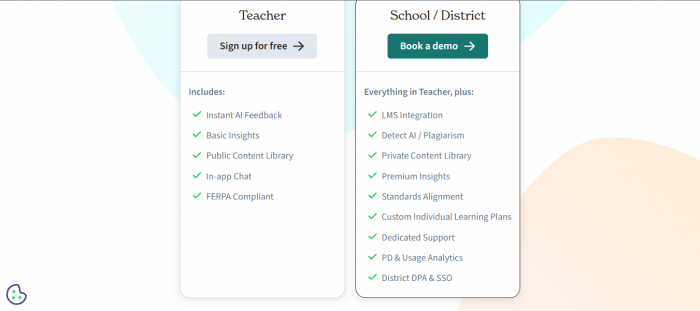
Class Companion offers a free plan designed for individual teachers. This tier includes unlimited students but limits AI grading to five assignments per month. The goal is to allow educators to test the system before committing to broader adoption.
For schools and districts, premium plans unlock additional capabilities such as unlimited AI grading, learning management system integration, plagiarism detection, and advanced analytics dashboards.
Pricing for institutional plans is customized and typically arranged through direct demos with the company.
Key Advantages
Educators who adopt Class Companion frequently highlight a few consistent benefits:
- Significant reduction in grading time
- Faster feedback cycles for students
- Support for revision and mastery learning
- Built-in AI tutoring through Ditto
These features combine to make the platform particularly appealing for teachers who assign large volumes of written work.
Limitations to Consider
While the system performs well with structured assignments, it has some limitations.
Highly complex prompts—such as advanced AP-level document-based questions—may require more manual review. The system also currently supports only English-language submissions, which restricts its use in multilingual classrooms.
Additionally, because the platform operates entirely online, reliable internet access is required for both teachers and students.
Real-World Reception
Early media coverage and educator feedback have generally been positive. Publications like Forbes have described the platform as an example of AI supporting educators rather than replacing them. Educational technology reviewers often highlight the personalized feedback system and the platform’s ability to save teachers hours of grading time.
However, experienced educators emphasize that AI grading still works best when assignments are structured clearly and rubrics are carefully designed.
In other words, the platform amplifies good teaching practices rather than replacing them.
Final Perspective
Class Companion reflects a broader shift occurring across education. Artificial intelligence is increasingly being used to reduce repetitive tasks so that teachers can focus more on instruction and student engagement.
The platform does not attempt to replace educators or automate learning entirely. Instead, it handles time-consuming grading mechanics while leaving judgment and instruction in human hands.
For teachers who regularly evaluate written assignments, this combination of automation and control can significantly reduce workload while improving the quality and speed of feedback.
In the evolving landscape of AI-powered education tools, Class Companion represents one of the clearest examples of how technology can assist teachers without removing them from the center of the learning process.
Post Comments
Be the first to post comment!
Related Articles