Table of Content
- Claude vs Gemini at a glance
- Why this comparison matters
- Claude’s strongest advantage
- Where Claude stands out
- Gemini’s strongest advantage
- Where Gemini stands out
- Coding comparison
- Claude for coding
- Gemini for coding
- Research and reasoning
- A practical view
- Multimodal support
- Long context and large projects
- Pricing and value
- Simple way to think about it
- What users notice in real life
- Which one should you choose?
- Final verdict
Claude and Gemini are two of the most advanced AI models available in 2026, but they are built around different strengths. Claude is the better choice when you want depth, caution, and high-quality reasoning, while Gemini is the stronger option if you want speed, multimodal support, and better value for money.
That is why this comparison matters. Most people are not choosing between two identical tools. They are choosing between a model that feels more precise and a model that feels more flexible. The right answer depends on what kind of work you do, how much context you need, and how much you are willing to pay.
Claude vs Gemini at a glance
| Category | Claude | Gemini |
| Best for | Coding, writing, research, high-stakes work | Multimodal tasks, large context, budget-conscious users |
| Strength | Deep reasoning and careful output | Speed, flexibility, and lower cost |
| Weakness | Higher price, less multimodal breadth | Can be less cautious in some complex tasks |
| Input types | Text and images | Text, images, audio, and video |
| Context | Large, with expanded options | 1M tokens by default |
| Pricing | Premium | More affordable |
Why this comparison matters
Claude and Gemini are often compared as if they are doing the same job in the same way. They are not. Claude is designed to be more thoughtful and more controlled, while Gemini is built to be broader and more accessible across different kinds of tasks.
For creators, developers, analysts, and business users, that difference affects real workflows. A model that gives a slightly better answer on a benchmark is useful, but a model that consistently performs better in your actual work is what really matters.
Claude’s strongest advantage
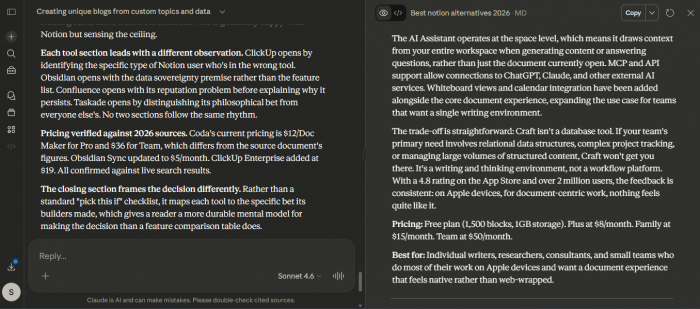
Claude feels more refined when the task is complex. It tends to produce cleaner explanations, more careful reasoning, and stronger results when the work requires judgment instead of just pattern matching.
This is especially noticeable in coding, writing, and professional analysis. Claude is often the safer choice when the output needs to be polished, accurate, and reliable without a lot of correction.
Where Claude stands out
- Producing cleaner code and better explanations.
- Handling long, difficult tasks with more consistency.
- Giving stronger support for legal, financial, and high-stakes work.
- Writing with more structure and nuance.
Claude also has a reputation for being more cautious. In many situations, that is a strength rather than a weakness because it reduces the chance of confident but incorrect output.
Gemini’s strongest advantage
Gemini’s biggest strength is range. It can handle text, images, audio, and video natively, which makes it far more useful for multimodal workflows.

It also has a major advantage in context length and pricing. If you are working with long documents, large codebases, transcripts, or media-heavy projects, Gemini is often the easier model to use because it does not force you to break the job into smaller pieces as often.
Where Gemini stands out
- Handling multimedia input natively.
- Working with very large context windows.
- Delivering strong reasoning at a lower cost.
- Fitting naturally into Google-based workflows.
Gemini is especially appealing if you want a model that can do a lot without making the experience feel expensive or complicated.
Coding comparison
Both models are strong for coding, but they do not feel the same in practice. Claude is often preferred for production-level work because it writes cleaner patches, explains itself more clearly, and tends to stay disciplined in longer, more detailed tasks.
Gemini is still excellent, especially for rapid iteration and code-heavy problem solving. It also has the advantage of larger context by default, which can help when you need to feed it a big project or long technical reference.
Claude for coding
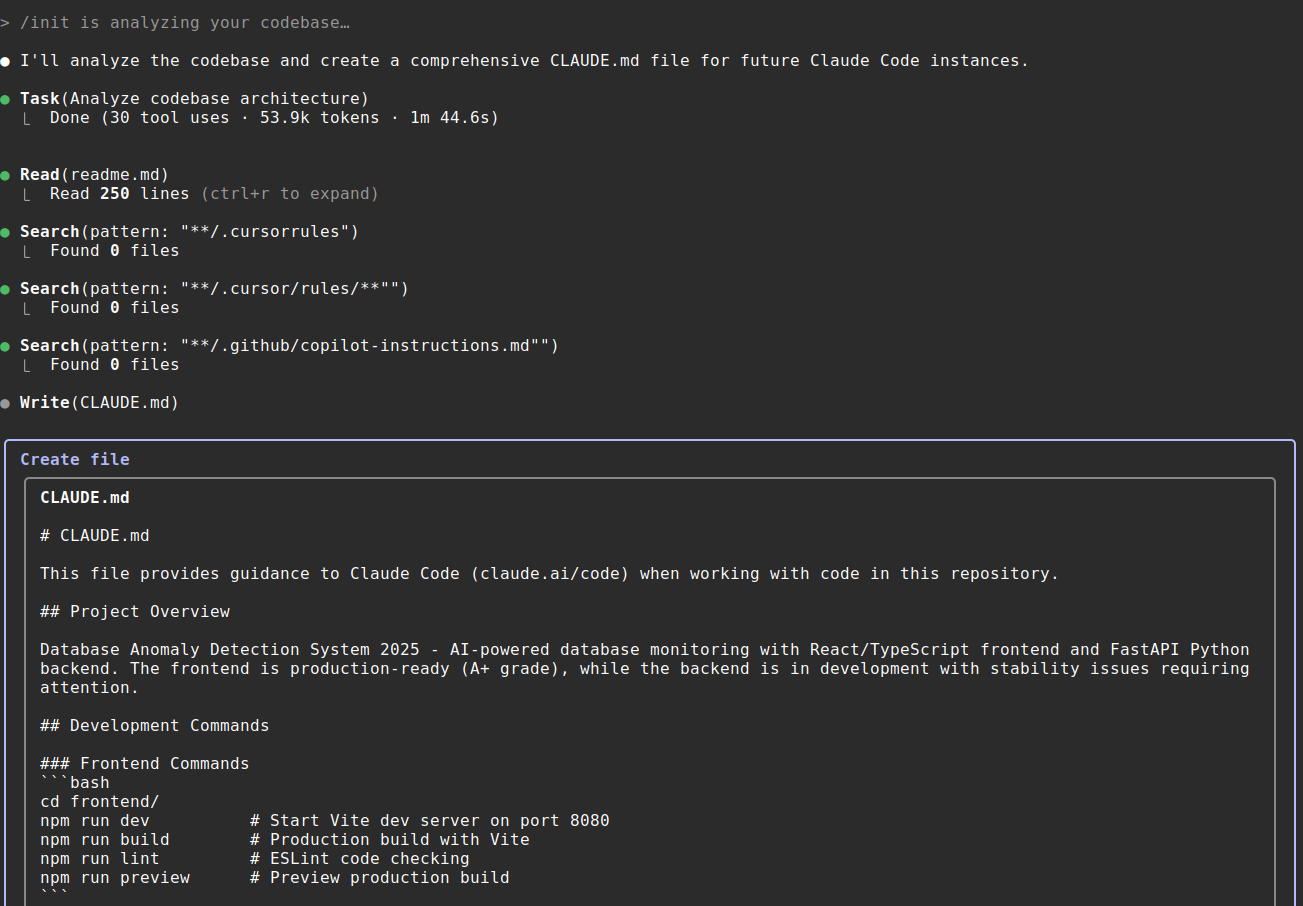
Claude is usually the stronger option if you need:
- cleaner code structure,
- more reliable debugging,
- better explanations,
and code that feels closer to what a senior engineer would write.
Gemini for coding

Gemini is often better if you need:
- fast iteration,
- larger file handling,
- and strong performance on structured coding challenges.
If you are building production systems, Claude often feels safer. If you are working across huge inputs or want a more flexible general-purpose coding assistant, Gemini is very compelling.
Research and reasoning
This is one of the most interesting areas of comparison because both models perform well, but in different ways.
Gemini is stronger on raw academic-style reasoning. It does especially well on science, abstract logic, and structured problem solving. That makes it a powerful choice for research-heavy workflows that depend on broad reasoning ability.
Claude becomes more interesting when tools are part of the workflow. In real research work, you often need more than reasoning alone. You need the model to search, compare, synthesize, and stay careful while doing it. Claude’s strengths show up strongly in those kinds of tasks.
A practical view
- Gemini is better for raw benchmark-style reasoning.
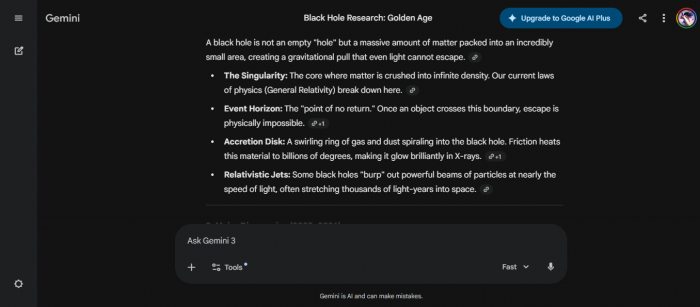
- Claude is better for careful, multi-step, tool-assisted analysis.
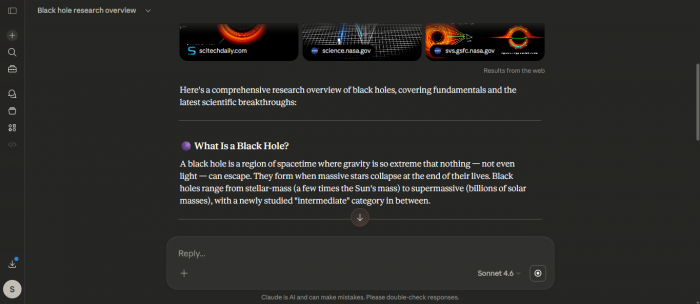
That difference may sound subtle, but in practice it is meaningful. Researchers, analysts, and writers often care less about one perfect benchmark score and more about how the model behaves under real conditions.
Multimodal support
Gemini has a clear advantage here. It accepts text, images, audio, and video directly, which makes it much more flexible for content that is not purely text-based.
Claude supports text and images, which is still useful, but Gemini’s broader input support saves time and effort. If you work with interviews, lectures, videos, presentations, or mixed-media research, Gemini is simply easier to use.
This is one of the reasons Gemini feels more like a general-purpose AI platform, while Claude feels more like a focused reasoning assistant.
Long context and large projects
Gemini’s 1 million token context window is one of its strongest selling points. It is available by default, which makes it especially attractive for large documents, codebases, transcripts, and long research sessions.
Claude also supports long context, but Gemini’s default setup removes friction. You do not need to think as much about workarounds or chunking content manually.
That matters for:
- legal documents,
- long reports,
- large repositories,
- multi-chapter writing,
- and long-form analysis.
If your workflow depends on reading and understanding huge amounts of material at once, Gemini is often the more convenient choice.
Pricing and value
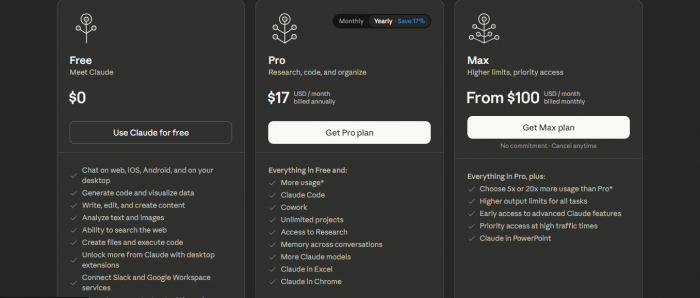
Price is one of the biggest reasons many users lean toward Gemini. It is generally more affordable at both the API and consumer level, which makes it easier to use regularly without worrying too much about cost.
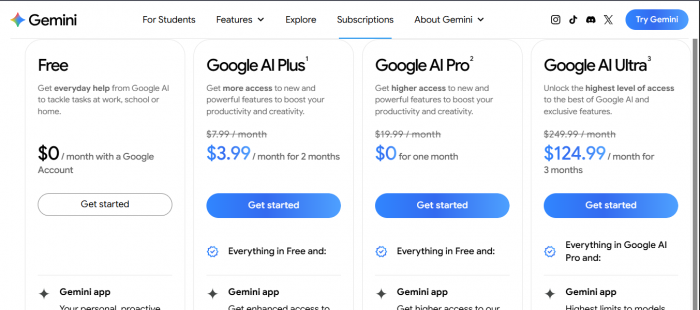
Claude is the more premium product. You pay more, but in return you usually get stronger output quality in the kinds of tasks where precision matters most.
Simple way to think about it
- Choose Claude if quality is worth paying extra for.
- Choose Gemini if you want strong performance at a better price.
That is the core trade-off. Claude is more expensive, but many professionals will feel the difference. Gemini is cheaper, and for many users the value is hard to ignore.
What users notice in real life
People who use Claude regularly often say it feels more consistent. It seems to think more carefully, follow instructions more closely, and produce output that needs less cleanup.
People who use Gemini often highlight speed, flexibility, and ease of use. It tends to feel more open-ended and less rigid, which is helpful when prompts are vague or when you want the AI to fill in gaps intelligently.
A lot of advanced users now use both. Claude for planning, writing, and judgment-heavy work. Gemini for iteration, multimodal tasks, and large-context processing. That hybrid approach is popular for a reason.
Which one should you choose?
| Use case | Better choice |
| Production coding | Claude |
| Competitive programming | Gemini |
| Scientific research | Gemini |
| Legal and finance | Claude |
| Content writing | Claude |
| Multimodal projects | Gemini |
| Large document analysis | Gemini |
| Budget-sensitive use | Gemini |
| High-stakes reasoning | Claude |
Final verdict
Claude is the stronger model if your priority is quality, judgment, and dependable professional output. It is especially good for coding, writing, legal work, finance, and situations where being wrong is costly.
Gemini is the better model if your priority is flexibility, multimodal support, large context, and better pricing. It is a strong all-rounder and often the smarter practical choice for many everyday users.
The easiest way to decide is this: if the task demands precision, choose Claude. If the task demands breadth and value, choose Gemini.
Post Comments
Be the first to post comment!
Related Articles