Table of Content
- The elevator pitch: what Five Surveys really is
- Setting up: who can join and what the sign‑up feels like
- A day in the life: how using Five Surveys actually plays out
- What the money really looks like
- Getting your money out: payouts, methods, and delays
- Living with the interface: site and app experience
- The reputation question: legit, scam, or something in between?
- A closer look at user sentiment
- Pros and cons, told like they really feel
- Who should actually use Five Surveys?
- How it stacks up in the wider survey universe
- So, is Five Surveys worth your time?
Five Surveys has a very simple promise: “Give us your opinions in five surveys, and we’ll hand you five dollars.” Simple promises are rare in the survey world, which is exactly why this platform has caught so much attention.
What follows is a full, 360‑degree look at Five Surveys on how it works, how much you can really make, where it shines, where it falls short, and who should actually bother signing up.
The elevator pitch: what Five Surveys really is
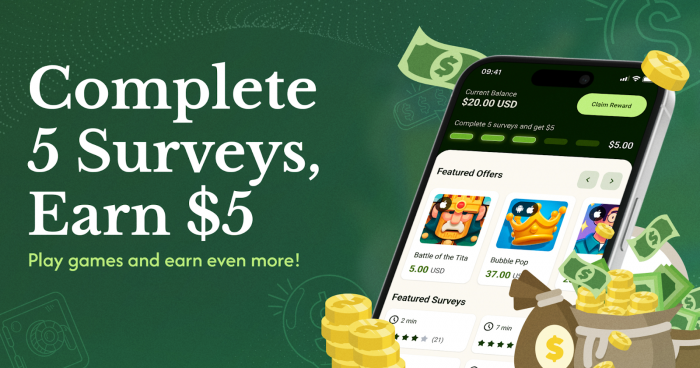
At its core, Five Surveys is an online survey platform and mobile app where each completed survey is worth a flat $1, and every time you finish five of them, you unlock a $5 payout.
There are no tokens, no “points”, no conversion tables to memorize; you see dollars on the screen, and those dollars can go to PayPal, bank transfer in some regions, Venmo, or gift cards.
Instead of running surveys itself, Five Surveys plugs into a network of third‑party market research providers.
These are the companies that want to know what brand of cereal you buy, what streaming service you’re cancelling next, or which ad you’d actually click on.
They pay for access to everyday people, Five Surveys matches you to those studies, and you get a slice of that budget when you complete a questionnaire.
On paper, it’s almost refreshingly straightforward: five surveys in, five dollars out.
In practice, the experience lives somewhere between “quick coffee money” and “why did that survey just boot me after 10 questions?” depending on your location and profile.
Setting up: who can join and what the sign‑up feels like
Signing up to Five Surveys feels like joining any modern web app, with one twist: the platform really wants to know who the user is, not just an email address. The process starts with the usual registration: email, password, verification, and then drops straight into a profiling process.
Here, the platform asks for age band, gender, education, job status, income brackets, household composition, interests, and sometimes whether the member makes purchase decisions at home. This is not just nosey data collection; it’s the engine that determines which studies appear and how often someone qualifies.
In terms of geography, Five Surveys is clearly not trying to be “every country under the sun.” It has rolled out in major markets like the US, UK, Canada, Australia, Germany, and other European countries, with an official country‑selection page where languages and regions supported can be checked.
Availability and targeting change as partners come and go, so any serious review should explicitly tell readers to check the current country list before assuming they can join.
Most similar panels require members to be adults under local law, often 18+, sometimes slightly lower where legal and with parental consent and Five Surveys appears to track that same pattern, though the exact age requirement should be verified during sign‑up.
A day in the life: how using Five Surveys actually plays out
A typical session: half an hour in the evening, phone in hand, Five Surveys app open. The dashboard greets the member with a very clear display: how many surveys have been completed in the current “set”, how many are left until that magic five, and what the pending balance looks like in actual dollars.
From there, the survey list shows up, and each survey comes with an estimated time of maybe 8 minutes, maybe 15 and sometimes a short hint about the topic. A tap on one of them starts the process.
The first few questions don’t look like the main survey; they’re screeners: age, country of residence, whether a car was bought in the last 6 months, or if the respondent is the decision‑maker for mobile plans at home.
This is where the real personality of Five Surveys appears. If the respondent fits the target demographic, access is granted to the full study; all questions are answered, and $1 smoothly drops into the Five Surveys balance when it is finished.
If the profile doesn’t match, the person is unceremoniously disqualified and booted out with nothing to show for those screener answers and a sour taste in the mouth.
After enough attempts, a pattern emerges: some studies are easy to get into, while others seem to reject respondents more often as they get closer to completing the set of five.
This is not unique to Five Surveys; it’s how a lot of survey routing works, but users definitely feel it more keenly when every fifth success is tied to a cashout.
What the money really looks like
The mathematical promise is clean: one survey equals one dollar, five surveys equal five dollars. If you only looked at that line and the estimated survey times (often in the 5–15 minute range), you could talk yourself into imaging $4–$12 per hour without trying too hard.
Reality is less flattering and more nuanced. Screeners chew into your time without paying you a cent, and not every survey that appears on your dashboard is one you actually get to finish.
Some in‑depth reviews report spending around two to three hours in total to hit a single $5 payout, broken across several sessions of trying, failing, qualifying, and finally completing enough surveys.
If you convert that into an hourly rate, you’re often looking at something more in the “coffee money” band than anything you’d mistake for a proper job. Regular users who treat it as a background habit rather than a grind typically end up in a rough monthly window of a few dollars on the low end to perhaps tens of dollars if they’re diligent, in a good region, and qualify frequently.
So yes, Five Surveys can pay, and it does pay, but it behaves like a micro‑earning app: the moment you think “this could replace a part‑time job”, you’re aiming it at the wrong target.
Getting your money out: payouts, methods, and delays
If earnings are the heart of the story, payouts are the spine. Five Surveys understands that, and its withdrawal system is one of the reasons it’s on so many “best survey apps” lists.
The minimum cashout is essentially baked into the name: you withdraw when you’ve reached $5, meaning one completed batch of five surveys. There’s no need to slog to $10, $25 or $50 like on some older survey sites; you simply reach the first milestone and you’re allowed to pull money out.
Where the money goes depends on where you live. Typical options include PayPal, Venmo in some countries, bank transfer or ACH, and a rotating selection of digital gift cards Amazon and similar big brands show up frequently.
Reported payout speeds are generally solid, with many users receiving money in one to two business days, sometimes even faster.
But this is not a fairy tale. Alongside happy payout screenshots, there’s a very visible group of users complaining that their accounts went “under review” right when they tried to withdraw slightly larger amounts, or that their payment request got stuck without explanation.
From the outside, it looks like classic over‑eager fraud prevention: a strict system that does catch some genuine cheaters, but occasionally snags legitimate users along the way.
A quick snapshot: key facts at a glance
| Aspect | Details |
| Reward model | Flat $1 per completed survey, $5 every 5 surveys. |
| Minimum cashout | $5 (one full set of 5 surveys). |
| Payout methods | PayPal, Venmo (some regions), bank transfer, gift cards. |
| Typical survey length | About 5–15 minutes when fully completed. |
| Supported regions | US, UK, Canada, AU, EU and others (varies). |
| Platform | Website plus Android app (and other mobile availability evolving). |
| Overall nature | Legit micro‑earning survey app with low hourly effective pay. |
Living with the interface: site and app experience
On the surface, Five Surveys looks and feels like a modern consumer app.
The dashboard is uncluttered, the fonts are friendly, and the one thing that really matters how close you are to that $5 block is front and center.
You’re usually never more than a couple of taps away from seeing available surveys, checking your balance, or starting a cashout request. Because everything is denominated in real currency rather than points, the psychological friction is low: you don’t need a cheat sheet to interpret your earnings.
The mobile app, particularly on Android, has built up a large number of installs and a decent rating, with users often praising how easy it is to open, answer a survey or two, and see the $1 increments stack up.
But scroll through those same reviews for a while and you’ll also find people frustrated with app crashes, occasional glitches, or surveys that hang at 99% and then never complete.
In other words, the UX is pleasant when everything cooperates, but it’s tightly coupled to the underlying survey networks: if the third‑party survey misbehaves, Five Surveys gets the blame in the user’s mind.
The reputation question: legit, scam, or something in between?
Whenever a money app blows up, the internet splits into two camps: people posting payment proofs, and people posting angry warnings.
Five Surveys is no exception.
On the “yes, it’s legit” side, there’s plenty of evidence:
● The company behind it operates in the established market research ecosystem and partners with recognized survey providers.
● Many reviewers and side‑hustle bloggers have tested it personally and received real payouts, sometimes multiple times.
● Ratings on large review sites sit in the “good” to “great” range, with thousands of users confirming that they have successfully cashed out.
On the “this feels like a scam” side, the charges are also consistent:
● Some users say they were blocked or put “under review” once they tried to withdraw more than the minimum, or after building a higher balance.
● Others complain that they were conveniently disqualified from multiple surveys just as they approached the fifth one needed for a payout.
A fair interpretation is that Five Surveys is a real, paying survey platform with a strict compliance layer and the usual problems of third‑party survey routing, rather than a fake money‑app designed purely to waste time. It’s not flawless, but it’s not a phantom either.
A closer look at user sentiment
When you look at user sentiment around Five Surveys across different platforms, a clear pattern emerges. On Trustpilot, the overall tone is generally “good” to “great”, with many reviewers highlighting that they receive real payouts, appreciate the simple system, and like the low cashout threshold. At the same time, some of these users complain about payout‑related issues, especially sudden account checks or reviews that slow down or block withdrawals.
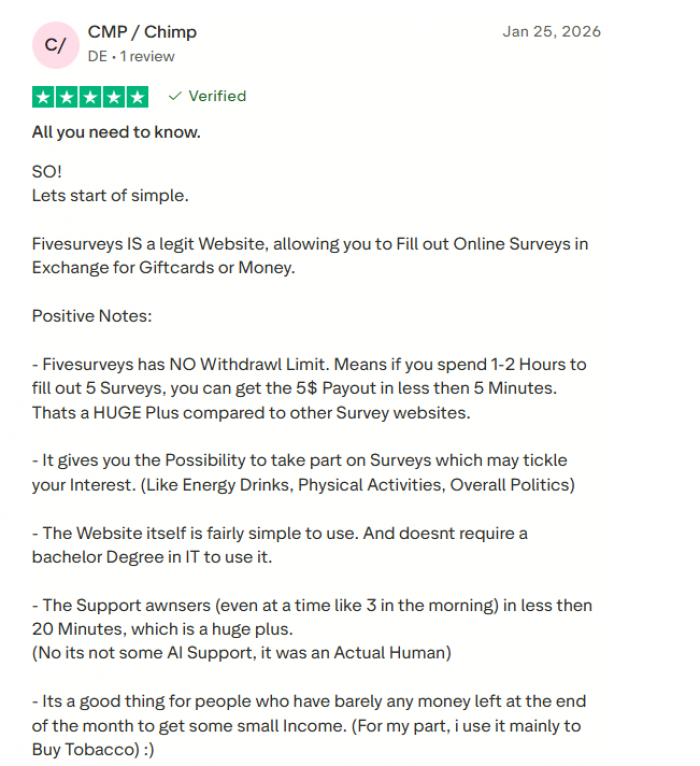
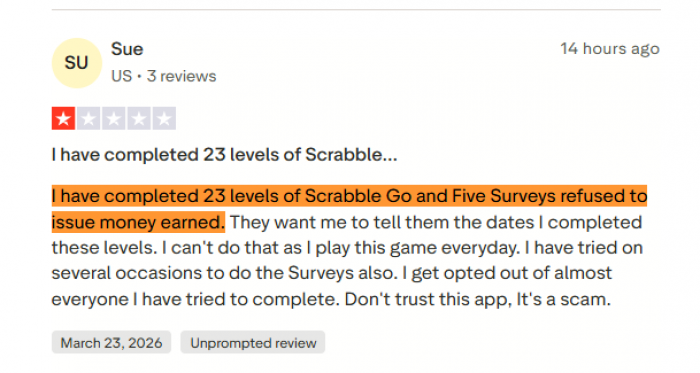
Reddit and other forums are much more divided. You will find people who report quick initial payouts and say the app worked well for them at the start. Alongside them are many posts accusing the platform of “rigged” screenouts especially when users are close to a payout and complaining about blocked withdrawals or accounts going under review, which fuels suspicion.
In app stores, the sentiment again trends generally positive, reflected in decent ratings. Users often mention how easy the app is to use and appreciate the convenience of being able to earn from their phones.
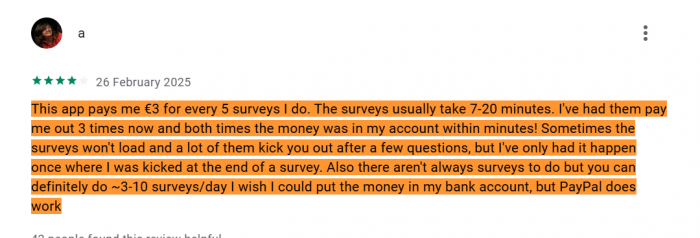
Yet even there, the negative reviews repeat familiar themes: bugs, surveys crashing or freezing, and disqualifications that make the experience feel inconsistent.
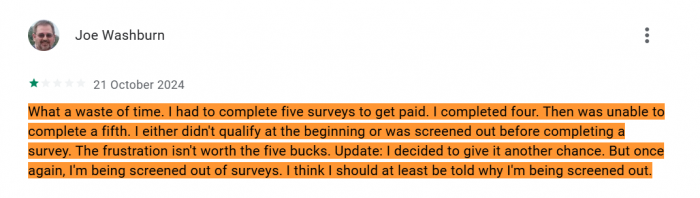
Quick Overview
| Source | Overall tone | What people like | What people dislike |
| Trustpilot | Generally “good” / “great”. | Real payouts, simple system, low cashout. | Payout reviews, sudden account checks. |
| Reddit/forums | Divided. | Quick initial payouts for some. | Claims of “rigged” screenouts, blocked withdrawals. |
| App stores | Generally decent ratings. | Easy to use, app convenience. | Bugs, survey crashes, disqualifications. |
Pros and cons, told like they really feel
Instead of rushing through a checklist, it’s more interesting to think in terms of trade‑offs what you are getting and what you are giving up every time you open Five Surveys.
On the plus side, the mental load is low. Each successful survey is a clean dollar, five of those dollars unlock a payout, and there’s no need to climb towards some painful $25 threshold before seeing anything. For people who enjoy ticking off small goals in between other tasks waiting for a train, half‑watching TV, this fits neatly into the day.
On the downside, the cost is paid in something that doesn’t come back: time plus attention.
Frequent disqualifications are more than just mildly annoying; they can halve or even quarter the effective hourly rate, and after enough failed attempts, it’s easy to feel like the app is wasting the user rather than paying them.
The occasional stories of payouts being delayed or accounts going under review at higher balances don’t help trust, even if many other members never experience those issues.
So the trade is clear: you’re swapping low‑stakes, flexible time for very small but real bursts of money, with some friction built into the process.
Who should actually use Five Surveys?
If you measure every opportunity strictly in dollars‑per‑hour, Five Surveys isn’t going to win any contests.
But if you treat it as a micro‑task you can dip into whenever you’re bored, the equation shifts.
It’s a sensible fit for people who:
● Enjoy the idea of exchanging spare minutes for a trickle of cash or gift cards.
● Prefer a cash‑denominated system rather than points.
● Live in supported countries and have access to good payout methods like PayPal or Venmo.
It’s a poor fit for:
● Anyone trying to pay off serious debt or build a meaningful side income from surveys alone.
● People who know they’ll be irritated by repeated disqualifications and occasional technical hiccups.
● Users in unsupported regions, or those whose preferred payout method isn’t available.
If you position it to your readers as a “pocket‑change machine” rather than a “side business”, they’re far more likely to be satisfied with the outcome.
How it stacks up in the wider survey universe
Every survey site plays with the same ingredients such as time, pay, friction but combines them differently.
Five Surveys’ combination is high transparency, low thresholds, and modest pay, whereas many competitors trade clarity for more complexity.
| Platform | Pay style | Cashout threshold | Typical effective pay feel | Best suited for |
| Five Surveys | Flat $1 per survey. | $5. | Low but clear. | Casual spare‑time earnings. |
| “Points” sites* | Points → cash/gifts. | Often $10–$25. | Varies; harder to read. | Gamified earning, long‑term users. |
| Premium panels* | Higher $ per hour. | Often $5–$10. | Higher but fewer surveys. | More serious survey‑takers. |
So, is Five Surveys worth your time?
If you think of time only as “billable hours”, Five Surveys won’t make sense: the effective hourly rate is too low and too unpredictable, especially once screeners and disqualifications are in the mix.
But if you think of time in “small pockets I usually waste anyway”, the app becomes more plausible: you’re turning otherwise lost minutes into the occasional $5 payout, and that can feel surprisingly satisfying.
The platform is legitimate, pays many users reliably, and offers a transparent, easy‑to‑understand earning model, but it also brings along the usual baggage of survey‑based side hustles frustration, inconsistency, and the need to temper expectations.
Used with eyes open, Five Surveys is a decent little money‑drip you can keep in your digital toolkit. Used with unrealistic hopes, it will only teach you the old lesson: if an app promises money for clicks, the catch is rarely hidden, it’s just your time.
Post Comments
Be the first to post comment!
Related Articles