Table of Content
- The Comfort of Building Fast
- When Speed Replaces Thinking
- A Website Is Not the Goal
- The Gap Between Design and Experience
- Templates Cannot Think for You
- The Missing Layer: Solution Thinking
- Where Rocket.new Fits In
- From Idea to Flow
- Content Is the Real Interface
- Iteration is Where Growth Happens
- The Problem With Over-Simplification
- Connecting Thinking to Execution
- What Most Builders Miss
- Bringing It All Together
- Where You Go From Here
Ideas rarely fail because they are bad. Most of them fail because they are rushed into the wrong shape.
That shape, more often than not, is a website.
It starts with excitement. You have something in mind, maybe a product, a service, or even just a concept you want to test. You open a no code website builder, pick a template, tweak some text, swap in a few images, and within hours, your idea is live.
It feels like progress.
But a few days later, something feels off. The website exists, yet nothing is happening. Visitors come and go. There is no engagement, no traction, no momentum.
This is the moment where a quiet realization begins to settle in.
A website is not a solution. It is only the surface.
_1776328083.jpg)
The Comfort of Building Fast
There is no denying how much no code tools have changed the game. They have removed the dependency on developers for early-stage ideas. They have made it possible for anyone to create something functional without writing a single line of code.
That accessibility is powerful.
But it also creates a new kind of problem.
When something becomes easy to do, we tend to do it without questioning whether we are doing the right thing.
Building a website has become easy. Building the right website has not.
And that difference is where most ideas lose their edge.
When Speed Replaces Thinking
Speed feels productive. Launching quickly feels like winning.
But speed without direction leads to noise.
Many people jump straight into building because tools make it tempting. Templates are ready. Layouts are pre-designed. Sections are already structured.
All you have to do is fill in the blanks.
Except your idea is not blank.
It is layered. It has context. It has intent. It has a specific audience with specific expectations.
And there is something else most people overlook at this stage.
They build in isolation, without context.
They do not look at what already exists in the market. They do not study how similar ideas are positioned, what messaging is working, or where others are falling short. This is where competitor intelligence becomes important.
Before you build, it helps to understand:
- How competitors present their value
- What kind of pages do they use to convert users
- Where users might be underserved or confused
- What patterns are already familiar to your audience
Without this awareness, you risk repeating the same mistakes or blending into the noise.
When you skip both thinking and context, you end up forcing something unique into something generic.
And users can feel that.
A Website Is Not the Goal
Let’s reframe something important.
Your goal is not to build a website. Your goal is to create an outcome.
That outcome could be:
- Someone signing up
- Someone is making a purchase
- Someone trusting your brand
- Someone understanding your idea clearly
A website is just the medium through which this happens.
But when the focus shifts entirely to building pages, the outcome gets lost.
This is why so many websites look complete but feel empty.
They exist, but they do not work.
The Gap Between Design and Experience
A well-designed website can still fail.
That sounds counterintuitive, but it happens all the time.
Why?
Because design is only one part of the equation.
Experience is what truly matters.
Experience is how a user moves through your website. It is how they feel at each step. It is how clearly they understand what you are offering and what they should do next.
Most no code website builder platforms focus heavily on design. They give you beautiful templates and flexible layouts.
But they do not guide you in shaping the experience.
They do not tell you:
- What to say first
- How to build trust
- When to introduce your offer
- Where to place your call to action
And without these, even the most visually appealing website can fall flat.
Templates Cannot Think for You
Templates are helpful starting points. They reduce the time it takes to get something live.
But they are not tailored to your idea.
They are designed for general use, not your specific intent.
So what happens when you rely on them too heavily?
You start adjusting your idea to fit the template instead of shaping the template around your idea.
This leads to:
- Generic messaging
- Misaligned sections
- Weak storytelling
In the end, your website becomes a version of what it could have been, not what it should have been.
The Missing Layer: Solution Thinking
This is where a deeper approach comes in.
Instead of asking, “How do I build this website?” The better question is, “What am I trying to solve?”
That shift changes everything. You move from assembling pages to shaping a solution, focusing on user problems, flow, and clarity.
This is where platforms built around solutioning start to stand out.
Where Rocket.new Fits In
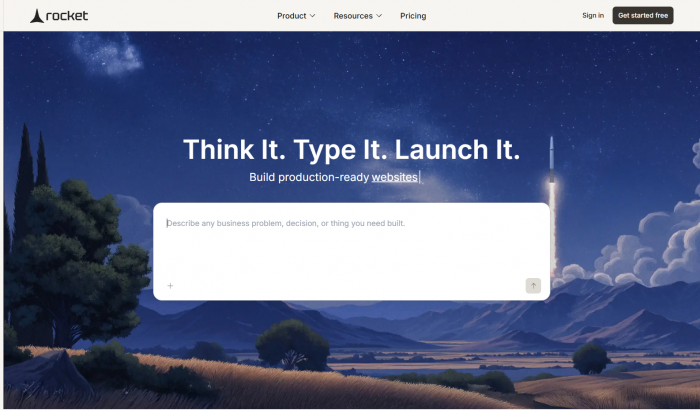
At this point, the gap is clear.
You do not just need a way to build pages. You need a way to think through what those pages should be.
This is where Rocket fits in differently.
Instead of starting with a blank canvas or a fixed template, it works more like a guided build process. You begin with an idea, and from there, you shape the structure, flow, and content step by step.
From a builder’s perspective, this changes how you approach the work.
You are not deciding everything from scratch. The platform helps you think through and define:
- What sections you actually need
- How those sections should connect
- What kind of content fits each part
It also brings in context that is usually missing at this stage, like how similar products are structured and where gaps exist. That makes it easier to avoid generic layouts and build something more intentional.
You still have control. You can edit, adjust, and refine.
But you are not starting blind.
You are building with a clearer path, where decisions are guided by intent, flow, and real context, not just templates.
You are not just building faster. You are building with better direction.
From Idea to Flow
Once your structure is clear, the next challenge is how users move through it.
One of the biggest challenges in building a website is not design. It is flow.
Flow determines how smoothly a user moves from one point to another.
A strong flow answers questions before they are asked. It removes confusion. It builds confidence step by step.
Here is what a simple flow might look like:
- Clear introduction of what you offer
- Immediate relevance to the user
- Supporting information that builds trust
- A natural transition to action
When this flow is missing, users hesitate. And hesitation often leads to exit.
Most builders do not help you think in terms of flow. They focus on sections, not sequences.
But sequences are what drive results.
Content Is the Real Interface
It is easy to focus on visuals. Colors, layouts, animations.
But what truly connects with users is content.
Your words carry the weight of your idea.
They need to:
- Explain clearly
- Connect emotionally
- Guide action
When content is weak, no amount of design can compensate for it.
And yet, content is often treated as an afterthought.
People design first and write later.
This usually leads to content being squeezed into spaces that were never meant for it.
A better approach is the opposite.
Start with what you want to say. Then design around it.
Iteration is Where Growth Happens
Launching a website is not the finish line. It is the starting point.
What happens after launch matters more than the launch itself.
You need to observe:
- Where users drop off
- What they engage with
- What they ignore
These insights help you refine your website over time.
Without iteration, your website remains static.
And static websites rarely perform well in dynamic environments.
A good builder helps you launch. A better approach helps you evolve.
The Problem With Over-Simplification
There is a growing trend of simplifying everything.
“Build a website in minutes.”
“Launch instantly.”
“Go live in one click.”
These messages are appealing, but they oversimplify the process.
They make it seem like the hardest part is building.
In reality, the hardest part is understanding.
Understanding your audience, your message, your positioning.
Without this, even the fastest tools cannot deliver meaningful results.
Connecting Thinking to Execution
So how do you move from an idea to something that actually works?
You need to bridge the gap between thinking and building.
This means:
- Taking time to clarify your idea
- Structuring your website intentionally
- Focusing on user experience, not just design
- Continuously improving based on feedback
Tools play an important role in this process. But they should support your thinking, not replace it.
This is why relying solely on a no code website builder can feel limiting after a point.
It gives you speed, but not always direction.
What Most Builders Miss
The future of building is not just about removing code.
It is about removing confusion.
It is about helping people go from vague ideas to clear, structured solutions.
This requires a combination of:
- Thoughtful planning
- Guided execution
- Flexible tools
- Continuous learning
Platforms that bring these elements together are shaping the next phase of digital creation.
They are not just builders.
They are enablers of better outcomes.
Bringing It All Together
Turning an idea into a website is not a linear process.
It is iterative. It is creative. It requires both thinking and execution.
A no code website builder can help you get started quickly. It can remove technical barriers and make building accessible.
But accessibility alone is not enough.
You need depth.
You need clarity.
You need a way to translate your idea into something that resonates with real users.
That is where the difference lies.
Where You Go From Here
At this point, the difference is clear.
Building a website is easy. Building something that works takes thought.
So before you open any tool, pause.
Get clear on what you are solving and who you are building for. Look at what already exists and find where you can do better. Shape your message first, then your layout.
Then build.
Use tools to move faster, not to skip thinking. Let structure guide your pages and content drive your design. And once your site is live, keep improving it.
Because what matters is not how fast you launch.
It is how clearly you build and how consistently you refine.
That is what turns an idea into something that works.
Post Comments
Be the first to post comment!
Related Articles