Table of Content
- What is Gauth AI? Overview & Background
- How Gauth’s Core Features Work (Snap-Solve, AI Chat, Live Tutors)
- Platform Access, Subject Coverage & Study Toolbox
- Performance: Speed, Accuracy & User Demographics
- Ratings & Feedback Trends
- Pricing, Plans & Accessibility
- Gauth vs Major Alternatives: Which Study App Fits You?
- Who Should Use Gauth (And Who Should Think Twice?)
- Key Considerations: Data Privacy, Learning Impact & Regulation
- Final Thoughts: Is Gauth AI the Right Study Buddy for You?
What happens when a homework-helper app climbs to the top of the U.S. education charts, blending instant answers, live tutors, and viral storytelling? Let’s have a look at Gauth AI, a study companion that claims to reshape how students tackle learning barriers, one photo at a time.
What is Gauth AI? Overview & Background
First, suppose you’re wondering what exactly Gauth AI does. The app, originally launched under the name Gauthmath around 2019/2020, is now positioned as an “AI study companion” by its maker.
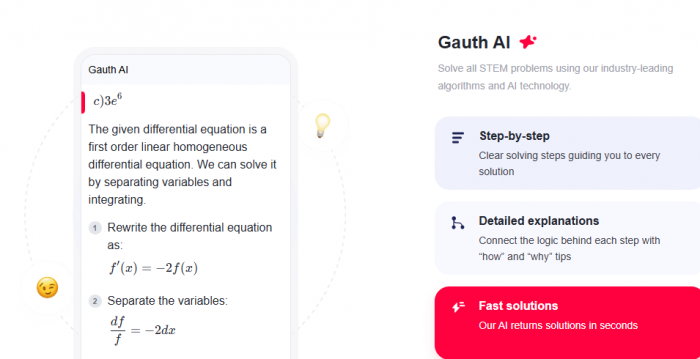
The parent company is tied to ByteDance, the same group behind TikTok, which adds another layer of interest (and caution) to the story.
In short: the app promises to help students across multiple STEM subjects by snapping problems, delivering step-by-step solutions and offering human tutor escalation, but let’s dig deeper into how this actually works, and where it falls short.
How Gauth’s Core Features Work (Snap-Solve, AI Chat, Live Tutors)
So, how does Gauth AI claim to help you study? And how does it perform? Here’s a breakdown, and then we’ll check the evidence.
Snap & Solve
You point your device at a printed or handwritten problem, upload it, and the app’s AI engine scans and generates a step-by-step solution. The official listing claims “accurate answers, step-by-step” and fast turnaround.
AI Chat Follow-ups
Beyond the initial solution, Gauth AI offers interactive chat (and in many cases voice + whiteboard) features so you can ask “why” or “how” a step was done.
Live Tutor Escalation
If the AI doesn’t suffice (or the problem is tricky), the paid tier lets you connect with real tutors 24/7. According to the site, thousands of experts are available.
Platform Access & Subject Breadth
The app is available for Android and iOS and has web support. It claims to cover not just algebra/trigonometry but also physics, chemistry, and more.
Having described how it works, let’s move on to performance—how well it really performs in the real world.
Platform Access, Subject Coverage & Study Toolbox
In this section, we check how broad Gauth AI’s reach and subject support really are, and what tools it offers beyond just “snapping pictures.”
The official site lists topics including geometry, calculus, statistics, algebra, physics, chemistry, and more.

The app also promotes additional features like “question bank,” reading/writing aids, flashcard-style tools, and voice/whiteboard tutoring for premium users.
But breadth does not always equate to depth, so the next step is checking how accurate and usable those features are in practice.
Performance: Speed, Accuracy & User Demographics
Here, we evaluate how Gauth AI actually performs in speed, accuracy, and usage.
Market Reach
According to a study, Gauth was the second-most downloaded education app on iOS in the U.S. as of 2024.
Accuracy Test
In an independent review by WIRED, when fed high-school level algebra/geometry problems, Gauth’s AI achieved roughly a “low B/high C” grade average and struggled with more advanced graphing/calculus questions.
User Feedback & Demographics
From user reviews:
A rating of ~4.8 stars on App Store/Google Play in certain listings.
On the flip side, Trustpilot reviews raise concerns about accuracy and paid-tier restrictions.
Thus, Gauth AI is fast and convenient for many routine tasks but less reliable on complex or unusual ones, and user demographics suggest significant usage among high school/college-prep students.
Ratings & Feedback Trends
Let’s look at the user sentiment: what users say works and what they say doesn’t, so you can decide whether the tool fits your study style.
Positive comments often mention:
- Quick solutions, intuitive interface.
- A step-by-step breakdown is useful for revision.
Negative comments raised:
- Some answers are incorrect or incomplete (especially advanced problems). > “A lot of the answers … are just wrong, especially the ones made by AI.
- Free tier usage limits and adverts. > “You have to pay for more than 3 questions … Sometimes answer isn’t even clear.”
Educator/parent concerns about reliance. > “Students are not learning anything … I just feel like I am wasting my time in a classroom with students who have absolutely no drive or curiosity.”
In sum: The app gets high marks for convenience and speed, but its accuracy and bigger learning impact are flagged by many.
Pricing, Plans & Accessibility
Here’s a practical look at cost and access, because fit and budget matter.
- Free tier: Includes basic problem-solving, but has usage caps, ads, and slower response.
- Paid tier (often called “Plus” or “Premium”): Removes ads, unlocks more features (live tutor, voice chat, more problems). For example one review lists ~$11.99/month or ~$99/year for full access.
Keep in mind: regional pricing may vary, and the value you get depends on your frequency of use.
If you only need help occasionally, the free tier might suffice, but heavy users or those wanting full access may find the paid plan worth it.
Gauth vs Major Alternatives: Which Study App Fits You?
It makes sense to compare Gauth AI with rivals so you can decide what fits your needs.
Alternatives include:
- Photomath: Strong on step-by-step math explanations and animated pedagogy; fewer live tutors.
- Microsoft Math Solver: Free unlimited math problem-solving, but no human tutor escalation.
- Mathway: A longstanding platform with wide topic coverage but many features behind a paywall.
If your goal is routine high school math and occasional help, you might be well served by a free or low-cost alternative. But if you want live tutors, multi-subject support, and a one-stop experience, Gauth could be a contender; just check whether its accuracy and cost match your expectations.
Who Should Use Gauth (And Who Should Think Twice?)
Let’s check the fit.
Good candidate if you:
- Often face homework problems in math/physics/chemistry and want a quick-turn solution.
- Appreciate the idea of both AI and live tutor support in one app.
- Are comfortable with the subscription cost and willing to engage actively (i.e., you review the answers, don’t just copy them).
Maybe less ideal if you: - Rarely need homework help (in which case a free tool may suffice).
- Do advanced university-level work (where Gauth’s accuracy may dip).
- Are you concerned about data/privacy issues or want a minimal-permission tool?
So, knowing your use case helps decide whether Gauth fits or you should look elsewhere.
Key Considerations: Data Privacy, Learning Impact & Regulation
Before you commit, there are some important caveats to check—because the tool is powerful but not risk-free.
- Privacy & ownership: With the parent company (ByteDance) in the background, some concerns have been raised over data collection and app permissions.
- Learning dependency: Educators worry that apps like Gauth could weaken students’ critical thinking or problem-solving skills if used merely to get answers. > “Students are not learning anything.”
- Accuracy limits: The AI isn’t flawless, particularly on advanced math or unusual problems, and occasionally delivers incorrect answers.
- Regulatory context: Some regions may restrict or monitor such homework-solver apps, given concerns about academic integrity and data flow.
Hence, view Gauth AI as a tool, not a substitute for learning, and use it with awareness.
Final Thoughts: Is Gauth AI the Right Study Buddy for You?
Let’s wrap it up. If you’re a student who regularly wrestles with math, physics, or chemistry homework and you want a fast, intuitive study aid, then Gauth AI appears to offer a compelling option. Its combination of snap-photo solving, chat/voice support, and human tutors is rare.
But, and this is important, it’s not perfect. It may miss or misinterpret complex or niche problems. It comes with usage caps in the free tier and cost for full features. Its impact on deep learning is still under debate.
So: treat it as a supplement, not a crutch. Use it to check your work, clarify steps, and reinforce your understanding, not just to offload the problem entirely. If you do that, you’re more likely to get meaningful value from it.
Would I Recommend It? (Pros & Cons)
Pros:
- Quick, intuitive problem solution workflow (photo → steps).
- Multi-subject support beyond just basic math.
- Live tutor escalation offers human backup.
- Cross-platform access (iOS, Android, web).
Cons:
- Free tier usage is limited, which might push you toward paid plans.
- Accuracy is still imperfect for advanced/niche problems.
- Potential data/privacy concerns given parent-company context.
- Risk of over-reliance rather than engaging with learning.
In conclusion: if you’re prepared to use it wisely, engaging with the steps, reviewing the solutions, and treating it as study-aid rather than a copying tool, Gauth AI could be worth exploring. Just keep expectations realistic and continue practicing problem-solving without the app as well.
Post Comments
Be the first to post comment!
Related Articles




Grubby AI vs WriteHuman: Which One Should You Use?
Ridge Harper . Jun 30, 2026