Table of Content
- What If Your Imagination Had an AI Co-Author?
- What is Gening AI, and Who Is It For?
- Gening AI Features: Inside Its Creative Toolkit
- What Users Are Saying: Feedback and Reviews
- Gening AI Pricing: Is It Worth It?
- Gening AI vs. Competitors: How Does It Compare?
- Where Gening AI Falls Short
- My Rating on Gening AI
- Final Thoughts: Overhyped or the Future of Creativity?
What If Your Imagination Had an AI Co-Author?
Gening AI promises to turn simple prompts into immersive worlds, characters, and storylines. But in a crowded field of creative AI tools, does it truly delive, or just ride the hype wave? This hands-on review explores its core features, pricing, user feedback, and how it stacks up against RunwayML, Artbreeder, and ChatGPT.

What is Gening AI, and Who Is It For?
At its core, Gening AI is an advanced AI-powered creativity platform built for creation, not just conversation. Unlike standard chatbots, it focuses on generating personalized worlds, dynamic characters, and interactive storylines from your prompts.
It’s designed for:
Writers and Storytellers – to brainstorm, expand plots, and overcome creative blocks.
Game Developers – to rapidly prototype characters, environments, and narratives.
Digital Artists – to explore unique concepts and immersive fictional settings.
Hobbyists – for anyone curious about pushing the boundaries of AI-driven imagination.
It’s less about automation and more about creative collaboration between human ideas and AI execution.
Gening AI Features: Inside Its Creative Toolkit

Gening AI’s strength lies in its integrated suite of creative tools. Here’s what stands out:
| Feature | Description |
|---|---|
| World Builder | Generates landscapes, cities, cultures, and climates from text prompts. |
| Character Generator | Builds backstories, motivations, and relationships for each persona. |
| Interactive Plot Engine | Lets writers design branching storylines that adapt to reader or player decisions. |
| Multimedia Blend | Adds ambient audio or limited visuals for an immersive creative feel. |
These features make Gening AI stand apart as a narrative sandbox rather than a productivity tool.
What Users Are Saying: Feedback and Reviews
After reviewing user feedback across platforms such as Trustpilot, G2, Reddit, and creator forums, a clearer pattern emerges around how Gening AI is perceived in real-world use.
Many creators appreciate Gening AI for its strong world-building capabilities. Users frequently describe it as a powerful environment-generation tool that helps construct immersive digital settings with minimal friction. It is often praised for interpreting abstract or loosely defined prompts in a way that feels imaginative rather than mechanical. Several users consider it a useful creative partner during brainstorming phases, especially when developing concept scenes, fantasy landscapes, or stylized backdrops.
However, feedback becomes more mixed when projects grow more complex. Some users report performance slowdowns during heavier rendering tasks or when layering multiple creative elements into a single project. While environment generation receives consistent praise, character generation is commonly described as less refined, with outputs occasionally feeling generic or lacking detailed personality depth. A number of creators also note that its visual output quality, particularly for character realism, does not always match specialized platforms like RunwayML or Artbreeder.
Pricing is another recurring concern. Freelancers and independent creators often mention that subscription tiers can feel expensive relative to the output limitations, particularly when compared to competitors offering broader toolkits or more flexible rendering options.
Overall, user sentiment positions Gening AI as an ambitious and creatively strong platform that excels in environmental design but still struggles with optimization, character depth, and pricing alignment. Many users see it as a promising but imperfect tool that works best when used for specific strengths rather than as an all-in-one creative solution.
Gening AI Pricing: Is It Worth It?
Gening AI uses a freemium model, but the real value is locked behind paid plans.
| Plan | Price | Best For | Key Limits |
|---|---|---|---|
| Free | $0 | First-time users | Low credit limit & basic outputs |
| Pro | $29 / month | Writers & game devs | Full feature suite |
| Business | $99 / month | Studios & teams | Collaboration + priority access |
Verdict: The Pro Plan offers the right balance of flexibility and power. However, freelancers may find the cost steep given its weak visual output.
Gening AI vs. Competitors: How Does It Compare?
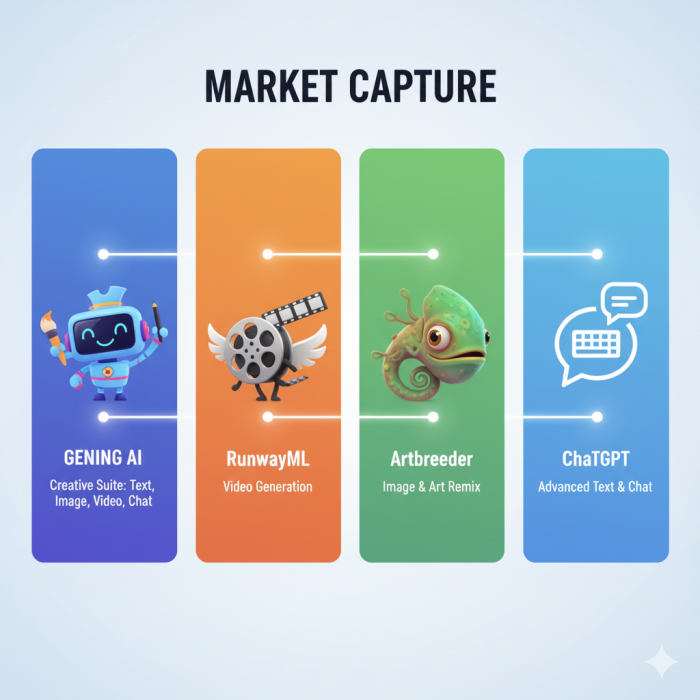
| Feature | Gening AI | RunwayML | Artbreeder | ChatGPT (OpenAI) |
|---|---|---|---|---|
| Primary Focus | Worlds & Stories | Video & Images | Art & Images | Text & Conversation |
| Visual Generation | Weak | Strong | Strong | None |
| No-Login Access | Yes | No | No | Yes |
| Mobile App | No | Yes | No | ✅Yes |
- Choose RunwayML if you need professional-grade video/image AI.
- Choose Artbreeder if your focus is digital art and character design.
- Choose ChatGPT for brainstorming, text generation, and conversations.
- Choose Gening AI if your priority is integrated world-building and storytelling.
Where Gening AI Falls Short
Despite its innovative approach to AI-assisted world-building, Gening AI still shows noticeable gaps when compared to more mature visual-first platforms. One of the most common criticisms is that, while its environmental design capabilities are strong, its character development often feels formulaic. Story arcs and personality layers can come across as predictable, especially in longer narrative sequences. For creators who need emotionally nuanced or highly distinctive characters, the output sometimes lacks the depth and variability required for professional-grade storytelling.
From a technical standpoint, performance becomes less consistent as project complexity increases. Users working on layered environments, multi-scene narratives, or heavy visual integrations report slower rendering times and occasional interface lag. This is particularly evident when combining detailed world-building prompts with character interactions and visual elements simultaneously. While basic projects run smoothly, more ambitious builds can strain the system, leading to delays that disrupt creative flow.
Another limitation is its comparatively narrower graphical asset library. When placed alongside visual-centric tools that specialize in cinematic rendering, motion control, or high-resolution avatar design, Gening AI’s visual outputs may appear less polished or less customizable. It focuses more on conceptual generation than high-end graphical refinement, which can be a drawback for creators seeking production-ready visuals.
There is ongoing discussion within the user community about anticipated updates that may address optimization and asset expansion. However, as of 2026, users should expect occasional slowdowns, moderate graphical limitations, and character outputs that may require manual refinement or supplemental tools to reach higher creative standards.
My Rating on Gening AI
Based on its current capabilities, performance consistency, creative flexibility, and pricing structure as of 2026, I would rate Gening AI 3.9 out of 5.
It earns strong marks for its imaginative world-building engine and its ability to interpret abstract prompts in a way that supports immersive storytelling. The platform clearly understands spatial narrative design and excels at helping creators construct environments quickly without excessive manual setup. For concept designers, indie storytellers, and experimental creators, this is a meaningful advantage.
However, the rating is moderated by a few persistent limitations. Character depth can feel repetitive over longer arcs, performance slows during complex multi-layer builds, and graphical refinement does not yet match more visually specialized competitors. Pricing also positions it slightly above what many freelancers may consider comfortable for its current output ceiling.
In short, Gening AI is a creatively promising platform with strong conceptual strengths, but it still requires optimization and refinement before it can compete at the very top tier of AI creative tools.
Final Thoughts: Overhyped or the Future of Creativity?

So, is Gening AI the future of creative tools or just another overhyped AI platform?
The truth lies in between. It pushes imagination further by turning ideas into detailed worlds, but it also shows the limits of current AI, generic outputs, weak visuals, and high costs.
The big question it raises isn’t whether AI can build worlds. It’s this:
If AI handles the creation, what unique stories will humans choose to tell within those worlds?
The real future of creativity isn’t about whether AI can build worlds. It’s about what we, as creators, choose to do with them. AI can provide the canvas, but only humans can paint the story that makes it unforgettable.
Post Comments
Be the first to post comment!
Related Articles