Most AI tools try to sound smart. Grubby AI tries to sound human, sometimes a little too hard. It lives in that grey zone between “useful writing helper” and “please don’t get me expelled,” promising to scrub AI fingerprints from your text so detectors like GPTZero and Originality.ai don’t scream “machine.” When you zoom out across features, pricing, detector tests, and user reviews, what you get is not a magic invisibility cloak, but a narrow, sometimes impressive, often inconsistent humanizer that only really makes sense if you know exactly what you’re asking it to do.
Start here: what problem is Grubby AI really solving?
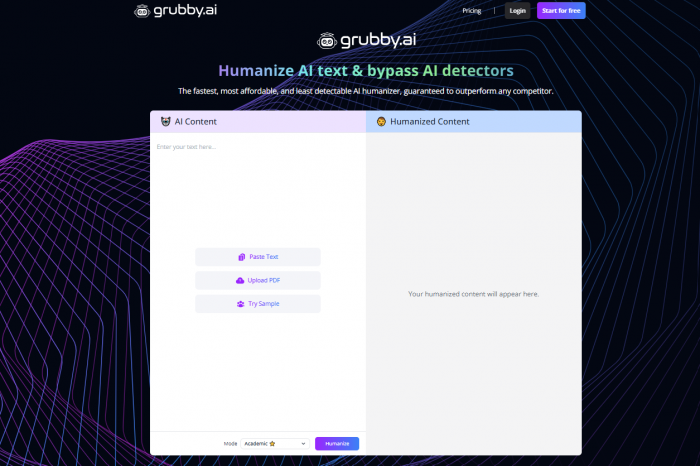
Strip away the landing‑page claims, and Grubby AI is basically a post‑processor for AI text. You’ve already used ChatGPT, Gemini, or another model; now you’re worried the output is too obviously machine‑written. Grubby steps in at that point, takes your AI draft, and tries to:
● Break predictable sentence patterns.
● Vary length, rhythm, and phrasing.
● Swap out overused tokens and connective phrases.
Its intended users are exactly the people caught in this tension: students who secretly write with AI, blog writers who don’t want their posts to feel robotic, agencies that push hundreds of AI‑assisted pieces a month and want them to “read human” at scale. Unlike full AI writing suites, Grubby doesn’t claim to brainstorm ideas or structure articles; it specializes in laundering the style of content that already exists.
If you think of the AI stack as: “Idea → Draft → Edit → Publish,” Grubby is deliberately camping in the “Draft → Edit” gap, not trying to do everything.
Inside the machine: how Grubby AI behaves with your text
Grubby’s interface is almost aggressively simple: a big text box, a dropdown of modes, a Humanize button, and a progress indicator.
The typical workflow is:
1. Paste a chunk of AI‑generated text.
2. Choose a mode (Simple/Standard/Enhanced, or more aggressive detector‑specific options on higher plans).
3. Hit Humanize, wait a few seconds, and read the rewrite.
Behind that, the engine does what you’d expect from an NLP‑heavy paraphraser: restructures sentences, introduces variation in clause ordering, changes word choices, and sometimes shifts emphasis to break the kind of uniform patterns detectors latch onto. On shorter, generic content think blog intros, product descriptions, casual email copy and this often works nicely: the text feels less “ChatGPT paragraph #324” and more like something a slightly rushed human might have written.
The fragile part is nuance. As content gets longer, more technical, or more tightly argued, users report exactly what you’d expect: occasional meaning drift, off‑tone sentences, and the need for careful human editing before you can safely hit publish or submit.
The headline feature: detector‑specific modes (and their reality check)
This is where Grubby tries to differentiate itself: it doesn’t just promise “more human‑sounding text,” it promises modes tuned for specific detectors like GPTZero, Originality.ai, ZeroGPT, and friends.
On paper, that’s clever:
● If your university uses GPTZero, you pick GPTZero mode.
● If your client uses Originality.ai, you pick Originality mode.
In practice, the results are much messier.
● One test took a 500‑word essay that GPTZero flagged as 95% AI and dropped it down to 12% AI after Grubby’s humanization, which is a huge shift in that specific scenario.

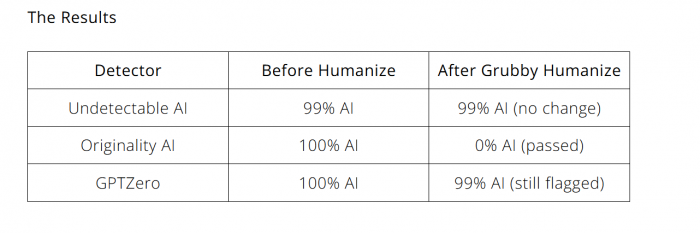
● Another test saw Originality.ai move from 100% AI to 0–1% AI after Grubby, while GPTZero stubbornly stayed at 99–100% AI on the same rewritten text.
● A broader benchmarking article concluded that Grubby’s “naturalness” averaged around 61–62%, with several detectors still reading 80–90% AI on many samples.
So yes, Grubby can sometimes turn a red flag into a green one but not consistently, and not across all detectors. GPTZero, in particular, appears much harder for Grubby to “fool” in independent testing.
Also worth noting: the modes that sound sexiest on the landing page, detector‑specific optimizations are usually not available on the free or very basic paid plans. They’re locked behind higher tiers, which matters once you step into pricing.
UX: fast, shallow, deliberately low‑friction
Grubby’s UX is built for people who don’t want a new hobby; they just want the AI to stop sounding like AI.
What you get:
● Minimal dashboard, simple onboarding, almost zero learning curve.
● Paste‑and‑go flow for short texts.
● Ability to rerun humanization if the first attempt still feels robotic.
What you don’t get:
● Deep tone sliders, multiple style presets, or rich editing tools like in big writing suites.
● A native research environment, SEO toolkit, or brainstorming modules.
For students or busy content writers, that trade‑off is often a feature, not a bug: there’s less to configure and more “get it done” speed. But if you’re used to premium AI writing ecosystems, Grubby feels very narrow by design.
Pricing: where the real value actually starts
On the surface, Grubby’s pricing looks familiar: freemium entry, then tiers based on word caps and features.

The free and low‑tier plans let you see how the engine behaves, but the thing Grubby promotes hardest detector‑specific humanization at scale only really exists on the mid/high tiers. That makes it more of a specialist tool for people who already know they need that, not a casual student toy.
Does Grubby actually “beat” AI detectors?
This is the question everyone asks, and the honest answer is: “sometimes, on some detectors, under some conditions.”
From published tests and user experiments:
● Originality.ai is where Grubby often looks strongest; there are documented cases of 100%‑AI texts dropping to 0–1% AI after processing.
● On GPTZero, results are far more disappointing: several reviewers saw little to no improvement (100% AI → 99% AI) after humanization, and some long‑form tests remained heavily flagged.
● On smaller detectors (ZeroGPT, Writer’s detector, etc.), Grubby sometimes does well, sometimes not—another sign that its patterns work better against some detection models than others.
It’s also important to note that Grubby’s own “detection” view inside the app tends to be more optimistic than third‑party detectors; multiple reviewers complain that the internal interface showed “100% human” while external tools still read the text as AI. That doesn’t automatically mean bad faith, but it does mean users shouldn’t treat Grubby’s internal meter as a source of truth.
Viewed coldly, Grubby isn’t an “off switch” for detection; it’s a probability‑shifter that can significantly help in certain narrow configurations and barely move the needle in others.
Output quality: more human, but not necessarily more you
If we ignore detectors for a moment and ask, “Is the writing actually better?”, the answer depends on what you start with.
Areas where Grubby tends to improve things:
● Breaks repetitive sentence patterns typical of raw LLM output.
● Adds slightly more conversational flow in marketing copy and blog‑style text.
● Helps remove obvious machine‑translation artifacts for multilingual users before they manually edit.
Where it struggles:
● Technical or academic writing where precise wording and argument structure matter.
● Longer essays where the engine has to manage coherence across many paragraphs; some users see bland phrasing, small factual distortions, or shifted emphasis.
So while Grubby often makes text more “human‑ish,” it doesn’t automatically make it more authentic to your voice. For writers who care about tone, you still have to come back with your own edits if you want the final piece to sound like you and not “generic internet person.”
Where it fits ethically: assistive layer vs “cheat code”
Lower‑risk, more defensible uses:
● Using it as a style smoother on AI‑drafted content you openly admit is AI‑assisted, then editing manually.
● Cleaning up multilingual or machine‑translated drafts before human review.
● Marketing workflows where the organization explicitly allows AI assistance as long as humans remain in the loop.
High‑risk or clearly problematic uses:
● Running entire essays through Grubby to hide AI authorship from university detectors.
● Masking AI‑generated content in journalism, medical, or legal contexts where readers and institutions expect transparent authorship.
Most serious reviewers now emphasize that institutions are not just punishing AI text, they’re increasingly punishing the intent to conceal AI use. Humanizers like Grubby don’t change that; they just raise the stakes if you get caught.
What real users actually say: the split screen
User sentiment around Grubby is sharply polarized, and that’s one of the most revealing datapoints you can show your readers.
The “this saved me” camp
On Trustpilot and Reddit, you’ll find people who genuinely like the tool:
● Some call it the “best humanizer on the market,” especially once they upgrade beyond the tiny 500‑word free limit and can use it regularly.
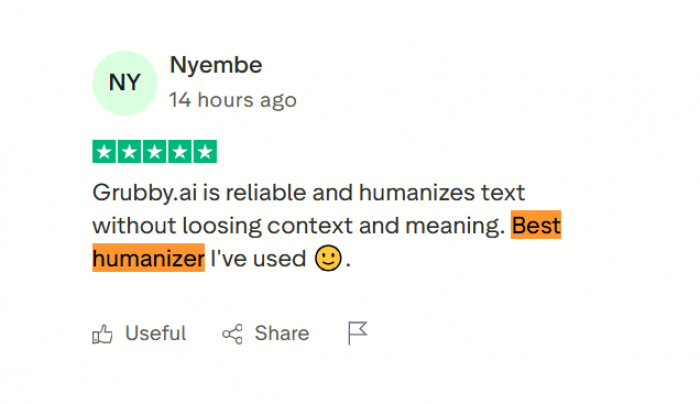
● Others praise it as “well worth the money” compared with other AI tools, saying it helps them clean up ChatGPT drafts as part of everyday writing.

● One Reddit thread where students debated humanizers includes multiple users rating Grubby around “8.5/10” and describing the price as “goated” relative to what they get from it. reddit
● A hands‑on reviewer from a tech publication described Enhanced mode transforming a 500‑word AI article into something “more natural and conversational” that could be used for blogs or emails with minimal adjustment.
These users are usually not expecting miracles; they want “good enough” humanization and are willing to keep editing afterward.
The “this is a scam” camp
Then there’s the other side of the wall:
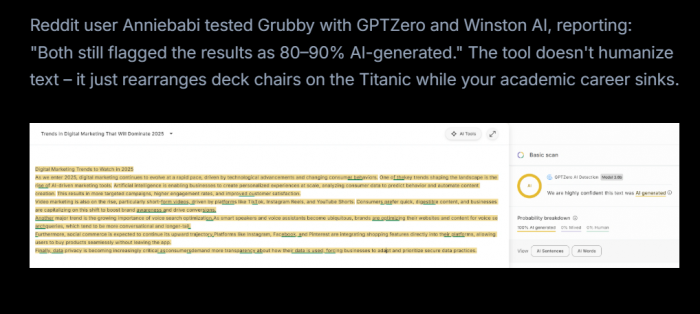
● Multiple Reddit users who tested Grubby against GPTZero, Winston AI, and other detectors reported that scores barely moved—80–90% AI before and after leading them to say it “doesn’t humanize text, it just rearranges deck chairs on the Titanic.”
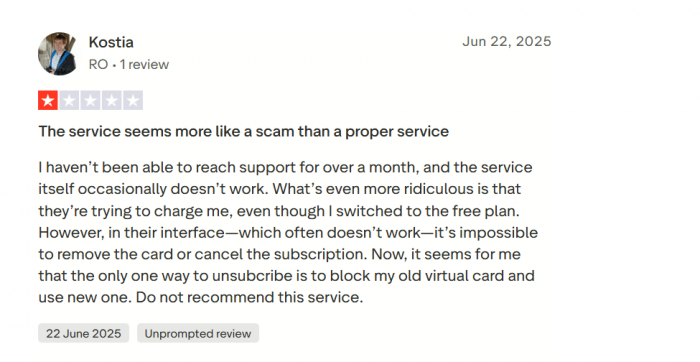
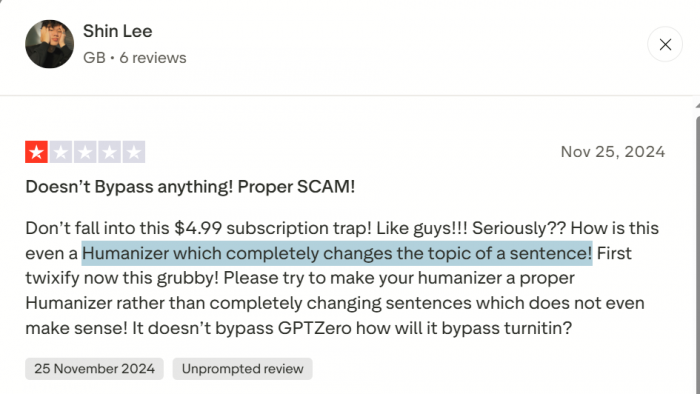
● Trustpilot contains harsh one‑star reviews calling it an “absolute scam,” complaining about “very poor quality” humanized content that “didn’t make sense” and alleging that promised refunds never materialized.
● Some reviewers note that Grubby “completely changes the topic of a sentence” or “changed the theme of humanised text,” echoing the meaning‑drift issues seen in technical use cases.
● Others mention reliability problems regions where the site didn’t work for weeks and no meaningful support response via the contact form.
The pattern behind the polarity
When you put these together, a pattern emerges:
● Users treating Grubby as a helper in a larger workflow often like it.
● Users treating Grubby as a guaranteed cheat code for detectors are usually angry.
● Users with strong support or refund expectations are more likely to write negative reviews when things go wrong.
That’s less about the UI and more about expectation management.
So where does Grubby sit in the AI tool landscape?
Grubby doesn’t compete head‑to‑head with big AI writing suites; it competes with other humanizers and with the built‑in “undetectable/humanize” switches those suites increasingly ship.
Compared with many of those:
● It’s visible, easy to test, and heavily talked about, which keeps it in “Top X humanizer” lists even when performance is mid‑pack.
● It rarely tops benchmark tables; several tests place it below newer or more sophisticated humanizers on average detection and quality scores.
● Pricing is neither the cheapest nor the most expensive; the real differentiator is the detector‑specific marketing, not pure value per word.
Quick comparison: Grubby AI vs similar tools
| Tool | Main focus | Key strength | Key concern |
| Grubby AI | AI humanizer with detector‑specific modes | Very simple to use; can strongly lower scores on some detectors like Originality.ai. | Inconsistent on GPTZero; mixed user reviews and tight limits on lower plans. |
| Undetectable AI | Humanizer + rewriting suite | Better overall rewrite quality and style options, part of a bigger writing toolkit. | Can be pricier; not always the best at strict detector bypass in tests. |
| StealthGPT | Aggressive bypass tool | Very strong undetectability in many community tests. | Narrow focus on bypass; higher ethical and policy risk, premium pricing. |
| HIX Bypass | Detector‑oriented humanizer | Multiple bypass modes, solid cross‑detector performance at competitive pricing. | Output can still feel mechanical without manual editing |
| QuillBot (Humanizer) | All‑in‑one paraphraser + humanizer | Trusted brand; combines paraphrasing, grammar and detection in one place.anangsha. | Humanizer is less specialized for bypass than dedicated tools.anangsha. |
For someone who already has a full AI writer, Grubby is an add‑on, not a replacement. For someone who only cares about humanization and nothing else, it’s one of a handful of candidates and a very noisy one in terms of reputation.
The honest fit test: who should consider Grubby AI?
If you want your review to actually help readers decide, you can anchor it around a simple fit test.
Grubby AI is a maybe for you if:
● You run a lot of AI‑assisted content and want a quick, one‑click humanization pass before your own edits.
● Your main detection threat is something like Originality.ai, where Grubby has shown strong wins in some tests.
● You’re okay with variability—sometimes it works brilliantly, sometimes it doesn’t—and you’ll always reread and revise.
Grubby AI is likely a no if:
● Your university or employer leans heavily on GPTZero and similar tools, and you’re hoping for zero‑risk invisibility.
● You need tightly controlled, high‑stakes writing where meaning cannot drift and policies are strict about AI concealment.
● You want a full content stack research, outline, draft, edit, SEO—in one place rather than bolting on an extra humanization tool.
Final take: a sharp tool, not a safety net
If you frame Grubby AI as a sharp but narrow tool, a way to disrupt obvious AI patterns in text you fully intend to edit and own, it can absolutely earn a place in a writer’s toolkit. Treat it as a safety net that will carry your essays past every detector and policy, and it quickly becomes a liability: inconsistent across platforms, sometimes over‑optimistic in its own detection view, and surrounded by polarized user experiences.
Grubby won’t magically make AI text invisible, but in the hands of someone who knows its limits and is willing to do the real writing work, it can make machine‑generated drafts sound a little less like machines and a little more like people.
Post Comments
Be the first to post comment!




Table of Content
- Start here: what problem is Grubby AI really solving?
- Inside the machine: how Grubby AI behaves with your text
- The headline feature: detector‑specific modes (and their reality check)
- UX: fast, shallow, deliberately low‑friction
- Pricing: where the real value actually starts
- Does Grubby actually “beat” AI detectors?
- Output quality: more human, but not necessarily more you
- Where it fits ethically: assistive layer vs “cheat code”
- What real users actually say: the split screen
- So where does Grubby sit in the AI tool landscape?
- The honest fit test: who should consider Grubby AI?
- Final take: a sharp tool, not a safety net