Table of Content
- What Continuous Feedback Really Means
- Why Organizations Are Moving Away From Annual Reviews
- Core Benefits of a Continuous Feedback Culture
- Continuous Feedback Versus Traditional Reviews
- How Performance Management Tools Support Continuous Feedback
- Steps to Building a Sustainable Continuous Feedback Culture
- Best Performance Management Tools for Continuous Feedback
- Real-World Examples of Continuous Feedback in Practice
- Challenges Organizations Encounter
- How to Measure Success
- Conclusion
Organizations are rethinking how performance is managed. Annual reviews, once considered a standard practice, are increasingly viewed as disconnected from how work actually happens. Teams move faster, roles evolve continuously, and expectations shift throughout the year. In this environment, delayed feedback often creates confusion rather than clarity.
A continuous feedback culture responds to this reality. It replaces isolated evaluations with ongoing conversations supported by performance management tools that make feedback timely, visible, and actionable. When implemented correctly, this approach strengthens engagement, improves alignment, and reduces the anxiety traditionally associated with performance reviews.
What Continuous Feedback Really Means

Continuous feedback is not about constant evaluation. It is about regular, purposeful communication tied to work as it happens. Feedback is shared close to events, projects, or decisions, allowing employees to adjust quickly rather than reflect months later.
Unlike traditional reviews, continuous feedback emphasizes two-way dialogue. Employees are encouraged to ask for input, clarify expectations, and share obstacles. Managers shift from judges to coaches, focusing on development rather than retrospective scoring.
Most effective models keep feedback lightweight. Frameworks such as progress, priorities, and problems help structure conversations without turning them into formal assessments. The goal is clarity, not documentation for its own sake.
Why Organizations Are Moving Away From Annual Reviews

Traditional performance reviews often suffer from predictable flaws. Feedback arrives too late to influence behavior. Evaluations are shaped by recency bias rather than consistent observation. Employees are surprised by ratings that do not reflect their understanding of their own performance.
Continuous feedback addresses these gaps by normalizing smaller, frequent conversations. Research shows that employees who receive regular feedback report higher motivation and stronger trust in performance systems. Expectations are clearer, and course correction happens earlier.
This shift also reflects how people work today. Cross-functional projects, remote collaboration, and agile teams require faster alignment than annual cycles can provide.
Core Benefits of a Continuous Feedback Culture
Faster Skill Development
When feedback is timely, employees can apply it immediately. Software engineers adjust code quality based on recent reviews. Sales teams refine messaging after live calls. Learning becomes iterative rather than delayed.
This accelerates growth without formal training programs for every adjustment.
Higher Engagement and Retention
Employees who receive consistent input feel seen and supported. They understand how their work connects to broader goals and where improvement is expected. This clarity reduces frustration and disengagement.
Organizations that prioritize ongoing feedback report higher engagement scores and lower voluntary turnover.
Reduced Performance Anxiety
Infrequent reviews often create pressure because too much weight is placed on a single conversation. Continuous feedback spreads that weight across many smaller interactions.
Employees know where they stand throughout the year, which lowers stress and improves confidence.
Stronger Alignment With Business Goals
When feedback is linked to goals, priorities stay visible. Employees adjust their focus as objectives evolve, keeping individual effort aligned with organizational direction.
This alignment supports productivity and adaptability in fast-changing environments.
Continuous Feedback Versus Traditional Reviews
Continuous feedback differs fundamentally from traditional performance systems. The distinction is not just frequency, but intent.
Continuous systems emphasize growth, coaching, and collaboration, while traditional reviews focus on evaluation and scoring. Communication flows in both directions rather than top down. Adjustments happen in real time instead of after the fact.
This difference changes how performance conversations feel and how seriously employees engage with them.
How Performance Management Tools Support Continuous Feedback

Technology plays a supporting role rather than a controlling one. Performance management tools make feedback easier to share, track, and revisit without formalizing every interaction.
Common capabilities include real-time feedback notes, peer input requests, goal tracking, and analytics that surface patterns over time. Some tools use AI to summarize themes or reduce bias by highlighting inconsistencies.
The most effective tools integrate into daily workflows rather than sitting apart as administrative systems.
Steps to Building a Sustainable Continuous Feedback Culture
Start With Clear Communication
Organizations must explain why the shift is happening and what will change. Workshops, leadership messaging, and open forums help build understanding and reduce resistance.
Employees need reassurance that feedback is meant to support growth, not surveillance.
Audit Existing Feedback Practices
Surveys and interviews help identify gaps in current processes. Many organizations already give feedback informally but lack structure or consistency.
Understanding what already works prevents unnecessary reinvention.
Define Clear Objectives
Feedback systems should support specific outcomes such as goal alignment, skill development, or engagement. Clear objectives guide tool selection and process design.
Without direction, feedback becomes noise.
Train Managers and Employees
Managers need guidance on delivering constructive feedback. Employees need support in receiving and acting on it. Shared models such as situation, behavior, and impact help keep conversations objective.
Training reduces fear and improves quality.
Pilot and Scale Gradually
Small pilots allow teams to test tools and routines before organization-wide rollout. Feedback from early adopters helps refine the approach.
Scaling works best when supported by visible leadership participation.
Best Performance Management Tools for Continuous Feedback
Rather than listing vendors exhaustively, it is more useful to understand tool categories and how they support feedback culture.
Performance Management Platforms
Rather than listing tools exhaustively, it is more useful to examine a small number of widely adopted platforms that are commonly used to support continuous feedback practices. The tools below are selected based on consistent use in 2025, breadth of features, and alignment with ongoing feedback rather than annual review cycles.
1. 15Five

15Five is designed around the idea of frequent check-ins between employees and managers. Its core workflow encourages weekly or biweekly updates where employees reflect on progress, challenges, and priorities. Managers respond with guidance, recognition, or clarification, creating a steady rhythm of dialogue.
The platform supports goal tracking and lightweight performance insights, which helps teams identify trends over time without turning feedback into a rigid scoring exercise. AI-assisted summaries are used mainly to surface themes and reduce repetition, not to replace managerial judgment.
15Five is commonly used by small to mid-sized teams that want to normalize feedback habits without adding heavy administrative overhead.
2. Lattice

Lattice offers a more structured approach to continuous feedback, combining peer feedback, manager input, engagement surveys, and goal alignment in one system. Employees can request feedback at any time, and managers can provide input tied directly to objectives or competencies.
The tool is often used in organizations that want feedback to connect clearly to OKRs and performance expectations. Its analytics help HR and leadership teams identify participation patterns and engagement trends across departments.
Lattice places emphasis on consistency and visibility, which can be useful in larger organizations where informal feedback may otherwise be uneven or siloed.
3. Leapsome
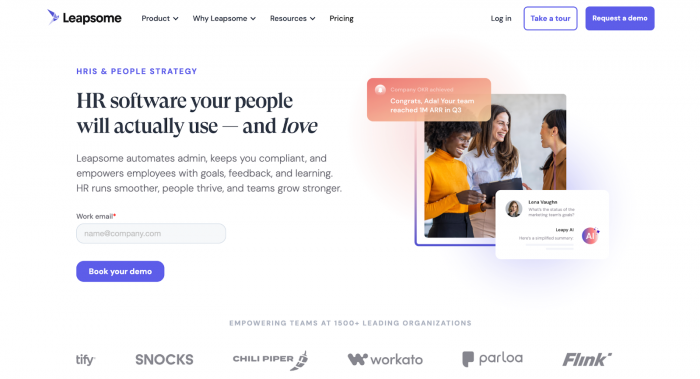
Leapsome integrates continuous feedback with learning and development. In addition to regular check-ins and 360-degree feedback, it allows organizations to link feedback directly to skills, competencies, and growth paths.
The platform supports structured feedback cycles while still enabling ongoing, informal input. This makes it suitable for teams that want feedback to feed directly into development planning rather than existing as standalone conversations.
Leapsome is often adopted by organizations that want a tighter connection between feedback, performance improvement, and employee development over time.
Real-World Examples of Continuous Feedback in Practice
Adobe replaced annual reviews with regular check-ins focused on goals, growth, and career conversations. Managers and employees use dashboards to track progress without formal ratings.
Netflix emphasizes candid, face-to-face feedback guided by principles of assistance and appreciation. Feedback is expected, direct, and framed as support rather than critique.
Smaller teams report similar outcomes. Organizations that introduced peer feedback sessions saw improved collaboration and faster project delivery due to early issue resolution.
Challenges Organizations Encounter
Cultural resistance is common. Some employees fear constant scrutiny, while managers worry about time demands. Clear guidelines on frequency and intent help prevent overload.
Technology adoption can also be challenging. Tools must integrate smoothly and remain easy to use. Poor adoption often reflects unclear purpose rather than tool limitations.
Organizations that address these issues openly see higher participation and better outcomes.
How to Measure Success
Metrics should focus on behavior and outcomes rather than volume alone. Useful indicators include feedback frequency, participation rates, engagement scores, retention trends, and goal completion rates.
Qualitative feedback matters as much as quantitative data. Conversations about how feedback feels are essential to refining the system.
Conclusion
Building a continuous feedback culture is less about tools and more about mindset. Performance management tools provide structure and visibility, but culture is shaped by how feedback is given, received, and acted upon.
Organizations that succeed treat feedback as a shared responsibility rather than a managerial task. They prioritize clarity, trust, and learning over scoring and judgment.
In a work environment defined by constant change, continuous feedback offers stability through communication. When supported by thoughtful tools and consistent leadership behavior, it becomes a foundation for sustained performance and growth.
Post Comments
Be the first to post comment!