Review websites influence modern buying decisions more than advertisements ever could. Before purchasing software, adopting an AI platform, or trusting a financial tool, most professionals now scan reviews. The challenge is that not every review website deserves that trust.
Some platforms operate with strong editorial integrity. Others quietly prioritize affiliate revenue, paid placements, or undisclosed sponsorships. A polished interface and confident tone can easily create the illusion of authority.
In 2026, verifying the credibility of a review website is no longer optional. It is a core part of digital due diligence. This guide provides a structured, tool-backed framework to help you evaluate whether a review platform is genuinely trustworthy.
Why Review Website Verification Matters
A review site can appear professional while still being biased or misleading. The risk is rarely obvious malware. More often, the danger is subtle distortion.
Common credibility risks include:
- Affiliate-driven rankings disguised as neutral reviews
- Paid placements presented as organic recommendations
- Fabricated testimonials or recycled content
- Anonymous ownership structures
- Sudden domain rebrands posing as long-term authorities
Blind trust can lead to poor software decisions, vendor regret, wasted budgets, or exposure to unreliable tools.
The goal is not skepticism for its own sake. The goal is informed trust backed by evidence.
The Modern Verification Mindset
High-performing buyers no longer rely on a single signal. Instead, they look for pattern consistency across multiple indicators.
A legitimate review website typically shows:
- Transparent ownership
- Consistent historical presence
- Reasonable trust score
- Real user discussion trails
- Balanced editorial tone
- Technical security hygiene
One positive signal proves little. Multiple aligned signals build confidence.
12 Trusted Tools to Evaluate Review Website Legitimacy
Below is a structured toolkit used by experienced SaaS buyers, marketers, founders, and procurement teams.
1. ICANN Lookup
Best for: Domain registration verification
ICANN Lookup is one of the most reliable starting points when assessing any review website. It shows when the domain was registered and where it is managed.
What to check
Domain creation date
- Registrar details
- Nameserver consistency
- Domain status
Why it matters
If a website claims “10 years of industry authority” but the domain was registered six months ago, that mismatch deserves scrutiny.
Pro tip
Longevity alone does not guarantee trust. But false longevity claims are a strong red flag.
2. Whois.com
Best for: Ownership transparency signals
Whois.com complements ICANN by sometimes revealing additional ownership patterns.
Key signals
- Hidden vs visible ownership
- Frequent registrar changes
- Recently transferred domains
- Bulk-registered networks
Interpretation guidance
Privacy protection is common and not automatically suspicious. However, when combined with aggressive affiliate behavior and thin content, hidden ownership becomes more concerning.
3. ScamAdviser
Best for: Automated risk scoring
ScamAdviser evaluates websites using behavioral and technical signals to produce a trust score.
What it analyzes
- Hosting environment
- Server reputation
- Domain age
- Malware associations
- Traffic patterns
How to use it properly
Do not treat the score as absolute truth. Instead, treat it as risk probability.
What to watch for
- Very low trust scores
- Recently flagged domains
- High-risk hosting clusters
Consistency across multiple trust tools matters more than any single rating.
4. Scam Detector
Best for: Secondary reputation validation
Scam Detector provides another independent algorithmic assessment. Running both ScamAdviser and Scam Detector helps identify pattern alignment.
Why this matters
If multiple automated systems flag the same domain, deeper investigation is justified.
Use case
- Quick credibility screening
- Cross-checking suspicious sites
- Early-stage filtering
5. SimilarWeb
Best for: Traffic reality checks
Authority claims should align with real audience behavior. SimilarWeb estimates traffic volume and engagement trends.
Key metrics
- Monthly visits
- Traffic trends over time
- Geographic distribution
- Bounce behavior
Red flag scenario
A site claiming to be a “leading global review authority” but showing minimal traffic may be overstating its influence.
Important nuance
Low traffic does not automatically mean low credibility. Niche platforms can be legitimate. The key is consistency between claims and data.
6. Semrush
Best for: SEO footprint and authority signals
Semrush provides deeper insight into search visibility and domain authority patterns.
What to examine
- Organic keyword footprint
- Backlink profile
- Traffic growth stability
- Authority score
Why it matters
Established review platforms typically show:
- Gradual traffic growth
- Diverse backlink sources
- Category keyword coverage
Sudden spikes or extremely thin keyword coverage may indicate a newer or less established platform.
7. Wayback Machine (Archive.org)
Best for: Historical consistency checks
The Wayback Machine is one of the most powerful credibility tools available.
What it reveals
- When the site first appeared
- Previous site themes
- Rebranding history
- Content evolution
High-value insight
If a domain previously hosted unrelated content (for example, gambling or generic blogs) and suddenly rebranded as a software authority, that transition deserves scrutiny.
Professional tip
Check multiple historical snapshots, not just one.
8. VirusTotal
Best for: Malware and security scanning
Before trusting any review site, confirm it is technically safe.
VirusTotal aggregates results from dozens of security engines.
What to look for
- Malware flags
- Suspicious scripts
- Blacklist presence
Important context
Technical safety does not guarantee editorial integrity. But technical risk is an immediate disqualifier.
9. Google Safe Browsing
Best for: Phishing and threat detection
Google’s Safe Browsing check helps confirm whether a site has been flagged for harmful behavior.
Why this matters
If Google has flagged the domain, proceed with extreme caution.
This is a quick but essential hygiene step.
10. Sucuri SiteCheck
Best for: Website security posture
Sucuri scans for:
- Malware injections
- Blacklisting
- spam injections
- defacement signals
For review websites, this helps confirm the platform is not compromised or operating in a risky hosting environment.
11. Trustpilot, Reddit, and Sitejabber (Public Sentiment Check)
Best for: Meta-reputation analysis
A legitimate review platform should itself have a reputation footprint.
Search the review site’s name across:
- Trustpilot
- GeniusFirms
- Appcritica
What to focus on
Not isolated complaints, but repeat patterns such as:
- Paid ranking accusations
- undisclosed sponsorship claims
- fake review allegations
- biased comparison concerns
Pattern repetition is far more meaningful than individual criticism.
12. Advanced Google Search Operators
Best for: Hidden signal discovery
Sometimes the simplest tools surface the strongest insights.
High-value search queries
- "Website Name" + scam
- "Website Name" + fake reviews
- "Website Name" + controversy
- site:domain.com “sponsored”
- site:domain.com “affiliate”
Why this works
These searches often uncover:
- forum discussions
- legal disputes
- disclosure pages
- user complaints
- investigative blog posts
This step frequently reveals signals that automated tools miss.
Behavioral Red Flags You Can Spot Without Tools
Even before running tools, experienced evaluators watch for editorial patterns.
A review website may require caution if it:
- Publishes only extremely positive reviews
- Ranks the same vendors repeatedly across categories
- Uses aggressive “Buy Now” affiliate buttons
- Shows identical writing tone across multiple authors
- Lacks meaningful product criticism
- Uses stock-photo testimonials with generic names
- Provides vague or missing ownership information
Legitimate review platforms usually demonstrate balanced critique and consistent editorial voice.
A Practical Step-by-Step Verification Workflow
To avoid random checking, follow this professional sequence.
Step 1: Domain Reality Check
- ICANN Lookup
- Whois.com
Confirm the site’s age and ownership signals.
Step 2: Automated Risk Scan
- ScamAdviser
- Scam Detector
Look for major risk flags.
Step 3: Authority and Traffic Validation
- SimilarWeb
- Semrush
Check whether influence claims match real visibility.
Step 4: Historical Consistency
- Wayback Machine
Verify the site’s evolution matches its authority narrative.
Step 5: Technical Safety
- VirusTotal
- Google Safe Browsing
- Sucuri SiteCheck
Confirm the site is technically clean.
Step 6: Public Reputation Cross-Check
- Trustpilot
- GeniusFirms
- Techsuggest
Look for repeated transparency concerns.
Step 7: Editorial Transparency Review
Manually inspect:
- About page
- disclosure statements
- author profiles
- contact details
If multiple signals align positively, the site is likely credible. If several concerns cluster together, caution is warranted.
How Professional Teams Apply This in 2026
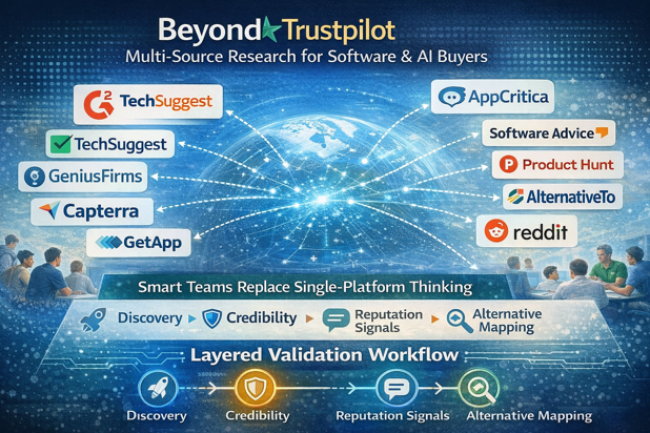
Modern SaaS buyers rarely rely on one review platform. Instead, they build layered validation workflows.
A typical mature process looks like this:
1. Discovery on curated directories
2. Credibility validation via review marketplaces
3. Reputation cross-check via community sources
4. Competitive mapping via alternative tools
5. Final validation through controlled product pilots
This multi-angle approach dramatically reduces costly software mistakes.
Final Perspective
In today’s AI-accelerated market, evaluating review websites is as important as evaluating the products they rank. A polished interface does not equal authority. Confident rankings do not guarantee neutrality. Affiliate-heavy environments can quietly distort buyer perception.
The most reliable approach is pattern-based verification across ownership data, technical safety, historical consistency, traffic reality, and public sentiment.
The goal is not paranoia. The goal is structured, evidence-backed trust.
A review website that survives scrutiny across these layers is far more likely to deserve attention. Teams that adopt this disciplined validation mindset consistently make better software decisions, avoid expensive vendor regret, and build more resilient technology stacks.
In 2026 and beyond, that discipline is no longer optional. It is a competitive advantage that compounds over time.
Post Comments
Be the first to post comment!
Related Articles