Table of Content
- Domain History and Ownership Reality
- Claimed Identity vs Observable Reality
- Blog or Tool-Based Platform? Structural Clarification
- Content Quality and Editorial Standards
- About Us Page: Surface-Level Disclosure
- Contact Information and Communication Channels
- Social Media and Brand Presence
- Author Attribution and Accountability
- Reviews, Reputation, and Third-Party Validation
- Final Verdict: What KongoTech.org Really Is
At first glance, KongoTech.org appears to be a standard technology and digital marketing blog. The website features categories such as social media tips, organic growth strategies, technology updates, and general blogging content. On the surface, this positioning aligns with hundreds of independent tech blogs operating today.

However, when examined beyond surface-level design and navigation, KongoTech.org exhibits multiple characteristics that raise questions about its authenticity, editorial integrity, and long-term credibility. These concerns are not based on opinion alone but on verifiable patterns commonly associated with expired domain repurposing and traffic-monetization networks.
This article presents a full, structured investigation into KongoTech.org, separating claims from verifiable facts, and evaluating the site against modern trust, transparency, and publishing standards.
Domain History and Ownership Reality
Domain Lifecycle and Repurposing Patterns
KongoTech.org shows strong indicators of having undergone ownership transition after domain expiration. This is a common practice where expired domains with existing backlinks, age, or residual authority are acquired and reused for entirely different purposes.
Key observations include:
- No publicly accessible continuity between earlier versions of the domain and the current site
- Sudden appearance of broad, unrelated content categories
- Absence of historical branding consistency
In legitimate publications, domain evolution is typically documented through archived content, team continuity, or public announcements. None of these are present here.
Ownership Transparency
The domain’s registration details are fully masked using privacy protection services. While privacy protection alone is not suspicious, it becomes problematic when combined with:
- No disclosed company name
- No legal entity identification
- No accountable editorial leadership
In credible media operations, anonymity at every level is extremely rare, especially when the site solicits partnerships, advertising, and guest content.
Claimed Identity vs Observable Reality
What KongoTech.org Claims
Based on its navigation menus, footer text, and About Us section, KongoTech.org positions itself as:
- A technology information website
- A source of social media growth and blogging tips
- A platform open to writers and brand partnerships
These claims imply editorial responsibility, subject matter expertise, and long-term intent.
What the Site Actually Demonstrates
When analyzed objectively, the site functions less like a focused publication and more like a multi-topic traffic capture platform. The content structure does not reflect a coherent editorial vision or audience persona.
Instead of depth within a niche, the site prioritizes breadth, a known tactic for maximizing search impressions rather than serving a defined readership.
Blog or Tool-Based Platform? Structural Clarification
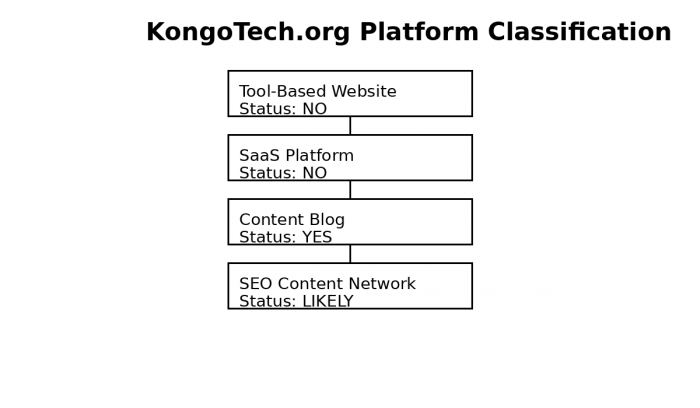
Not a Tool-Based Website
KongoTech.org does not provide:
- Proprietary software tools
- Online utilities
- Dashboards or SaaS features
- Product documentation or changelogs
There is no evidence of in-house product development or technical infrastructure beyond basic WordPress publishing.
Blog-Style Content, But Without Editorial Discipline
Although it technically qualifies as a blog, it lacks essential attributes of a professional blogging platform:
- No recurring author voices
- No topic specialization
- No editorial calendar or thematic consistency
This hybrid structure is typical of SEO-first content networks, not reader-first publications.
Content Quality and Editorial Standards
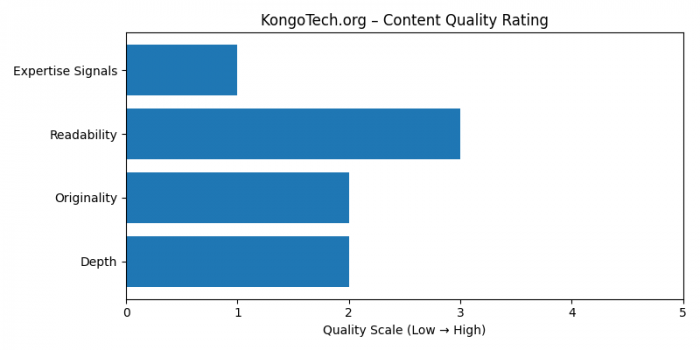
An evaluation of the writing quality on KongoTech.org reveals consistent structural patterns across many of its articles. The content often opens with broad, generic introductions that restate the topic in simple terms without offering a distinctive hook or perspective. Sentence construction tends to be repetitive, and explanations of complex subjects are typically surface-level rather than deeply analytical. Instead of unpacking technical nuances or providing layered breakdowns, the articles frequently summarize commonly available information. This creates the impression that many pieces follow templated outlines, potentially pointing to automated or semi-automated production methods rather than deeply researched editorial workflows.
Another notable gap is the absence of clear expertise signals. High-trust digital publications usually demonstrate credibility through first-hand experience, case studies, proprietary screenshots, data-backed insights, or detailed testing results. They also provide transparent author attribution, including professional background or subject-matter credentials. On KongoTech.org, these trust markers are largely missing. Articles tend to read like general summaries compiled from widely available sources rather than informed, experience-driven analysis. While this does not automatically make the information incorrect, it significantly weakens perceived authority and reduces overall editorial credibility for readers seeking reliable, expert-level guidance.
About Us Page: Surface-Level Disclosure
What the Page Contains
The About Us section provides a short, generic description stating that the site covers technology, finance, gaming, lifestyle, and health topics. It also encourages users to write for the platform.
What Is Missing
- Critically absent information includes:
- Founder or owner identity
- Editorial team details
- Company registration
- Mission or editorial philosophy
- Content review or quality standards
This level of vagueness prevents readers from understanding who is responsible for the content and why the site exists beyond monetization.
Contact Information and Communication Channels
Listed Contact Methods
KongoTech.org lists:
- A Gmail email address
- A WhatsApp contact number
Professional Assessment
For a site presenting itself as a tech publication, this setup is inadequate. Legitimate operations usually provide:
- Domain-based email addresses
- Support or editorial contact forms
- Physical mailing addresses
- Clear business communication channels
Relying solely on Gmail and WhatsApp is more typical of affiliate marketers or short-term SEO operators than established media entities.
Social Media and Brand Presence
A legitimate and growth-focused technology publication typically invests in building a visible digital footprint beyond its website. This usually includes active and verifiable social media profiles on platforms such as X, LinkedIn, Facebook, or YouTube, where content updates are shared and audience interaction takes place. Established blogs also tend to link articles to identifiable author profiles, often connected to professional networks or portfolios. These signals help demonstrate transparency, ongoing engagement, and a long-term commitment to audience building rather than short-term traffic acquisition.
In the case of KongoTech.org, these brand-building indicators appear largely absent. There are no clearly verified or consistently active social media accounts directly associated with the site. There is also no visible follower community, comment ecosystem, or meaningful engagement loop that suggests sustained audience interaction. Additionally, articles do not appear to link back to identifiable author profiles or professional networks that would reinforce expertise and accountability.
This lack of external presence does not automatically imply malicious intent, but it does suggest that the platform may not be focused on cultivating long-term brand credibility or community trust. Instead, it appears to operate primarily as a standalone content site without the broader ecosystem typically associated with reputable, audience-driven tech publications.
Footer Links and External Associations
Outbound Link Analysis
The footer contains an unusually large number of external links, many of which:
- Are unrelated to technology
- Reference betting, gambling, or affiliate-heavy topics
- Appear in multiple foreign languages
Why This Matters
This pattern suggests:
- Paid link insertion
- Affiliate arbitrage
- SEO link farming
Such practices directly conflict with modern quality guidelines for editorial integrity and user trust.
Author Attribution and Accountability
Author Presence
Most articles lack:
- Named authors
- Author bios
- Credentials or experience references
In cases where names appear, there are no linked profiles or professional verification.
Impact on Trust
Without author accountability, readers cannot evaluate:
- Expertise
- Bias
- Accuracy
- Responsibility for errors
This severely weakens the site’s trustworthiness.
Reviews, Reputation, and Third-Party Validation
Independent Mentions
KongoTech.org has:
- No meaningful presence on review platforms
- No citations from reputable publications
- No organic discussions on forums or social platforms
Traffic Behavior Insights
Available analytics data suggests traffic is primarily search-driven, with little evidence of repeat visitors or brand loyalty. This is typical of SEO-driven properties rather than trusted resources.
User Risk Assessment
Potential Risks
Users interacting with such sites may encounter:
- Misleading download links
- Aggressive advertising
- Affiliate redirects
- Low-quality or outdated information
While the site may not directly distribute malware, the ecosystem it participates in carries elevated risk.
Final Verdict: What KongoTech.org Really Is
KongoTech.org is best described as:
- A repurposed expired domain
- Operated anonymously
- Focused on traffic acquisition rather than editorial value
- Monetized through aggressive outbound linking and affiliate content
It is not a scam in the legal sense, but it is also not a reliable or authoritative technology publication.
Who Should Avoid Using KongoTech.org
- Readers seeking expert or professional guidance
- Businesses looking for brand-safe advertising
- Contributors expecting editorial credibility
- Users downloading software or following technical instructions
Conclusion
KongoTech.org exemplifies a broader trend in modern SEO where aged domains are revived solely to capitalize on residual authority. While such sites may rank temporarily, they do not provide lasting value to users and often fail long-term trust evaluations.
For readers and businesses prioritizing credibility, transparency, and expertise, KongoTech.org does not meet the standards expected of a legitimate technology publication.
Post Comments
Be the first to post comment!
Related Articles