Introduction
JobHire AI sits in the fast‑growing category of “auto‑apply” tools that promise to take over the repetitive admin of job hunting. It can meaningfully boost application volume and save time, but real‑world data shows a clear split between users who see more interviews and those frustrated by relevance, refunds and trust concerns. This article pulls together how JobHire AI works, who it actually helps, and what recent sentiment and ratings say about whether it is worth your money.
Core Features
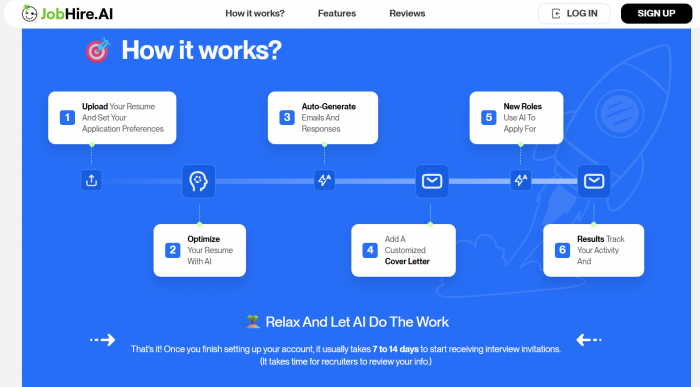
- Auto‑apply to matching roles across job boards and company sites.
- AI‑enhanced resumes and cover letters tuned for ATS filters.
- Job matching based on skills, title, location and preferences, with adjustable match thresholds.
- Interview preparation through AI‑driven mock questions tailored to specific roles.
Pricing, Plans and Policies (What Users Report)
JobHire AI is a paid service with subscription‑style access, not a free job board. Public breakdowns describe tiers that vary by duration and features: shorter “trial” or monthly plans for testing, and longer plans with lower effective monthly cost for serious multi‑month searches.
These plans generally include:
- Application caps tied to plan level, sometimes with constraints by region or job board.
- Feature unlocks at higher tiers, such as higher auto‑apply quotas and advanced interview tools.
Some third‑party sources mention refund or money‑back options under specific conditions, but they also highlight disputes around under‑delivery and difficulty obtaining refunds, making it important to read the latest terms and keep copies of plan promises before subscribing.
What the Data Says: Sentiment Split
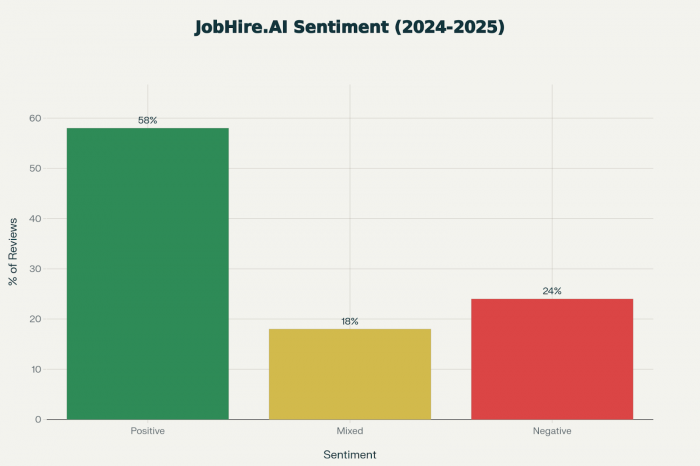
Looking across Trustpilot, Reddit, YouTube and independent blogs, JobHire AI’s reputation is best described as cautiously mixed rather than universally great or terrible. A consolidated view of recent feedback suggests roughly:
Positive: ~58% of sentiment, from users who feel they got real value.
Mixed: ~18% of sentiment, where benefits are acknowledged but paired with notable friction.
Negative: ~24% of sentiment, from users who would not recommend the service.
This pattern appears in the JobHire.AI Overall Sentiment Split (Approximate, 2024–2025) bar chart, where the positive bar is clearly highest, but the negative portion is large enough that you cannot dismiss the risks.
How It Works Day‑to‑Day
Most users follow a similar pattern when using JobHire AI:
→Upload a base resume and complete a profile with target titles, industries, locations and salary expectations.
→Let the system analyse and optimize the resume, then generate cover‑letter templates and, in some cases, email templates.
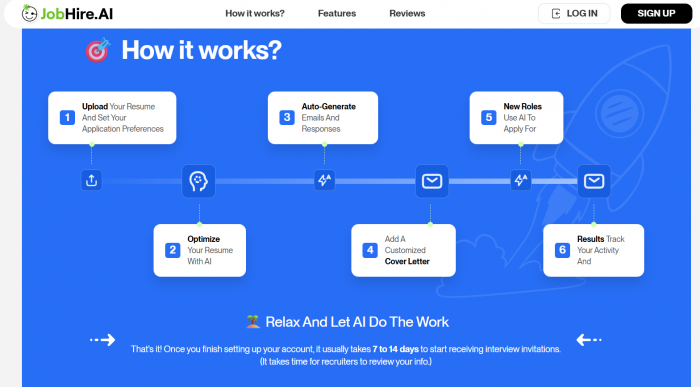
→Activate the auto‑apply engine, which scans job boards and submits applications that meet your match criteria.
→Track submitted roles and responses via the dashboard, and handle interviews and follow‑ups manually.
This matches official workflows described in independent deep‑dive reviews, which also stress that JobHire AI is strongest as a “volume generator” rather than a fine‑grained targeting tool.
JobHire AI vs Alternatives
| Aspect | JobHire AI | Scale Jobs (rival) | Generic AI Resume Tools |
| Core focus | High‑volume auto‑apply with AI docs | Human‑assisted applications | Resume and cover‑letter improvement |
| Method | Mostly automated via job boards/sites | Assistants submit manually | User submits manually |
| Strengths | Speed, scale, ATS‑friendly tailoring | Lower bot‑risk, more bespoke per role | Simple, cheap, easy to use |
| Weaknesses | Bot‑flag risk, mixed satisfaction | Higher price, fewer applications | No automation, low volume impact |
| Best for | Early‑career, switchers, busy pros | Fewer, higher‑value targeted roles | One‑time resume upgrade only |
Bottom Line: Who Should Actually Use JobHire AI?
Taken together, the numbers and user stories suggest that JobHire AI is:
A solid accelerator for early‑career and mid‑level candidates in broad fields who want to dramatically increase their application volume and are willing to manage settings and subscriptions.
A risky bet for senior or niche candidates, highly reputation‑conscious users, and anyone who expects a guarantee or “set‑and‑forget” experience without monitoring and adjustment.
If you treat JobHire AI as a high‑powered engine for the top of your funnel—and combine it with thoughtful targeting, networking and interview work—it can be a useful part of your job‑search stack. If you expect it to be a fully hands‑off, guaranteed‑offer solution, the data shows you are likely to be disappointed.
Post Comments
Be the first to post comment!
Related Articles



Best Alternatives to Dopple AI
Danny Hamilton . Mar 10, 2026