Studying today is less about finding information and more about fighting information overload. Lecture slides, PDFs, YouTube lectures, e-books, and notes pile up faster than most students can revise. Jungle AI steps into this chaos with a bold promise: “studying doesn’t have to suck.”
Instead of spending hours creating flashcards and practice questions, Jungle AI automatically converts your materials into interactive quizzes, flashcards, and multiple-choice questions in seconds.
1. What Is Jungle AI and Who Is It For?
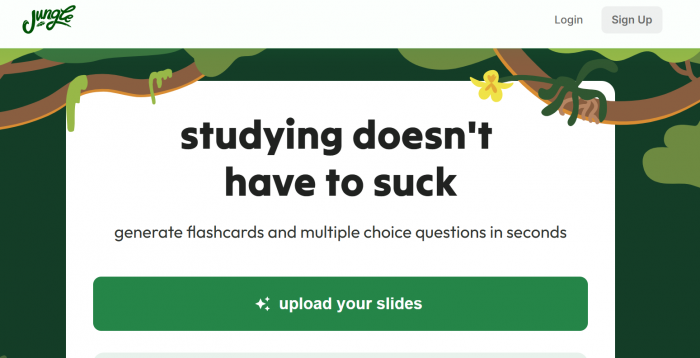
Jungle AI is an AI-powered study tool that transforms your learning materials i.e., lecture slides, PDFs, textbooks, videos, and notes into personalized flashcards and practice questions. It’s designed to reduce the “prep time” of studying, so students can spend more time actually learning and testing themselves instead of manually creating revision content.
The platform is used by over 1 million students and is available on web and mobile (Android and iOS), making it accessible to learners across different devices and contexts.
Jungle AI’s core audience is:
● High school and university students preparing for exams in theory-heavy subjects such as biology, history, or economics.
● Medical, nursing, and other professional students who need to process vast amounts of content quickly and repeatedly.
● Competitive exam aspirants (MCQ-heavy tests) who benefit from automated question generation and spaced repetition.
2. How Jungle AI Works: From Lecture Slides to Flashcards in Seconds
At its core, Jungle AI follows a simple but powerful workflow: upload → generate → review → refine → repeat.
Step 1: Upload Your Study Content
Jungle lets you bring in your study material from multiple sources:
● Lecture slide decks (PowerPoint, Google Slides as exported files)
● PDFs (textbook chapters, handouts, research papers)
● Webpages and online articles
● PowerPoint files directly
● YouTube videos (for video-based lectures)
● Textbooks and e-books (via uploaded files or text excerpts)
● Study guides and notes
This multi-format support is critical because most students now learn from a mix of slides, handouts, LMS exports, and online videos rather than a single textbook.
Step 2: Generate AI-Powered Flashcards and Questions
Once your content is uploaded, Jungle’s AI parses it and generates concise, targeted flashcards and practice questions. These typically include:
● Direct recall questions for key facts and definitions
● Conceptual questions that test understanding of relationships and mechanisms
● Application-style questions, especially in case or scenario format for fields like medicine or business
Jungle emphasizes speed: turning long slide decks or dense PDFs into study-ready questions in seconds rather than hours.
Step 3: Review, Customize, and Organize
You’re not locked into whatever the AI generates. Jungle allows you to:
● Review the generated flashcards
● Edit question wording, answers, or explanations
● Remove irrelevant or redundant cards
● Organize flashcards into decks or sets based on chapters, topics, or exams
This editability ensures that the study content remains aligned with your course’s depth and exam style rather than being a generic AI output.
Core Feature Snapshot
| Area | Details |
| Question types | Flashcards, multiple choice, free response, and case-style questions. |
| Input formats | PDFs, slide decks, webpages, PowerPoint, YouTube videos, notes, textbooks, study guides |
| Output | AI-generated flashcards, quizzes, and practice questions built from your actual content. |
| Study mechanics | Spaced repetition support, progress tracking, gamified tree-growing interface |
| Platforms | Web app plus mobile apps via Google Play and App Store |
3. Question Formats: MCQs, Free Response, and Case Questions
Many AI tools can summarize content, but Jungle’s strength lies in how it structures that content into testable questions.
Multiple-Choice Questions (MCQs)
MCQs are at the heart of Jungle’s quiz experience, especially for competitive exams and standardized tests. The system can:
● Generate single-answer options with plausible distractors.
● Focus on key definitions, facts, and conceptual distinctions.
● Turn long paragraphs into bite-sized questions for rapid drilling.
MCQs pair well with instant feedback, allowing students to quickly see where they misinterpreted a concept.
Free Response Questions
Free response questions force you to recall information without seeing options, which increases retrieval difficulty and strengthens memory. Jungle supports open-ended questions where students must type or think through the answer before checking the solution.
These are useful for:
● Essay-style subjects where definitions are not enough.
● Formula-based topics where you must generate steps yourself.
● Concept explanations in your own words to test depth of understanding.
Case Questions
For professional fields, case questions simulate real-world scenarios:
● Medical students might see patient cases requiring diagnosis or treatment choices.
● Business or law students might get scenario-based questions that test application, not just recall.
Case questions are especially powerful for exams that test reasoning and decision-making rather than rote memorization.
4. Learning With Jungle AI: Spaced Repetition, Retrieval Practice, and Gamification
Jungle AI doesn’t just generate content; it tries to structure your study experience based on evidence-backed learning principles.
Retrieval Practice at the Core
Retrieval practice means actively trying to recall information rather than passively re-reading it. Jungle encourages this by:
● Presenting flashcards and questions instead of summaries.
● Asking you to select or generate answers, then comparing them against the solution.
● Providing AI feedback on what you got right or wrong so you can see gaps immediately.
By constantly forcing you to retrieve and apply concepts, Jungle builds stronger, more durable memories than simple note review.
Spaced Repetition for Long-Term Retention
Spaced repetition is the strategy of revisiting information at increasing intervals to combat forgetting. Jungle supports this by:
● Tracking which questions you’ve answered and how often.
● Prioritizing weaker or less frequently reviewed items.
● Encouraging repeated exposure over time rather than cramming.
Users like Ladedra, a vet student, specifically mention how Jungle has helped with “space repetition and long term studying,” suggesting that this is a central part of the tool’s value.
Gamification: Grow Trees as You Learn
Instead of purely numeric progress bars, Jungle uses a tree-growing metaphor:
● As you answer questions and complete sessions, you grow virtual trees.
● This visual and gamified feedback makes progress feel more tangible and satisfying.
● The “studying as addictive as gaming” narrative aligns with Jungle’s focus on engagement.
Gamification doesn’t replace hard work, but it helps maintain motivation across repeated sessions and long exam cycles.
5. User Experience and Real-World Feedback
Jungle AI’s branding and UX speak directly to student frustrations.
Simple, Student-Centric Positioning
The homepage leans on a very direct message: “studying doesn’t have to suck” and “generate flashcards and multiple choice questions in seconds.” This immediately addresses two pain points:
● Studying feels boring and overwhelming.
● Creating revision material manually takes too long.
The visual design emphasizes clarity and action: easy access to “Try it free,” “Sign Up,” and “Login” so students can reach the “magic moment” quickly. reddit
Testimonials and Social Proof
Jungle leans heavily on real student voices for credibility:
● Users praised and called it “insane” how good the questions are that Jungle generates from lecture slides.

● External sources indicate that the app is trusted by over 1 million students and has hundreds of thousands of active users across platforms.
Community discussions also highlight its growth and traction—for instance, an Indie Hackers thread mentions Jungle doing significant recurring revenue with strong engagement metrics.
Mobile and Cross-Device Access
The availability of Jungle on both Google Play and the App Store means students can:
● Study on the go, between classes or during commutes.
● Keep progress synced between devices.
● Use quick sessions for micro-learning rather than only long study blocks.
This aligns well with how modern students mix laptop-based and mobile-based studying.
6. Pricing, Free Trial, and Onboarding
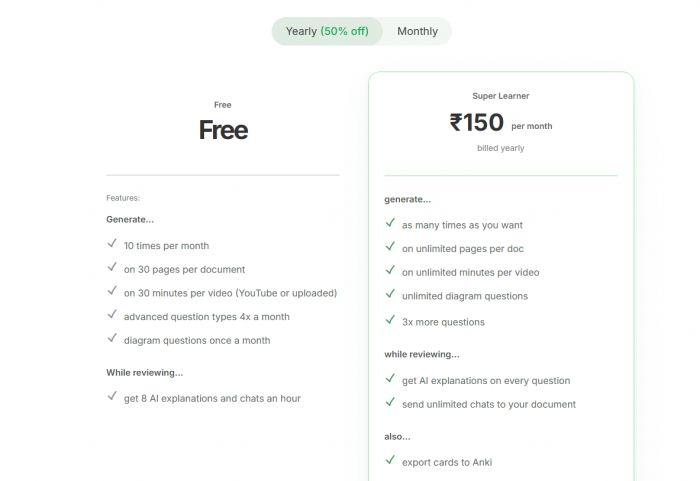
Jungle offers a free entry point plus paid tiers for heavier users, which is important for students on a budget.
Free Plan
According to third-party reviews, the free plan typically includes:
● Limited content generation (e.g., up to 15 times per month).
● Limited case questions (e.g., 1 per month).
● Capped personalized feedback (e.g., 5 questions per hour).
● No Anki export on the free tier.
The free plan is suitable for light users or those testing the platform before committing.
Paid Plans: Mega Mind and Super Learner
Jungle’s paid tiers are designed for power users:
● Mega Mind
● Unlimited content generation per month.
● Unlimited case questions.
● Increased number of questions and features compared to free.
● Anki export for integrating Jungle output into Anki workflows.
● Super Learner
● Generally removes most caps on questions and feedback.
● Includes full personalized feedback for every question.
● Retains Anki export and advanced study features.
Pricing amounts can vary over time and by promotion, so it’s best to check Jungle’s official pricing page for the latest figures.
7. Use Cases and Ideal Personas
Jungle AI works best when you already have content to study and need to convert it into active practice.
University and College Students
For undergraduates and postgraduates, typical use cases include:
● Uploading lecture slides before midterms or finals to generate quick revision quizzes.
● Turning PDF readings or textbook chapters into flashcards for weekly review.
● Creating topic-wise decks (e.g., “Cell Biology – Week 3”) for regular spaced sessions.
This is especially helpful in reading-heavy majors like medicine, law, psychology, business, and engineering theory courses.
Medical and Professional Students
Medical and other professional tracks often require both factual recall and case-based reasoning.
● Jungle can convert dense medical slides or notes into stepwise questions and case scenarios.
● Students can repeatedly drill high-yield topics, then use case questions to practice clinical reasoning.
● Testimonials and case studies show strong adoption among medical students in particular.
Competitive Exam Aspirants
For exams dominated by MCQs:
● Students can convert coaching notes, PDFs, and previous-year papers into practice sets.
● The AI-generated distractors help simulate exam-style traps and common misconceptions.
● Spaced repetition ensures regular, structured revision across subjects rather than last-minute cramming.
8. Jungle AI Pros and Cons
No tool is perfect, and a balanced view helps students decide if Jungle fits their workflow.
Strengths
● Fast content-to-quiz conversion: Converts lecture slides, PDFs, and videos into flashcards and questions in seconds, saving hours of manual work.
● Rich question formats: Supports flashcards, MCQs, free response, and case questions for deeper testing.
● Learning science-backed features: Built around retrieval practice, spaced repetition, and instant feedback.
● Gamified experience: Tree-growing progress and a “studying as addictive as gaming” approach to improve engagement.
● Cross-platform availability: Works via the web and native apps on major app stores, with over 1M students using it.
● Workflow integrations: Anki export on higher plans for students who already rely on Anki decks.
Limitations and Considerations
● Free plan constraints: Capped generations, feedback, and case questions may feel limiting during intense exam periods.
● Question quality variance: As with any AI, the quality of questions depends heavily on the clarity and structure of the input content, and some editing may be required.
● Privacy and data sensitivity: Students uploading proprietary or confidential material (e.g., internal slides) should review Jungle’s privacy policy and data handling practices.
● Not a replacement for understanding: Jungle accelerates practice but still requires students to genuinely engage with explanations and feedback.
9. Jungle AI vs Traditional Tools and Alternatives
To understand where Jungle fits, it helps to compare it conceptually with other study approaches.
| Approach | Manual Flashcards (e.g., paper, basic apps) | Generic Chatbots | Jungle AI |
| Content input | Manually typed questions and answers | Pasted text or prompts | Upload slides, PDFs, videos, notes, web pages directly. |
| Question generation | Entirely manual | Requires you to engineer prompts | Automatic flashcards, MCQs, free response, case questions. |
| Learning science features | Sometimes spaced repetition only | Minimal, not structured for studying | Spaced repetition, retrieval practice, instant feedback, gamification. |
| Workflow integration | Limited export/import options | None or basic copy-paste | Anki export on advanced plans. |
| Engagement | Depends on user discipline | Not optimized for study habits | Tree-growing and game-like progression to sustain usage |
Other AI flashcard tools exist, but Jungle differentiates itself with its strong focus on multi-format content ingestion, mobile availability, and a heavy emphasis on study behavior and engagement loops.
Final Verdict: Should You Use Jungle AI for Your Exams?
Jungle AI is a compelling option for students who are drowning in slides, PDFs, and videos but lack the time or energy to manually build structured revision material. It takes the grunt work—converting content into flashcards and quizzes—and automates it, while layering on spaced repetition, instant feedback, and gamification to keep you coming back.
If you’re a light user or just curious, the free plan is good enough to test how well it fits your study style and subjects. For serious exam seasons, especially in medicine, professional programs, or intensive competitive exams, the paid “Mega Mind” or “Super Learner” tiers are worth considering purely for the time saved and the ability to push more content through the system.
Used well, Jungle AI can help you move away from passive re-reading toward active, structured, and more enjoyable learning—exactly what most students need in 2026.
Post Comments
Be the first to post comment!
Related Articles




Dopple AI Explained: The Dopple AI Problem
Lesley Nicole . Jan 23, 2026Table of Content
- 1. What Is Jungle AI and Who Is It For?
- 2. How Jungle AI Works: From Lecture Slides to Flashcards in Seconds
- Core Feature Snapshot
- 3. Question Formats: MCQs, Free Response, and Case Questions
- 4. Learning With Jungle AI: Spaced Repetition, Retrieval Practice, and Gamification
- 5. User Experience and Real-World Feedback
- 6. Pricing, Free Trial, and Onboarding
- 7. Use Cases and Ideal Personas
- 8. Jungle AI Pros and Cons
- 9. Jungle AI vs Traditional Tools and Alternatives
- Final Verdict: Should You Use Jungle AI for Your Exams?
- Comments
- Related Articles