Few software platforms have lived through as many phases of the internet as Softonic. Founded in the late 1990s, well before app stores and cloud delivery became the norm, the site played an early role in how millions of users discovered and downloaded programs online.
Today, Softonic is still one of the most heavily visited software portals globally. At the same time, its reputation remains one of the most debated in the download ecosystem. This review takes a balanced look at Softonic as a company, a platform, and a domain, focusing on facts rather than hype or dismissal.
Official website: https://www.softonic.com/
Origins and Rapid Expansion
Softonic was launched in 1997 in Barcelona by Tomás Diago as a university project centered on software sharing. At a time when finding safe downloads online was fragmented and often risky, Softonic offered something users immediately valued: a centralized catalogue, organized categories, and strong localization support.
As global internet access improved and broadband adoption accelerated, the platform scaled quickly.
Key early milestones
- Rebranded as Softonic in 2000
- Expanded multilingual support by 2004
- Reached roughly 100 million monthly users by 2010
- Generated about €15 million in annual revenue by 2010
By the early 2010s, Softonic had become one of the largest software directories on the web, with particularly strong traction in emerging markets and non-English regions.
The Turning Point: The Softonic Downloader Era
The period between 2007 and 2015 marked the most controversial chapter in Softonic’s history. During this time, the company introduced its own proprietary installer called the Softonic Downloader.
Instead of sending users directly to the original developer files, downloads were wrapped inside Softonic’s installer environment. This move significantly changed user perception of the platform.
The installer became controversial for several reasons. It sometimes included bundled toolbars and ad-supported components. Some users reported browser changes they did not fully expect, along with system slowdowns linked to additional software. Security companies such as Malwarebytes later classified the downloader as a potential unwanted program. Importantly, it was not labeled malware, but it was widely associated with adware-like behavior.
The business impact was severe. In 2014, Google withdrew advertising support from Softonic, triggering a sharp revenue drop. By 2015, the company had laid off nearly half of its workforce.
The Cleanup and Strategic Reset
Softonic responded with a major strategic shift. In early 2015, new leadership was brought in with experience in download platforms. One of the first major decisions was to permanently discontinue the Softonic Downloader.
The company moved back to a direct-download model. Users now receive the original installer from the software developer rather than a Softonic-wrapped file.
Following the reset, Softonic also increased its focus on mobile applications, expanded editorial content such as reviews and comparison lists, and worked to rebuild advertising relationships.
Technically, the changes were implemented quickly. Rebuilding trust, however, proved far slower.
What the Platform Looks Like Today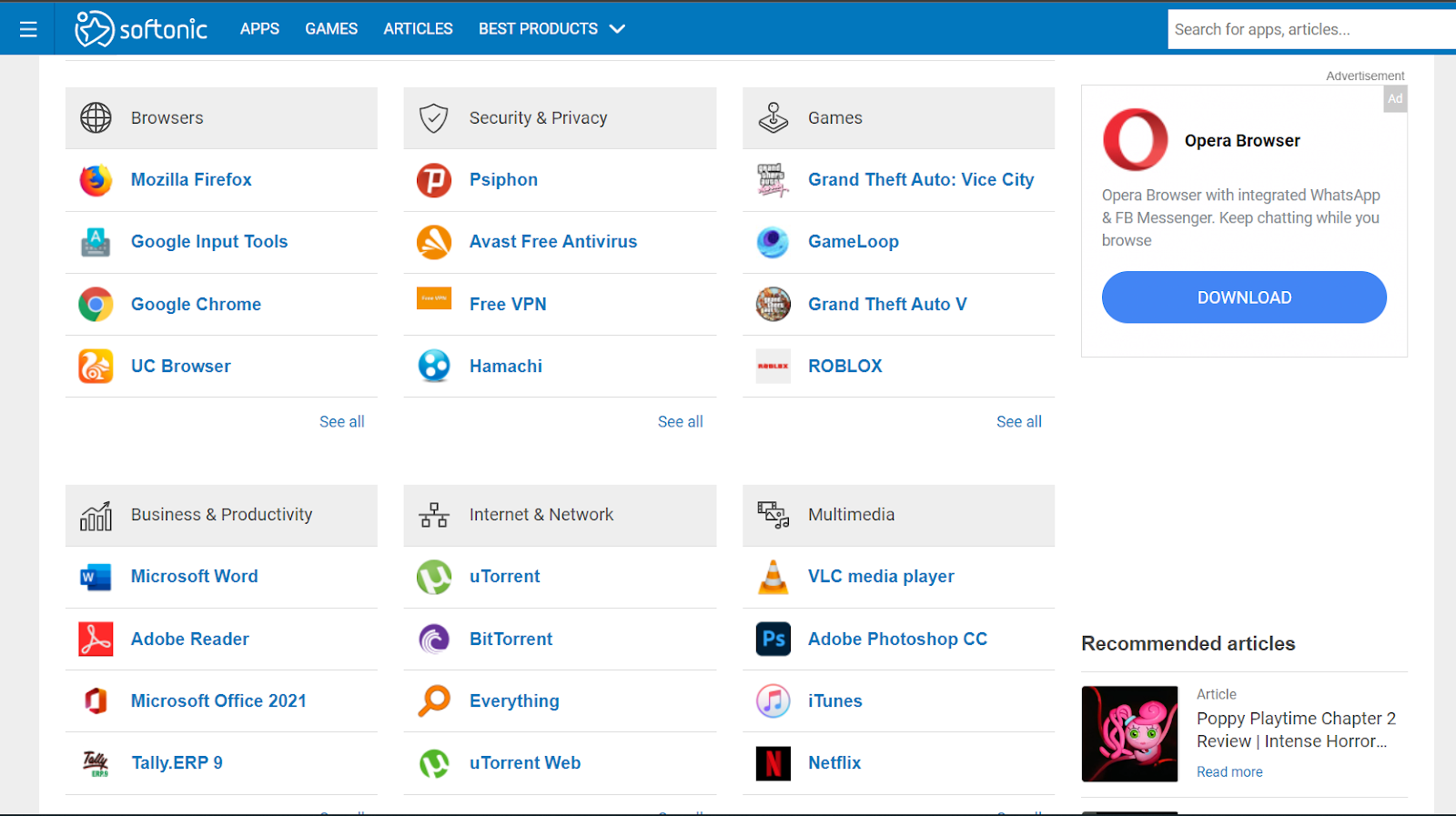
As of 2026, Softonic operates primarily as a large-scale software discovery and content platform rather than a bundled download service.
The site now hosts a catalogue of more than one million programs and apps across Windows, Mac, Android, and iOS. It supports over 17 languages and maintains a strong mobile user base. Traffic data consistently shows that India accounts for a significant share of visits, with most users accessing the platform via smartphones.
The overall product today feels closer to a hybrid between a software directory and a content-driven review site.
Business Model and Revenue Streams
Softonic’s monetization strategy has also evolved. The company no longer depends on bundled installers for revenue. Instead, it operates through a more conventional mix of digital publishing and partnership income.
Primary revenue sources include display and programmatic advertising, affiliate partnerships with software vendors, sponsored placements, and featured listings. The company has also expanded into B2B software advisory through its Appvizer acquisition and manages additional tech properties such as Download.com.
Recent financial disclosures indicate that Softonic generated approximately €28.4 million in revenue in 2024, representing its strongest performance since the pre-crisis period.
User Sentiment and Reputation Reality
Despite clear operational changes, public perception remains mixed and often cautious.
Many users still associate Softonic with earlier bundled software experiences. Others point to occasional confusion caused by advertisement-style download buttons, which can make navigation less straightforward for non-technical users. Across forums such as Reddit and in various YouTube discussions, advice to avoid third-party download portals still appears regularly, regardless of Softonic’s technical cleanup.
Positive feedback does exist, particularly around the site’s large catalogue and editorial content. However, historical distrust continues to outweigh many of the platform’s recent improvements.
Where Softonic Makes Sense Today
Softonic can be useful in certain contexts. It works reasonably well for discovering new software, comparing alternatives, and reading editorial reviews or rankings. For users researching tools or exploring options, the platform still provides broad coverage.
That said, caution is still reasonable in specific scenarios. Downloading security-sensitive or mission-critical software is generally safer directly from official developer websites. Non-technical users may also find ad-heavy interfaces confusing. In enterprise or compliance-heavy environments, direct vendor downloads remain the preferred standard.
Final Perspective
Softonic in 2026 is very different from the platform many users remember from its most controversial years. The company has removed the practices that caused the greatest damage and rebuilt its model around advertising, content, and partnerships.
However, reputation rarely resets at the same speed as infrastructure.
Today, Softonic occupies an unusual position in the software ecosystem. It is large, operationally legitimate, and widely used, yet still approached with caution by many experienced users.
The most practical stance is a balanced one. Softonic can be a helpful discovery and research tool. When it comes to downloading software, especially important applications, official developer sources and carefully curated platforms remain the safer default.
That ongoing tension between scale and trust continues to define Softonic’s story.
Post Comments
Be the first to post comment!