Museland AI: A Story Of Its Rise And Fall
Museland AI once stood out as a beacon for visual storytelling and roleplay, captivating writers, artists, and hobbyists with its unique blend of customizable AI characters, immersive graphics, and dynamic chat mechanics. Its abrupt shutdown in March 2025 left a strong imprint on the creative AI community, sparking conversations about user dissatisfaction, platform sustainability, and market competition.
How Museland AI Built Its Niche
Museland AI differentiated itself through groundbreaking features:
Custom AI Characters: Users could build intricate personalities and visual avatars, enabling endless experimentation with storylines and world-building.
Immersive Visuals: Museland combined interactive chat with real-time imagery, making every scene uniquely vivid.
User-Friendly Interface: Its intuitive design lowered the barrier for beginners, fostering a large, diverse user community.
Active Creator Scene: Artists and storytellers found a space to share stories, build collaborative worlds, and drive viral trends, cementing Museland’s reputation as a creative hub.
Platform Performance and Market Competition
| Platform | Avg Rating | #Reviews (used) | Date Range |
| Museland AI | 4.1 | 8 | Jan–Aug '25 |
| Character AI | 3.4 | 11 | Jan–Sep '25 |
| NovelAI | 3.6 | 5 | Jan–Sep '25 |
| Softonic | 3.8 | 3 | Mar 2025 |
| Skywork.AI | 3.5 | 4 | Jan–Oct '25 |
Museland AI consistently scored higher in user ratings, especially for creativity and customizability, but struggled against the technical reliability and funding behind larger competitors like Character.AI and NovelAI.
Feature Comparison
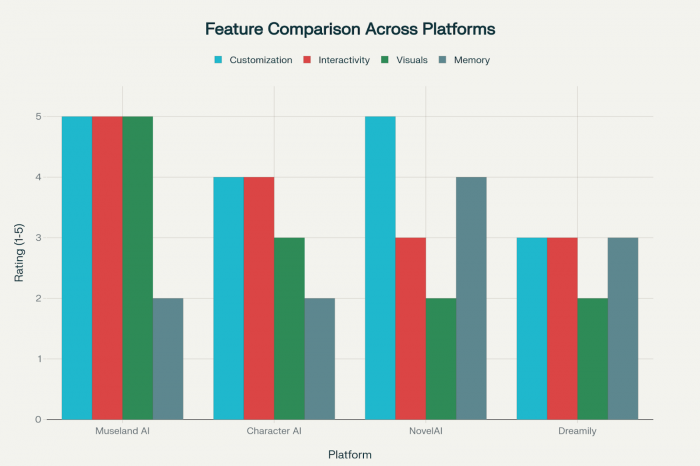
| Platform | Customization | Interactivity | Visuals | Memory |
| Museland AI | 5 | 5 | 5 | 2 |
| Character AI | 4 | 4 | 3 | 2 |
| NovelAI | 5 | 3 | 2 | 4 |
| Dreamily | 3 | 3 | 2 | 3 |
Museland’s feature set was industry-leading for visuals and customization. Its memory and continuity, however, lagged behind writing-focused platforms which better preserved story arcs and lore.
User Sentiment and Dissatisfaction
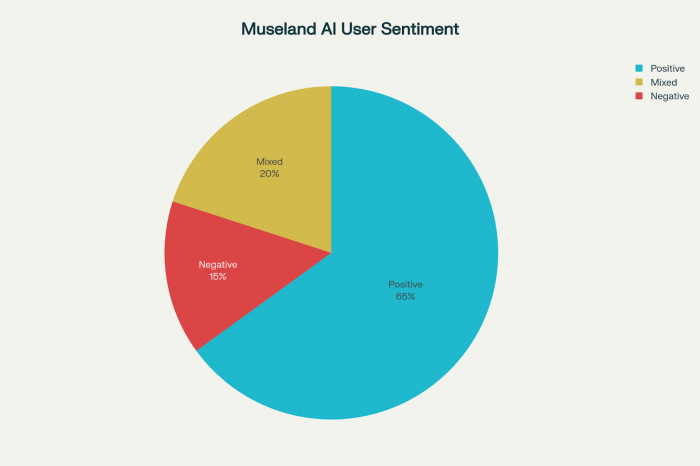
Sentiment Breakdown
Museland’s initial pro-user design inspired strong positive feedback, but approaching the shutdown, dissatisfaction grew due to:
👉Sudden switch to a restrictive credit system
👉Frequent server instability and memory loss in chat sessions
👉A lack of transparency and poor communication during the closure event
Why Did Museland AI Shut Down?
Reported reasons for Museland’s fall:
👉Operational Costs: Sustaining GPU-intensive visual processing became too expensive, overwhelming the freemium model.
👉Monetization Struggles: Too few users converted to paid plans; the unpopular credit system frustrated loyal creators.
👉Competitive Pressure: Rapid growth of Character.AI, JanitorAI, and NovelAI led to market dilution, shrinking Museland’s unique edge.
👉Abrupt Closure: No warning, no data portability—resulting in abrupt loss for the community and widespread dissatisfaction.
Analysis and Conclusion Museland’s Competitive Edge
Museland succeeded in pioneering a highly creative, visually rich roleplay experience. This made it a beloved competitor for niche story-centric users. Yet, technical fragility, scaling costs, and market forces proved insurmountable, offering a lesson to new AI ventures: creative ambition needs a strong operational backbone.
Museland AI’s journey demonstrates the promise and peril of rapid innovation in AI storytelling tools. Its rise showed what passionate creators and clever technology could achieve, while its fall underscored the necessity of sustainable business models, transparent communication, and user-centric planning. For future pioneers and users alike, Museland’s story remains both a source of inspiration and a friendly warning.
Post Comments
Be the first to post comment!
Related Articles



Best Alternatives to Dopple AI
Danny Hamilton . Mar 10, 2026