At first glance, NoodleMagazine presents itself as a simple video discovery site. The name suggests something editorial or curated. The interface suggests something else entirely.
This investigation looks beyond surface impressions to examine what NoodleMagazine actually publishes, how it operates, what scale it has reached, and what risks users should realistically account for when interacting with it.
Rather than focusing on rumors or assumptions, this analysis relies on publicly available signals: site behavior, policy language, traffic data, infrastructure records, and category-level risk patterns.
What Kind of Content Does NoodleMagazine Publish?
Despite the branding, NoodleMagazine does not function like a magazine in the editorial sense. It does not publish original articles, reporting, or commentary.
Instead, its core function appears to be video discovery and aggregation, with a heavy emphasis on adult content.
Evidence supporting this includes:
- Homepage and “latest video” sections dominated by explicit thumbnails and adult search tags
- An 18+ framing in its policy language
- Content organization that resembles adult “tube” or indexing platforms rather than a creator-led service
Importantly, NoodleMagazine does not clearly position itself as a creator platform. There is no visible emphasis on original uploads, verified creators, or licensing partnerships. The experience is oriented around browsing, searching, and clicking through a large catalog.
How the Platform Appears to Work
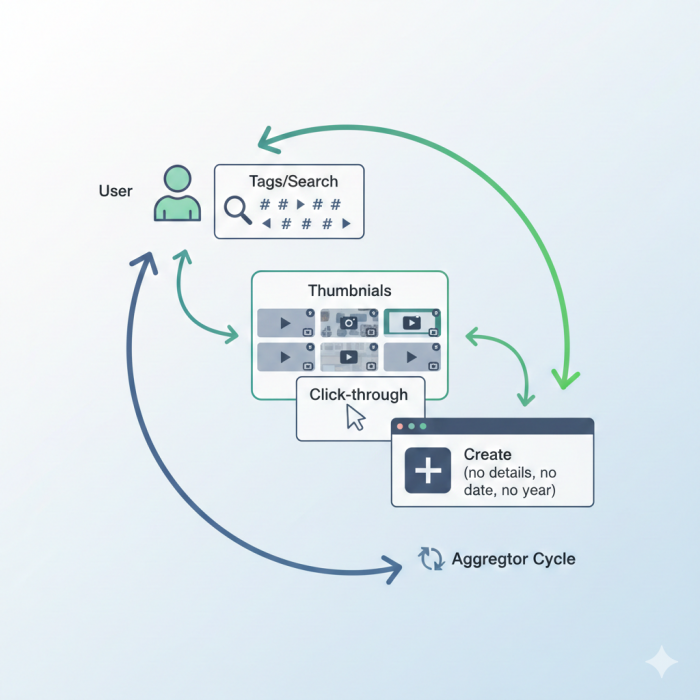
From a structural standpoint, NoodleMagazine behaves like an aggregator or index, not a publisher.
Key indicators:
- Large volumes of short video entries
- Tag-driven navigation
- Emphasis on trending searches and “latest” feeds
- Minimal context around source, licensing, or creators
This matters because aggregation changes responsibility boundaries. Whether content is hosted directly, mirrored, or embedded from third parties affects legal exposure, moderation expectations, and takedown reliability. NoodleMagazine does not make this distinction transparent.
Evidence Box: Traffic and Scale
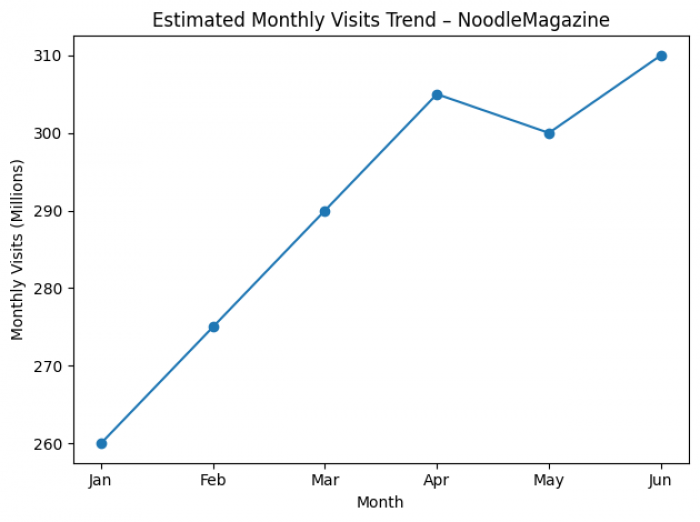
Observed demand signals (third-party estimates):
- Monthly visits estimated in the hundreds of millions
- Average visit duration measured in several minutes
- Multi-page browsing behavior rather than single-page exits
- Large international audience, including the US, India, and parts of Eastern Europe
Why this matters:
At this scale, even small policy or security weaknesses affect a very large number of users. NoodleMagazine is not a niche or fringe site in terms of usage.
Ownership and Infrastructure Signals
Public domain records show:
- Domain registration dating back several years
- Use of Cloudflare name servers
- No publicly visible individual or company ownership details
- Registrar based outside major US/EU consumer brands
What this tells us (and what it doesn’t):
- Infrastructure choices are common across the web and not inherently suspicious
- Lack of transparent ownership does limit accountability and trust
This pattern is typical of high-complaint, high-risk content categories
No direct claim of illegality can be made from infrastructure alone. But it does shape the risk profile.
Policies and Legal Positioning
NoodleMagazine publishes:
- A privacy policy that permits broad data collection and third-party sharing
- A DMCA takedown process positioning the site as a “service provider”
- Explicit adult-only disclaimers
Interpretation:
The presence of a DMCA workflow suggests the platform expects copyright complaints. The privacy language signals monetization through advertising and partner networks rather than subscriptions or creator licensing.
The Central Uncertainty: Licensing vs. Aggregation
The most important unanswered question is content provenance.
From publicly visible pages, users cannot easily determine:
- Whether videos are licensed
- Whether content is user-uploaded
- Whether videos are embedded from third-party hosts
- Whether content is mirrored without authorization
This lack of clarity is not uncommon in adult aggregation ecosystems, but it is precisely what increases legal, ethical, and safety uncertainty for users.
Risk Scoring Table
| Area | Risk Level | Why |
| Privacy | High | Broad tracking language, third-party sharing, ad-driven model |
| Legality | Medium–High | DMCA reliance, unclear licensing, aggregation ambiguity |
| Safety | Medium | Category-level malvertising risk, redirects common in similar sites |
| Usability | Medium | Easy discovery, but cluttered interface and ad interference |
Overall risk profile:
High-utility / high-risk
How NoodleMagazine Compares to Safer Alternatives
The idea of a “best alternative” depends on what a user values.
- For lower legal and privacy risk: licensed, paid adult platforms with clear ownership and moderation
- For general video discovery (non-adult): mainstream platforms like YouTube or Vimeo
- For free adult aggregation: alternatives exist, but they usually carry similar or higher risk profiles
The category itself is the risk driver, not just the individual site.
Final Assessment: My Position
NoodleMagazine appears to succeed at what it is optimized for: rapid, large-scale discovery of adult videos.
However, it fails to meet the standards of transparency, accountability, and user protection that would qualify it as a trustworthy publisher or platform.
I would not describe it as a scam, but I would also not describe it as safe, reputable, or user-first. Its design choices prioritize traffic and aggregation efficiency over clarity, provenance, or long-term trust.
For users who understand and consciously accept that trade-off, the site’s existence is unsurprising. For users who expect editorial integrity, clear licensing, or strong privacy guarantees, NoodleMagazine is misaligned by design.
Post Comments
Be the first to post comment!
Related Articles