Three product images, a logo, and a rough brief. That was all I handed Pencil AI before asking it to build a set of ads ready for Facebook and TikTok. No designer, no copy doc, no Canva file. Within a few minutes, the platform had produced a range of video and static ad creatives, each one tagged with a predicted performance score telling me which it thought would win before a single dollar of media spend. Whether that score actually means something is a fair question, and one worth digging into honestly.
What Pencil AI Is Built For
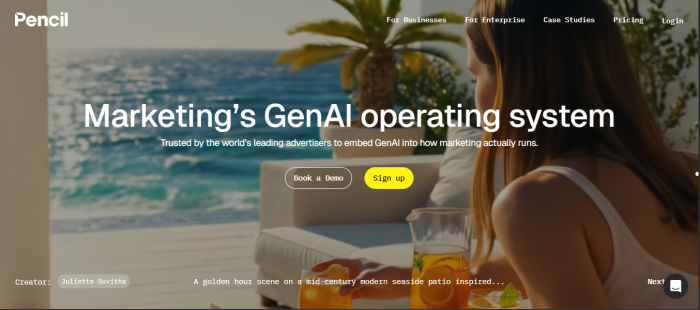
Pencil AI is a generative advertising platform owned by The Brandtech Group. It is built specifically for ecommerce brands and marketing agencies that run paid social and search campaigns regularly and need a reliable pipeline of fresh creatives to keep testing.
Its models pull from over one billion dollars of historical ad spend data to generate creatives and predict how they are likely to perform. It integrates directly with Facebook, Instagram, TikTok, YouTube, Google, and Snapchat ad accounts, and can connect to your Shopify store to automatically pull in product images, descriptions, and branding.
The difference between Pencil and a general design tool is that Pencil is not trying to help you make pretty things. It is trying to help you make ads that convert, then scale the ones that do and cut the ones that do not.
How It Works Inside a Real Campaign
The setup follows a clear sequence. You connect your ad accounts and Shopify store if you use one. You upload brand assets: logo, fonts, hex codes, product photos, and any existing video clips. Pencil locks those into a brand guardrail so every creative that comes out stays visually on brand without you policing each output manually.
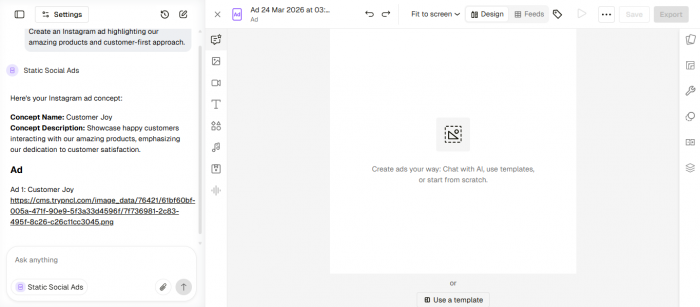
From there, you describe the campaign angle or objective, choose the format you need (video, static, carousel), and let the generation run. A standard batch of ads typically takes two to three minutes to produce. What you get back is a grid of creative options, each labelled with a Pencil Score that estimates how likely it is to outperform your account's historical average based on patterns in your own data and wider platform trends

You can edit any ad directly inside the platform through a drag and drop editor before exporting. If a layout is close but not quite right, you adjust copy, swap a visual, or change the call to action without leaving Pencil. Then you push the finished ads directly to your connected ad account.
Key Features Worth Knowing
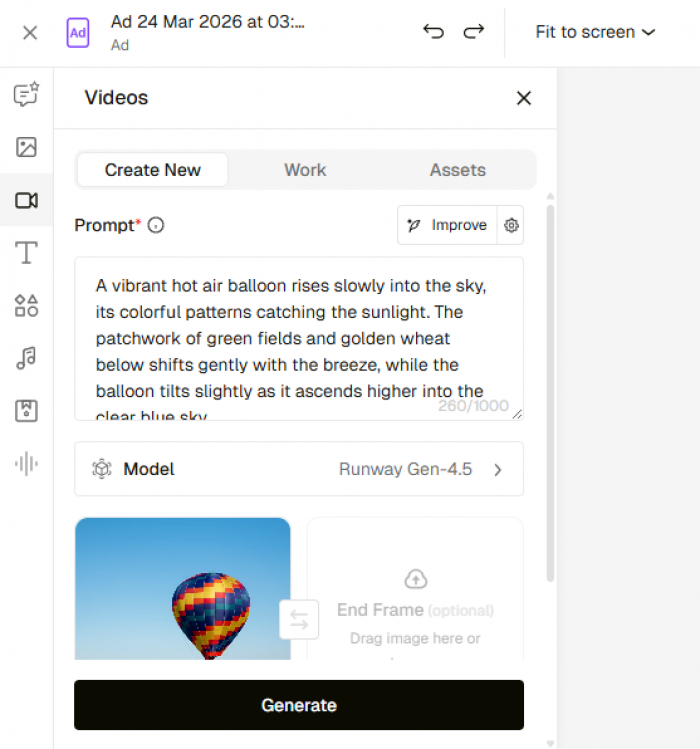
AI video and static ad generation is the core capability. Pencil converts your raw product assets into finished ads with captions, music where appropriate, transitions, and correctly sized formats for each platform. For teams that previously spent days producing video ads, this alone compresses timelines significantly.
The Pencil Score is the feature that most often comes up in user discussions. Every generated ad receives a prediction based on historical performance patterns from your connected accounts and Pencil's wider dataset. The system claims top quartile predicted ads outperform bottom quartile ones by around two times on average. That is a useful shortlist filter, not a guarantee, and experienced users treat it accordingly.
Creative variation at scale matters for performance marketers who need to test many angles simultaneously. Pencil can generate multiple layout and messaging variants from the same asset set quickly, which supports the kind of systematic creative testing that separates scaling brands from stagnant ones.
Brand guardrails are especially important for agencies managing multiple clients. Logos, typography, and colour palettes are locked into each brand workspace. Creative strategists at the enterprise level can set approval workflows so nothing goes out that violates brand guidelines.
Multi-language and multi-market support extends to over 30 languages and regions, including Hindi, Japanese, Portuguese, French, German, Korean, and more. The platform also factors in regional calendar events and local cultural signals when adapting ad messaging
My Experience Testing Pencil AI
After connecting a test brand profile and uploading three product images with a simple logo, I triggered a generation run. The first batch of ads arrived in under three minutes. The static options were clean, well laid out, and immediately usable with light copy edits. The video ads were more interesting: the platform had assembled short clips from still images, added a product callout, and formatted them for both a square social feed and a vertical story format.
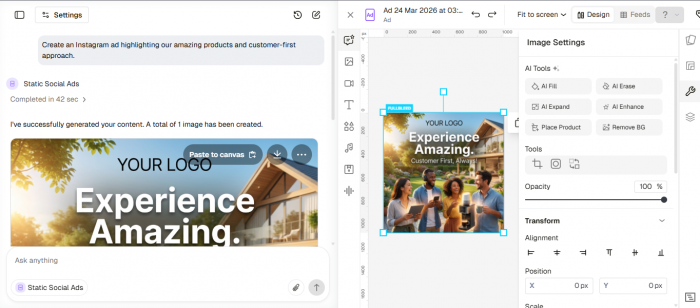
The Pencil Score showed a clear spread. Three ads scored in the top tier, several clustered in the middle range, and two sat near the bottom. Visually, the differences made sense. The top-scored options had cleaner hierarchy and stronger visual contrast. The low-scored ones were either too text-heavy or had the product too small in the frame.
The editor was genuinely useful for quick fixes. Swapping a headline or adjusting emphasis took less than a minute per ad rather than requiring a return to external tools. For teams that want to stay inside one workflow from generation to export, that matters.
Where I felt the experience fall slightly short was in the creative originality of some outputs. When you generate multiple variations quickly, a few of them can look like slight remixes of each other rather than meaningfully different concepts. True creative differentiation still required a degree of human direction on the brief.
My Rating for Pencil AI
| Area | Rating (out of 10) | Comment |
| Ease of use | 8.8 | Clear workflow, small learning curve for new users |
| Creative generation speed | 9.3 | Ads ready in 2 to 3 minutes from brief |
| Design and video quality | 8.4 | Strong baseline, some outputs need editing |
| Prediction score usefulness | 8.6 | Good shortlisting tool, not a guaranteed result |
| Overall score | 8.7 | Excellent for teams that test creatives frequently |
What Real Users Say About Pencil AI
The feedback picture that emerges from G2, community reviews, and direct user quotes is largely positive, but with specific friction points worth knowing before you sign up.
Speed and creative volume are the things users mention most consistently. Marketing teams report that ad production that previously took one and a half weeks now happens in under three days. One ecommerce brand described it as generating some of their best ever Facebook creative. Another user put it more simply: they were still running the same ads for two years and were looking forward to finally testing something new. These are the kinds of reactions you see when a tool genuinely removes a real bottleneck.

The Pencil Score draws genuine interest from performance marketers. Users who connect their own ad accounts and let the platform learn from real campaign history report that the predictions become more relevant over time as the model has more data to work from. Several reviewers describe using it as a triage filter: instead of testing twenty creatives randomly, they focus on the top five the score surfaces and reserve budget for those first rounds.
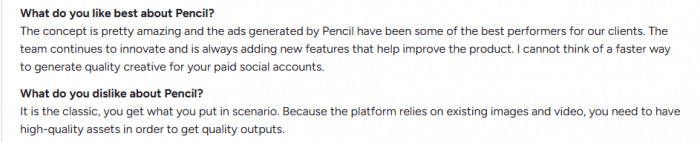
The integrated editor also gets positive mentions. Teams that previously had to bounce between Pencil, Figma, and their ad manager appreciate being able to make final copy and layout adjustments inside the same tool before export.
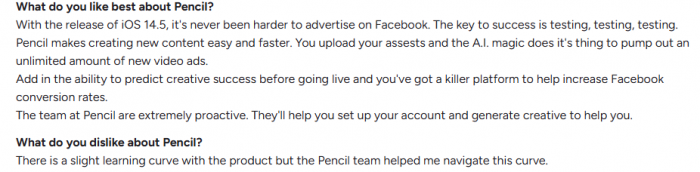
On the critical side, the recurring theme is a learning curve for users who are less familiar with performance marketing workflows. The platform assumes a degree of existing knowledge about ad accounts, creative testing, and media strategy. New or less experienced users sometimes find themselves unsure how to interpret the scores or structure their testing approach without guidance. The support team is consistently described as responsive and helpful in addressing this, but the onboarding does require some investment.
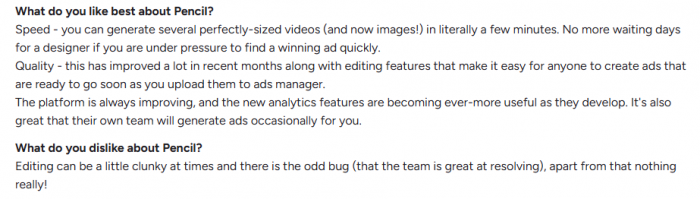
Creative constraints are another honest limitation flagged in reviews. When working with limited asset libraries, the AI can produce outputs that feel visually similar to one another. The quality of what Pencil generates depends heavily on what you feed it: rich, varied product imagery and video clips produce a more diverse and interesting output than a single flat product photo.
It is also worth noting that some negative reviews circulating on Reddit and Trustpilot about a "Pencil scam" refer to an entirely different company called Pencil Design Co, a jewellery CAD application, not this marketing platform. Pencil AI itself is a legitimate enterprise software company under The Brandtech Group with over 1,000 brands and agencies actively using the platform.
Pricing Overview
| Plan | Price | Best For |
| Core | Around $14 per month | Solo founders and small advertisers |
| Growth | Around $55 per month | Scaling brands and growing teams |
| Enterprise | Custom pricing | Agencies managing multiple clients |
Annual subscriptions offer meaningful discounts and a free trial is available to test the workflow before committing. Higher tier plans unlock multiple brand workspaces, which is the main draw for agencies running several client accounts under one login.
Who Should Actually Use Pencil AI
Pencil AI makes the most sense for:
- Ecommerce brands running active Facebook, Instagram, and TikTok campaigns that need fresh creatives regularly
- Performance marketing teams that live and breathe creative testing and want data to guide their decisions earlier
- Agencies handling multiple clients who need a reliable system for producing on-brand ads at volume without a full design team behind every brief
- Growth marketers who are currently producing one or two creatives per campaign cycle and want to move to systematic, higher volume testing
If you run occasional one-off campaigns or your advertising is mostly organic, Pencil is more platform than you need. The real return on investment shows up when you can take advantage of the testing volume and predictive insights it is built to support.
Closing Thoughts
Pencil AI is not trying to be a creative tool in the traditional sense. It is trying to be a performance engine for paid media teams who already understand that testing more creatives, more consistently, is one of the highest leverage activities in digital advertising.
Used with a solid brief, decent brand assets, and a willingness to interpret the prediction scores as guidance rather than gospel, it can genuinely change the pace at which you move from idea to live campaign. For brands and agencies serious about scaling through paid channels, that acceleration is worth a serious look.
Post Comments
Be the first to post comment!
Related Articles