Table of Content
AI video tools have matured rapidly over the last two years. What started as experimental motion generation is now a core part of marketing stacks, creator workflows, and agency production pipelines. Among these tools, Pika Labs has positioned itself as a fast, social-first AI video generator built for speed and iteration.
But beyond the visuals and hype, pricing is what determines whether a tool becomes part of your workflow or just another short-lived experiment.
Understanding Pika Labs pricing requires more than looking at numbers. It requires understanding how the platform is meant to be used.
How Pika’s Pricing Model Actually Works
Pika Labs operates primarily on a credit-based structure. Instead of offering unlimited generation, it allocates a set number of monthly credits depending on your subscription tier. Every video you create consumes credits, and the amount used depends on factors such as resolution, duration, and complexity.
This approach gives users predictable monthly budgeting but requires awareness of how quickly credits can be consumed, especially during testing phases.
Longer videos, higher resolutions, or repeated regeneration attempts naturally increase usage. That means the true cost of Pika is closely tied to how experimental your workflow is.
The Free Tier: Testing the Waters
Like many AI platforms, Pika typically offers limited free access so users can explore its capabilities before committing financially.
The free tier usually includes:
- A restricted number of monthly credits
- Watermarked exports
- Standard queue-based rendering
- Basic access to core generation features
This plan is suitable for experimentation and learning the interface. However, anyone planning to publish consistently will quickly encounter limitations.
Free access works best as a trial phase, not as a long-term production solution.
Paid Plans: Scaling Output
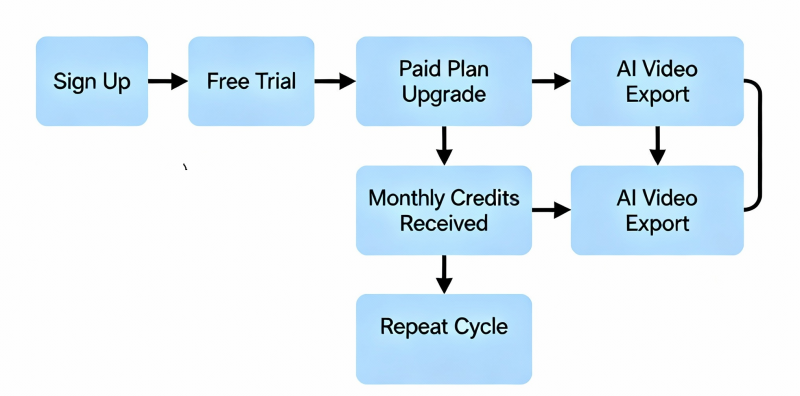
Once you move into paid tiers, the differences become clear. Paid plans generally increase credit allowances, improve rendering priority, remove watermarks, and unlock higher resolution exports.
The more frequently you create videos, the more necessary these upgrades become.
For light creators who produce occasional short clips, entry-level paid plans may be sufficient. But for teams or agencies producing content at scale, higher tiers prevent workflow bottlenecks caused by credit shortages or slow rendering queues.
The pricing structure is built around output velocity. If you generate frequently, upgrading becomes less optional and more practical.
What You’re Actually Paying For
It’s easy to focus on subscription cost, but the real evaluation should consider what Pika replaces.
Traditional video production involves scripting, filming, editing, revisions, and post-production. AI video tools compress that process dramatically. Pika in particular emphasizes speed. The ability to generate short clips quickly allows creators to test ideas, hooks, and formats at a much faster rate than traditional workflows allow.
So the cost question shifts from “How much does it cost?” to “How much time does it save?”
For marketers running multiple ad variations or creators testing different video hooks, that speed advantage can justify the subscription quickly.
Who Benefits Most from Pika’s Pricing Model?
Different user types experience the value differently.
Individual short-form creators benefit from mid-tier plans because they need enough credits to experiment while still exporting watermark-free content.
Marketing teams benefit from higher tiers because testing multiple creatives for campaigns consumes credits rapidly.
Agencies often require stable rendering priority and larger monthly allowances, making premium tiers more realistic for uninterrupted production.
The key variable is volume. Pika becomes more cost-efficient when integrated into consistent publishing cycles rather than occasional experimentation.
Hidden Cost Factors to Consider
AI video tools encourage iteration. That’s both their strength and their expense.
During creative testing, users often regenerate clips multiple times before achieving the desired output. Each regeneration consumes credits. Over time, experimentation can significantly increase usage beyond initial estimates.
Before upgrading, it’s wise to calculate your average credit usage per finished video. That small exercise prevents unexpected renewals or mid-month shortages.
Other factors to monitor include:
- Resolution upgrades
- Longer clip durations
- Feature-specific credit multipliers
- Rendering priority differences
AI tools reward structured workflows. The more disciplined your prompting and planning, the more efficiently you use credits.
How Pika Compares in Pricing Positioning
Within the AI video ecosystem, Pika sits between cinematic creative engines and marketing template platforms.
It is generally more affordable than high-end cinematic tools that emphasize advanced scene control. At the same time, it is more generation-focused than template-driven editors designed for static slideshow-style videos.
That positioning explains its pricing logic. It charges for creative output speed rather than enterprise reporting features or avatar infrastructure.
If your goal is fast visual experimentation and social-ready clips, the pricing aligns with that use case.
Is Pika Worth It in 2026?
The answer depends entirely on your workflow consistency.
Pika makes sense if:
- You produce short-form content regularly
- You test multiple variations before publishing
- Speed matters more than cinematic perfection
- AI video is part of your weekly routine
It may not be ideal if:
- You only generate video occasionally
- You require long narrative formats
- You expect full filmmaking-level control
For creators building volume-based strategies, Pika can become an efficient production layer. For casual users, the free plan may be sufficient.
Final Perspective
Pika Labs pricing reflects the evolution of AI video from novelty to infrastructure. It is not built for one-off experiments. It is built for creators who understand that publishing frequency, testing speed, and iteration cycles are now core growth drivers.
The smartest approach is not immediately choosing the highest tier. It is starting with realistic output goals, tracking credit usage carefully, and upgrading based on consistent need rather than anticipation.
AI video tools reward strategic use.
Pika is no exception.
Post Comments
Be the first to post comment!
Related Articles