When the Line Between Human and AI Blurs
If you’ve called customer support lately and found the voice at the other end calm, empathetic, and fluent in your problem, it might have been a PolyAI voice agent. What makes PolyAI remarkable isn’t just that it sounds human; it’s that it listens like one. Built from Cambridge’s dialogue-systems research, the company’s mission is to create AI voices that don’t just respond but understand. In 2025, that vision has moved from R&D labs to enterprise boardrooms.
The question now isn’t whether voice AI can work, but how deeply it should integrate into the human layer of service.
From Research Curiosity to Enterprise Infrastructure
Founded in 2017, PolyAI spent its early years building speech-understanding models capable of natural interruptions, multi-turn reasoning, and emotional tone control. Unlike traditional IVR systems that still frustrate users with menu loops, PolyAI’s voice-first architecture routes, solves, and even empathizes.
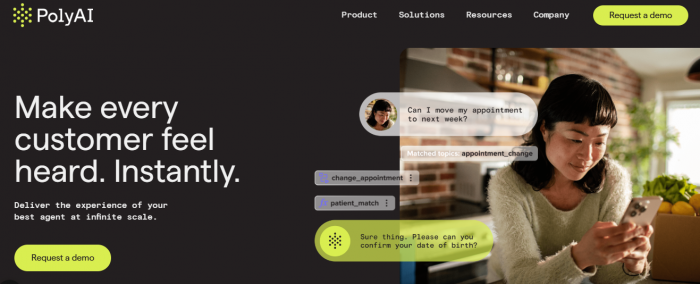
Its real success lies in scaling: the platform now supports high-volume deployments for Marriott, Volkswagen, Caesars, Metro Bank, and other global enterprises. These are not beta tests; they’re production systems handling millions of live calls monthly.
PolyAI’s story is less about voice bots and more about building infrastructure that finally makes automation feel human.
When ROI Meets Reality
The economics behind PolyAI are as impressive as the engineering. According to a Forrester Total Economic Impact study, enterprise clients recorded a 391 % ROI within three years and achieved payback in less than six months.
- $10.3 million in agent labor cost savings per organization
- 50 % reduction in call abandonment rates
- 25 % drop in agent attrition
These figures matter because they prove a point often lost in AI conversations: automation doesn’t just save time, it redefines where human effort belongs.
When machines take on repetition, humans reclaim empathy. That shift is becoming the most valuable form of ROI.
What Users Are Saying
Feedback from the field shows what data alone can’t. On G2, users highlight the naturalness of voice tone and ease of integration with legacy contact-center tools. “It felt like adding another employee, not software,” writes one verified enterprise reviewer.
Some describe PolyAI as a “production-grade conversational layer that handles high-stakes calls with brand consistency.” Meanwhile, Microsoft’s case profile calls its voice output “so authentic that callers never realize it’s AI.”
But transparency also defines the community discussion: reviewers note that analytics dashboards could be deeper and that some industries still require custom tuning for regional accents. In other words, the system’s success depends as much on how it’s configured as on what it can do out of the box.
That duality, reliability with room for refinement, may explain why PolyAI keeps enterprise clients while newcomers often fade.
Real-World Deployments That Tell the Story
Consider Hopper’s travel platform: its PolyAI assistant now fully resolves 15 % of inbound calls. Or Atos’s European rollout, where the system took over the workload of up to 95 full-time agents, halved operational cost, and contained 30 % of repetitive calls. In hospitality, one unnamed chain reported PolyAI handled 80 % of 40,000 calls on its first day in service.
Each use case shows a pattern: containment rises fast, hand-offs drop, and customer satisfaction actually increases. The more natural the conversation, the less it feels like automation.
In 2025, “AI takeover” looks less like replacement and more like relief, both for agents and customers.
The Human Side of Automation: Empathy as a Metric
Voice AI isn’t replacing empathy; it’s redistributing it. Employees once trapped in repetitive call loops can now focus on emotionally demanding cases. In healthcare and utilities, that means more time for compassion; in retail and hospitality, more room for loyalty-building.
Even in labor-sensitive markets, reviews highlight morale improvement after automation, and agent turnover drops because the work left behind is more meaningful. Ethics in AI often centers on fairness and privacy, but PolyAI adds a subtler dimension: how respectfully technology treats the humans still in the loop.
Automation done right doesn’t erase humanity; it amplifies it in places where it counts most.
Why Analysts and Investors Keep Watching
PolyAI’s trajectory hasn’t gone unnoticed. In September 2025, it appeared in multiple Gartner Hype Cycles for Customer Service and Cost Optimization and received the Voice AI Technology Excellence Award. Analysts see it not just as a vendor but as a bellwether for how “voice-as-a-product” will reshape CX infrastructure.
The investor appeal follows a similar logic: PolyAI isn’t chasing consumer flash, it’s selling operational uptime. That sober positioning may be why its funding has remained steady in a market where many flashy AI startups burn out.
In a noisy AI economy, credibility is the quietest and strongest currency.
Ethical and Workforce Implications for 2026–2030
As voice automation becomes mainstream, the moral and managerial questions deepen. How much transparency should customers get about talking to AI? Should employees be retrained to supervise AI systems instead of competing with them?
PolyAI’s open discussions around responsible automation and agent-assist collaboration are promising starts, but the sector still faces public perception hurdles. Research from MIT’s “Future of Work” lab suggests companies that disclose AI usage maintain higher customer trust than those that don’t.
The next decade will demand governance, not just algorithms.
The true innovation may not be synthetic voices, but the policies ensuring those voices serve people fairly.
What Buyers Should Know Before Choosing PolyAI
If your enterprise is evaluating conversational AI vendors, here’s what reviews and case data suggest to verify before signing a contract:
- Evaluate telephony integration — PolyAI supports SIP and PSTN natively; confirm it matches your stack.
- Inspect analytics depth — reviewers note insights are strong on containment and efficiency, but advanced sentiment tracking still evolves.
- Ask for industry-specific intent libraries — PolyAI excels in hospitality and finance; ensure coverage for your niche.
- Confirm data-privacy and compliance tooling — the platform maintains SOC 2-type II certification and GDPR readiness.
- Plan for post-launch iteration — success depends on treating the voice agent as a living product, not a one-time install.
Every review reinforces the same truth: the technology works best when the humans running it stay involved.
Final Reflection: The Future of Voice Sounds Human
By 2025, PolyAI will have proved that automation doesn’t need to sound synthetic or feel cold. Its case studies and user feedback reveal a path where AI augments labor instead of erasing it, where customer empathy scales alongside cost savings.
Voice AI is no longer an experiment; it’s an expectation. And if PolyAI’s trajectory continues, the next time you hear “Hi, how can I help?”, you won’t need to care whether it’s a person or a program. You’ll just know you were heard.
People Also Ask
Is PolyAI a legitimate AI platform for enterprises?
Yes. PolyAI is a verified enterprise voice-automation provider.
What kind of ROI do PolyAI clients actually see?
According to Forrester’s Total Economic Impact model, organizations achieved an average 391 % ROI with full payback in under six months, driven by labor savings and reduced call abandonment.
Which industries use PolyAI the most?
Hospitality, banking, utilities, healthcare, and retail dominate adoption. Case studies like Hopper, Atos, and Marriott show live deployments handling millions of calls.
Does PolyAI replace or assist human agents?
It primarily assists. The platform automates repetitive calls, allowing human agents to focus on complex, emotionally nuanced tasks, reducing burnout and attrition.
Is PolyAI safe for regulated sectors?
Yes. The company operates with SOC 2 Type II compliance, GDPR adherence, and built-in PII redaction across its telephony stack.
How fast can a company deploy PolyAI?
Enterprise deployments typically complete within 6–8 weeks, depending on integration depth and training scope.
Post Comments
Be the first to post comment!




Table of Content
- From Research Curiosity to Enterprise Infrastructure
- When ROI Meets Reality
- What Users Are Saying
- Real-World Deployments That Tell the Story
- The Human Side of Automation: Empathy as a Metric
- Why Analysts and Investors Keep Watching
- Ethical and Workforce Implications for 2026–2030
- What Buyers Should Know Before Choosing PolyAI
- Final Reflection: The Future of Voice Sounds Human
- People Also Ask
- Comments
- Related Articles