Table of Content
- What Is Songtell, Really?
- How Songtell Works Behind the Scenes
- Feature Set: What You Actually Use Day to Day
- How Accurate Is Songtell?
- Trust, Transparency, and Explainability
- AI Bias and Cultural Limitations
- Data, Licensing, and Privacy
- Reliability, Updates, and Long-Term Use
- Pricing and Value for Money
- Who Will Get the Most Out of Songtell?
- Songtell vs Genius vs Musixmatch
- Pros and Cons at a Glance
- Verdict: Is Songtell Worth Your Time?
Songtell isn’t just a “cool AI tool for lyrics” it’s quietly trying to redefine how we understand songs by turning dense, ambiguous lines into structured, essay-like interpretations. In this updated deep-dive, we’ll look at Songtell from every angle: features, UX, accuracy, trust, transparency, bias, pricing, and how it stacks against Genius and Musixmatch, so you can decide if it deserves a place in your music toolkit.
What Is Songtell, Really?
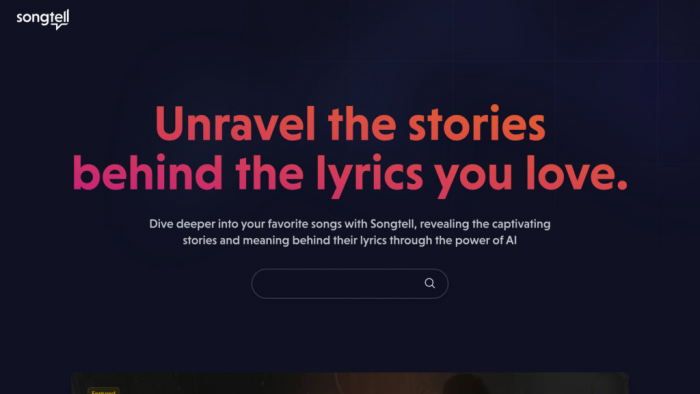
Songtell is an AI-powered song meaning analyzer that takes full lyrics, runs them through a large language model, and outputs narrative-style explanations of what the song might be about. Instead of leaving you alone with cryptic lines, it suggests themes, emotional arcs, and possible interpretations in plain English.
You typically arrive on a straightforward search page, type a song or artist name, pick the right track, and in seconds you see a structured explanation that reads like a short critical essay rather than a crowd comment thread.
The core promise: no more bouncing between random forums and half-finished Reddit theories to figure out what a song is trying to say.
How Songtell Works Behind the Scenes
Songtell’s engine is built on modern natural language processing. It ingests lyrics, segments them into verses, choruses, and bridges, and then analyzes them for patterns in narrative, imagery, tone, and recurring motifs.
At a high level, the pipeline looks like this:
● Lyrics retrieval: the system pulls lyrics from its catalog or a partnered database.
● Structural parsing: it identifies sections (verse, chorus, bridge) and important repetitions.
● Semantic analysis: the AI model looks at word choice, metaphors, and context clues to infer themes and emotional states.
● Interpretation generation: it composes a readable explanation—usually a top-level summary plus section-wise commentary.
Because this is model-driven and not artist-signed, every explanation is a “best-effort” reading, not canon. That distinction becomes critical when we talk about accuracy and trust later on.
Feature Set: What You Actually Use Day to Day
AI Explanations of Lyrics
The marquee feature is AI-driven interpretation. Songtell’s explanations aim to surface core themes such as heartbreak, disillusionment, escape, growth, or social critique, while also decoding metaphors and symbolic imagery in the lyrics. It highlights the emotional journey whether hopeful, resigned, angry, nostalgic, or conflicted and provides a concise narrative of the story the lyrics convey.
On well-known tracks, the outputs often read like a condensed review in a music magazine: not academic, but more thoughtful than a random fan comment.
Section-by-Section Breakdown
Rather than giving you one bland paragraph, Songtell often organizes insight by part of the song. Explanations may follow the structure of verse 1, chorus, verse 2, bridge, etc., so you can see how the meaning evolves from start to finish. This format is particularly helpful when a chorus sounds uplifting but the verses are darker or more ironic.
Search, Catalog, and Discovery
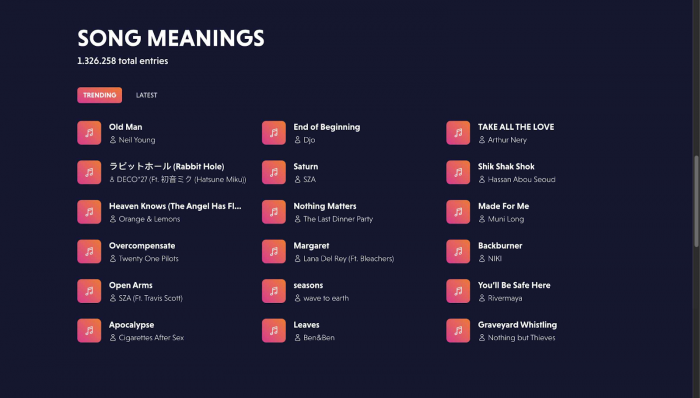
Songtell’s catalog covers a large number of tracks across genres and eras, with the strongest coverage in English-language and mainstream music. You can:
● Search by song title or artist name.
● Occasionally search using lyric fragments when you don’t remember the title.
● Browse popular or trending songs that many users are trying to understand at the moment.
This makes Songtell not just a diagnostic tool for a single song, but also a discovery surface for songs people find puzzling or thematically rich.
Multi-Language and Educational Use
Songtell has partial support for non-English tracks, though the nuance of interpretations varies by language and data quality. For teachers and students, this opens up a useful space where lyrics become contemporary “texts” to analyze like poetry: metaphors, narrative voices, symbolism, and cultural references can be explored with AI help.
Education-focused reviewers highlight that this can make literary analysis less intimidating by grounding it in music students already care about.
Interface, Performance, and Accessibility
The interface prioritizes simplicity: a search bar, search results, and an explanation page with minimal clutter. Most users can obtain interpretations without creating an account, which lowers friction and makes quick lookups painless.
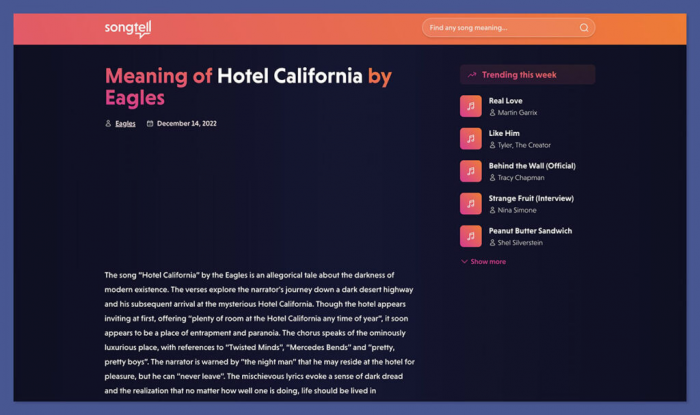
Performance is generally solid: for songs already in the database, explanations load almost instantly; for fresh requests, there can be a short generation delay as the model composes the response. Free users may see ads alongside content, while paid tiers are described as cleaner and ad-free.
How Accurate Is Songtell?
Accuracy is the make-or-break question for any AI interpretation tool.
Where Songtell does well:
It often demonstrates strong emotional accuracy, capturing the core feelings of a song such as grief, longing, empowerment, or regret especially when the lyrics are relatively straightforward. It is also effective at thematic framing, correctly identifying the central idea, whether it’s breakup healing, fame-induced anxiety, or political protest. Additionally, when a song follows a clear storyline, Songtell provides solid narrative clarity by summarizing the plot and the artist’s motivation.
Where it struggles:
It tends to struggle with dense cultural references, where lyrics rely on niche slang, local politics, or insider context, often resulting in more generic interpretations. Sarcasm and irony can also be misread, with the AI sometimes taking lines too literally instead of recognizing a tongue-in-cheek tone. In songs with highly abstract or fragmented lyrics, its explanations may become vague and high-level, offering limited deeper insight.
Trust, Transparency, and Explainability
Trust in an AI like Songtell doesn’t just depend on how accurate it can be; it also depends on how honest it is about its own limits. Reviewers point out several trust-related aspects:
● Clear AI labeling: Songtell does make it apparent that explanations are generated by AI, not written or approved by the artist.
● No implied official endorsement: interpretations are not presented as official, although the confident tone of the writing can still mislead inattentive readers.
● Limited methodological detail: while it’s obvious that a language model plus lyrics database is involved, the platform typically doesn’t provide deep technical documentation of the models, training data, or evaluation methods.
A best-practice way to frame this in your article is: treat Songtell as a well-read friend offering a plausible reading of a song not as a court ruling on what the song “really means.” Cross-check with interviews, artist statements, and community knowledge when accuracy matters.
AI Bias and Cultural Limitations
Like any model trained on text-heavy corpora, Songtell inherits biases and blind spots from its underlying data.
Common limitations include language bias, with English and Western mainstream tracks receiving richer interpretations than those from other languages or smaller scenes. There is also cultural flattening, where context-specific songs are reduced to broad themes like “struggle” or “hope.” Above all, normative assumptions can lead the AI to apply a dominant cultural lens, missing more nuanced or subversive meanings.
For sensitive topics like politics, religion, identity, it’s wise to treat Songtell as a starting point and actively seek human perspectives from within the culture the song comes from.
Data, Licensing, and Privacy
From a user perspective, two questions matter here: where do the lyrics come from, and what happens to your data?
● Lyrics and rights: publicly available descriptions indicate that Songtell relies on external lyrics databases and licensing arrangements, though details are not always front-and-center in consumer-facing pages.
● User data: as a web service, Songtell uses standard analytics, cookies, and logs, and some features may require a basic account; however, many interpretations are accessible without logging in.
Practical Advice: avoid pasting any personally sensitive information into the search field (even though songs are generally non-sensitive) and review the platform’s privacy policy if you plan to create an account or use it heavily.
Reliability, Updates, and Long-Term Use
Reliability isn’t just about uptime, it’s about whether the tool remains useful as listening habits evolve. Songtell’s database has steadily grown, with more songs and genres added over time. While new releases may not have detailed interpretations right away, popular tracks are usually covered fairly quickly. In terms of performance, it is generally stable, with only occasional delays when generating interpretations for songs that haven’t been analyzed before.
Because quality can vary song by song, it’s smart to test a handful of tracks you know well before forming a firm opinion on how much you want to rely on it.
Pricing and Value for Money
Songtell typically follows a freemium model with an accessible entry point and optional upgrades.
The free tier gives users access to a broad range of song interpretations, making it easy to explore meanings behind different tracks, but it includes ads and may come with some limits on usage or depth.
The premium tier, on the other hand, offers an ad-free experience, faster and prioritized analysis for newly requested songs, and additional advanced features that provide richer and more detailed insights.
Price points tend to sit in the low, consumer-friendly SaaS range (a few dollars a month), with discounts for longer-term plans. For listeners who only occasionally look up song meanings, the free tier will usually suffice; heavy users, educators, and creators may find a subscription justified by time saved and extra polish.
Pricing Overview
| Plan / Option | Indicative Price* |
| Free Plan | $0 |
| Premium Subscription | Around $3.99–$9.99 per month |
| Credit Pack – Starter | From $0.99 for 10 analyses |
| Credit Pack – Bulk | Around $9.99 for 200 analyses |
| Annual Subscription | Roughly $50–$90 per year |
Who Will Get the Most Out of Songtell?
Songtell serves a broad spectrum of users rather than a single niche. Curious listeners gain quick, non-technical explanations that move beyond “vibe” into actual thematic and narrative discussion. Students and teachers can anchor classroom conversations about metaphor, narrative, and social themes in music students already care about.
Journalists, bloggers, and video creators can use Songtell’s interpretations as scaffolding for deeper pieces, saving research time while still layering their own knowledge and sources on top. Fans of foreign-language music benefit from a bridge between literal translation and deeper emotional or cultural meaning, even if that bridge is sometimes imperfect.
For anyone who regularly pauses a track to ask “what is this actually saying?”, Songtell offers a fast, structured way to explore possible answers.
Songtell vs Genius vs Musixmatch
To understand Songtell’s place in the ecosystem, it helps to compare it with two giants of the lyrics world: Genius and Musixmatch.
Genius is built around human annotations. Fans and sometimes artists add notes to individual lines, linking to interviews, memes, and historical references. This delivers rich, nuanced context where communities are active, but coverage and quality vary widely from song to song.
Musixmatch focuses on delivering accurate lyrics and synced, karaoke-style displays across a vast catalog, with integrations into major streaming services. It is the go-to option when you want to read or sing along, but it offers limited depth when it comes to thematic interpretation.

Songtell occupies a distinct middle ground. It does not rival Musixmatch in synced playback or Genius in community annotation, but it does something neither system is designed to do: generate a holistic, song-level explanation in seconds using AI. For listeners who want a cohesive narrative interpretation rather than a patchwork of comments, this is a compelling value proposition.
Put simply:
● Choose Genius for human nuance, debate, and deep references.
● Choose Musixmatch for lyrics access and synced displays.
● Choose Songtell for an instant, coherent explanation when you don’t want to wade through comments.
Pros and Cons at a Glance
Advantages
● Strong at emotional and thematic interpretation for mainstream songs.
● Structured, readable format that’s more useful than scattered forum posts.
● Minimal learning curve and quick results with or without an account.
● Valuable for education and content creation as a fast idea generator.
Drawbacks
● Interpretations are AI guesses, not artist-verified truths.
● Generic or shallow explanations for culturally dense, highly abstract, or niche songs.
● Potential cultural bias toward English and Western contexts.
● Free tier includes ads and occasional usage friction; details of plans vary.
Verdict: Is Songtell Worth Your Time?
Taken as a whole, Songtell delivers on its promise: it uses AI to make song meanings more accessible, quickly and at scale. For casual listeners, teachers, and many creators, it offers a rare combination of breadth, structure, and ease of use that genuinely changes how you can engage with lyrics.
Based on my overall evaluation, the ratings would be:
● Accuracy: around 3.8/5 (strong on themes, variable on nuance).
● Transparency: around 3.5/5 (clearly AI-driven, but method is a black box).
● Reliability and UX: around 4.0/5 (stable and easy to use).
It is not a replacement for artist interviews, scholarly criticism, or passionate fan essays and it does not need to be. The most productive way to use Songtell is to treat it as an intelligent, well-read companion: one that proposes a plausible reading, invites you to think more deeply, and leaves plenty of room for your own interpretation and further research.
Post Comments
Be the first to post comment!
Related Articles