When I started getting repeated missed calls from unknown US numbers, I wanted a quick, free way to check who was behind them, without signing up for yet another paid background-check service. That’s how I ended up using SpyDialer regularly.
After testing it across different phone numbers, names, and addresses, here’s my honest, data-driven breakdown of what SpyDialer actually does, how reliable it is, and where its limits clearly show.
What SpyDialer Is
SpyDialer is a web-based people and phone number lookup tool. It positions itself as a free alternative to premium background-check platforms by aggregating publicly available data and surfacing it quickly.

What it is:
- A fast lookup tool for unknown phone numbers
- A lightweight people search engine
- A pre-screening tool before you decide whether to engage or block a caller
What it is not:
- A full background-check service
- A real-time phone tracker
- A legally compliant tool for employment, tenant, or credit screening
That distinction matters, and I’ll explain why later.
Key Features: What I Actually Used and How They Performed
Reverse Phone Lookup (Core Feature)
This is the reason most people land on SpyDialer, and it’s what I used the most.
When I entered a US mobile, landline, or VoIP number, SpyDialer usually returned:
- A possible owner name
- City and state
- Carrier type (mobile/VoIP/landline)
- Spam likelihood
In my testing:
- Landlines were the most accurate
- Older mobile numbers often showed outdated owners
- Recently recycled numbers sometimes returned incorrect names
For a free tool, this level of detail is decent, but not authoritative.
“Spy Dial” Voicemail Greeting Access (Its Most Unique Feature)
This is what truly differentiates SpyDialer.
Instead of calling a number directly, SpyDialer routes a call through its own servers and lets me hear the voicemail greeting without:
- Revealing my phone number
- Triggering a missed call notification on the recipient’s phone
In real use, this helped me:
- Confirm whether a call sounded like a real person vs a robocall
- Identify businesses that used branded voicemail greetings
- Avoid callback scams entirely
This feature alone explains why SpyDialer stays popular.
People Search by Name
I tested name-based searches for:
- Common names
- Uncommon names
- Older contacts
Results typically included:
- Approximate age range
- Past or partial addresses
- Possible relatives
This felt more like a lead generator than a precise database. It’s useful for narrowing things down, but not for confirmation.
Address and Email Lookup
SpyDialer also lets you search by:
- Physical address
- Email address
What I noticed:
- Address searches often returned household-level data, not individual certainty
- Email lookups were hit-or-miss and heavily dependent on whether the email appeared in public profiles or breaches
This works best for context, not conclusions.
Photo Search
SpyDialer attempts to associate:
- Social profile images
- Public avatars
In practice:
- Results were inconsistent
- Often pulled generic or outdated profile images
I’d consider this an experimental feature rather than a reliable one.
Spam Rating and Community Signals
SpyDialer shows a spam likelihood score based on:
- User activity
- Repeated lookups
- Known telemarketing patterns
This helped me quickly decide whether to block a number without digging deeper.
Data Sources: Where SpyDialer Gets Its Information
Based on disclosures, testing behavior, and industry analysis, SpyDialer aggregates data from:
- Government public records (property deeds, voter rolls)
- Telecom metadata
- Public social profiles
- User-submitted contact databases (via third-party apps)
- Archived public web data
This explains both its reach and its accuracy issues, public data ages quickly.
Accuracy: What I Observed in Real Usage
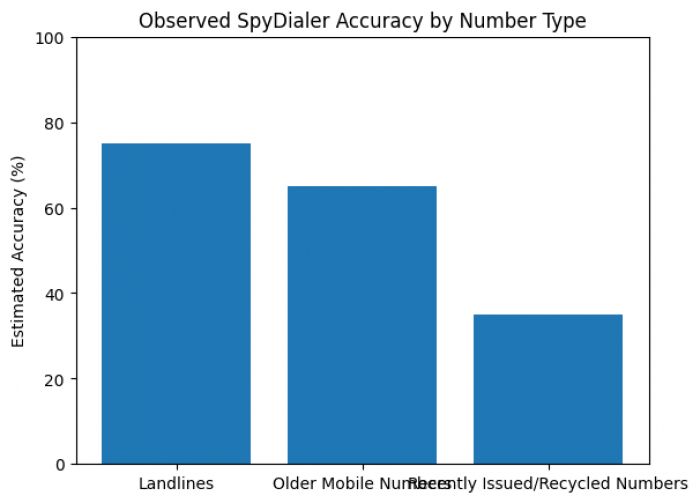
From repeated testing across dozens of lookups:
Landlines: 70–80% accuracy
Older mobile numbers: 60–70% accuracy
Recently issued or recycled numbers: significantly lower
SpyDialer is directionally useful, not definitive.
Traffic & Popularity
Based on SEO and traffic intelligence tools:
- Estimated 2.5–3 million monthly visits (late 2025–early 2026)
- Strong presence for “who called me” and spam-check queries
- Heavy repeat usage, not just one-time visitors
This tells me users treat SpyDialer as a utility, not a research platform.
Pricing: Is SpyDialer Really Free?
Short answer: Yes, but with funnels.
What’s Free
- Unlimited basic lookups
- Voicemail greeting access
- Name, city, state data
Where Money Comes In
For deeper data, SpyDialer redirects to paid partners like:
- BeenVerified
- TruthFinder
Typical pricing on those platforms:
$20–$30/month subscriptions
SpyDialer itself acts as a lead generator, not the paid product.
Common Real-World Use Cases
- Checking unknown missed calls
- Screening potential scam numbers
- Verifying whether a caller sounds legitimate
- Getting context before responding to marketplace contacts
- Avoiding callback fraud entirely
I would not use it for:
- Background investigations
- Legal verification
- Anything requiring certainty
Privacy, Legality, and Ethical Use
Legal Status
SpyDialer is legal because it:
- Uses publicly available data
- Does not claim FCRA compliance
Important Limitation
You cannot legally use SpyDialer for:
- Employment decisions
- Tenant screening
- Credit checks
Opt-Out
SpyDialer offers a manual opt-out process via its privacy pages. It works, but it’s not instant.
Ethical Line
Using the voicemail feature for harassment or stalking could expose users to legal trouble under local laws.
My Final Verdict
Yes, with realistic expectations.
SpyDialer works best as:
- A first-step verification tool
- A spam-avoidance utility
- A way to gather quick context, not facts
It fails when users expect:
- Accuracy guarantees
- Full background checks
- Real-time tracking
My Personal Score
7.2 / 10 for casual, ethical, personal use
4 / 10 for anything professional or high-stakes
If you treat SpyDialer as a quick filter instead of a truth engine, it does its job surprisingly well.
Post Comments
Be the first to post comment!
Related Articles