Table of Content
- The Return of Voice in an Overexposed World
- The Idea: Anonymous, Yet Intimate
- What Makes AirTalk Different from Other Random Chat Platforms
- A Safer Successor to Omegle? Maybe, But Different
- Privacy That Feels Personal, Not Performative
- Real Conversations, Real People, No Pressure
- The Invisible Algorithm: How AirTalk Matches Voices
- What’s Missing (and That’s Okay)
- Data and Legitimacy: Is AirTalk Real or Risky?
- Who Is AirTalk Really For?
- AirTalk vs Competitors: A Quick Look at the Market
- The AirTalk Paradox: Old-School in a New Age
The Return of Voice in an Overexposed World
Everyone talks but few really talk anymore.
In a time when every conversation seems to happen through filters, DMs, or video boxes, AirTalk Live is trying to bring back something older, slower, and oddly refreshing: voice-only conversation.
No video. No usernames. No likes. Just random strangers matched by voice, connecting across borders in real time.
It’s a strange idea that suddenly feels necessary. Especially after Omegle’s shutdown, people have been looking for new ways to connect that don’t feel either creepy or commercial, and AirTalk is quietly filling that void.
The Idea: Anonymous, Yet Intimate
AirTalk Live works like this: you open the site, choose your country filter or interest, and click “Start Talking.” Seconds later, you’re connected to a random voice somewhere in the world.
It doesn’t sound revolutionary until you realize how unfiltered that feels in 2025. There’s no camera to judge, no profile to curate, no chat history to overthink. Just two people talking.
It’s what online interaction used to be: simple and fleeting. You don’t exchange details; you exchange moments.
What Makes AirTalk Different from Other Random Chat Platforms
AirTalk doesn’t try to be everything. It doesn’t bombard you with filters, coins, or subscription pop-ups.
Instead, it bets on safety through limitation.
The tool includes:
- AI moderation for image transfers (screens all uploads)
- Country filters to narrow who you connect with
- Interest tags for better topic matching
- Voice-only interface to remove visual risk factors
- It’s not sleek or complex — and that’s the point. Its appeal lies in what it doesn’t ask for.
A Safer Successor to Omegle? Maybe, But Different
Comparisons to Omegle are unavoidable, but AirTalk isn’t trying to copy it.
Omegle thrived on chaos, anyone, anywhere, anytime. That freedom eventually became its downfall.
AirTalk seems to have learned from that failure.
It trades complete freedom for managed anonymity. With moderation and no visual exposure, the risk of inappropriate encounters drops significantly.
It’s not bulletproof, but it’s a big improvement. And unlike most replacements, it doesn’t hide behind apps or paywalls.
Privacy That Feels Personal, Not Performative
A recurring problem in modern “free” apps is that they’re only free because you are the product. AirTalk breaks that rule.
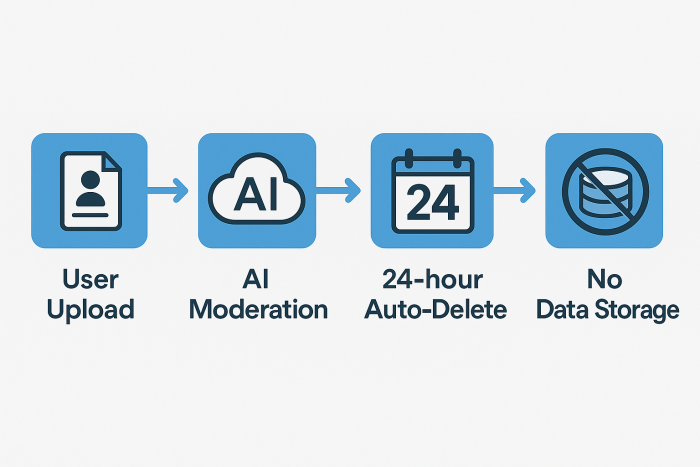
The platform clearly states that uploaded data and images are automatically deleted within 24 hours, and user content isn’t used for AI training or data sales.
For something that connects strangers worldwide, that transparency is rare.
In essence, you get the feeling that AirTalk was built to protect a conversation, not harvest it.
Real Conversations, Real People, No Pressure
Using AirTalk feels strangely human. You might talk to a student in another country, someone winding down after work, or a random person looking to kill boredom.
Because there are no cameras, people tend to open up more. The voice becomes the identity — and that shifts the tone entirely.
A few users online describe it as “the least judgmental chat space on the internet.”
And for once, that doesn’t sound like marketing fluff.
The Invisible Algorithm: How AirTalk Matches Voices
Though it looks simple on the surface, AirTalk’s matching logic is surprisingly thoughtful.
It pairs users using lightweight algorithms that consider country, interest tags, and activity level.
Unlike social media feeds, there’s no algorithm shaping what you should see — only randomness shaping who you might meet.
The unpredictability is the charm. Sometimes awkward, sometimes deep, but almost always real.
What’s Missing (and That’s Okay)
AirTalk isn’t for everyone.
You won’t find polished interfaces, permanent contacts, or endless gamification loops. It’s minimalist even a bit raw.
There’s also no mobile app (yet), and moderation isn’t perfect. Some users have reported occasional silent connections or mismatched filters.
But for something that’s free, browser-based, and constantly improving, those edges almost add to its authenticity.
It feels like the early web again imperfect but alive.
Data and Legitimacy: Is AirTalk Real or Risky?
For a random-chat platform, trust is everything. According to ScamAdviser, AirTalk Live scores “likely legitimate” with verified SSL encryption and a clean reputation.
SimilarWeb data also shows monthly traffic in the hundreds of thousands, primarily from the U.S. and India — suggesting real, active use.
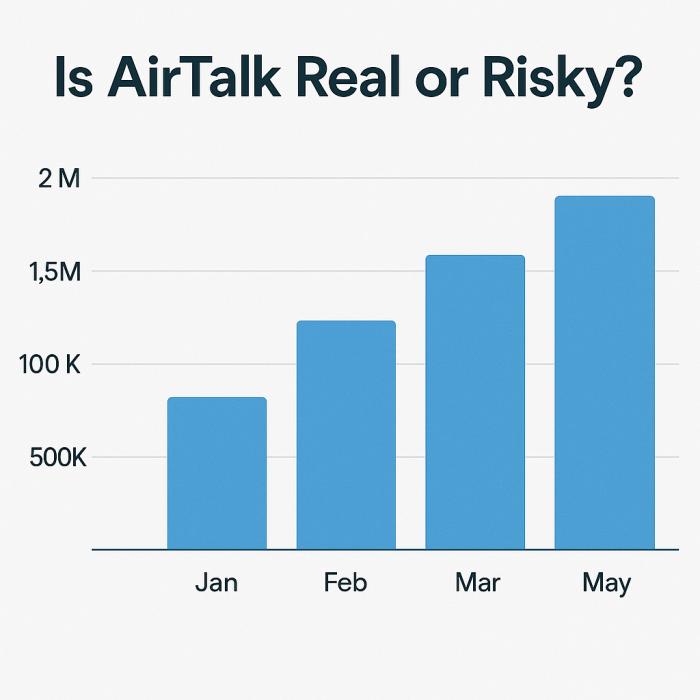
So yes, it’s safe to say AirTalk isn’t some shady replica or throwaway clone — it’s a functioning, growing platform with actual users.
Who Is AirTalk Really For?
If you’re the kind of person who:
- Prefers voice over video,
- Misses the randomness of early internet chatrooms, or
- Just wants to speak freely without digital baggage —
Then, AirTalk fits you perfectly.
But if you crave persistent connections or high-end UX, this isn’t the tool for you. AirTalk is about fleeting communication — conversations that vanish but linger in thought.
AirTalk vs Competitors: A Quick Look at the Market
| Platform | Mode | Cost | Safety | Unique Trait |
| AirTalk Live | Voice-only | Free | AI-moderated | Anonymous, private |
| Tohla | Video/Text | Free | Basic | Multi-mode chat |
| FaceFlow | Video | Free | Average | Mini social network |
| Chatblink | Text | Free | Low | Simple random chat |
| OmeTV | Video | Free | Moderate | App-based alternative |
This makes AirTalk the most low-tech yet high-trust option among its peers — focusing on conversation, not content.
The AirTalk Paradox: Old-School in a New Age
There’s an irony here — in 2025, the next big social trend might actually be going backward.
Voice-only chat feels almost nostalgic, but in a landscape dominated by image filters and algorithmic attention, that simplicity has power again.
AirTalk doesn’t try to compete with AI companionship or hyper-real avatars. It just gives you another person to talk to.
And that, somehow, feels futuristic.
When you close a tab after an AirTalk call, there’s no profile to check, no photo to linger on just a lingering memory of someone’s tone, laugh, or silence.
That’s what makes it special.
In a world obsessed with visibility, AirTalk reminds us that connection doesn’t always need a camera.
Sometimes, all you need is a voice unfiltered, unrecorded, and briefly human.
Post Comments
Be the first to post comment!
Related Articles