Techexample.org appears frequently in search results for beginner-friendly technology topics, AI explainers, coding basics, software overviews, and trending tools. At first glance, it presents itself as a helpful, accessible resource for readers who want quick answers without technical complexity.
However, visibility alone does not equal credibility. This report takes a deeper look at how the site operates, what signals it sends to users and search engines, and whether it should be trusted as a learning or reference source.
How the Platform Positions Itself in the Tech Content Space
Techexample.org frames itself as a simplified learning destination. Its language, layout, and topic selection suggest a focus on entry-level understanding rather than professional mastery.
In practice, the site functions as a broad, multi-topic tech blog rather than a focused educational platform. It publishes a high volume of articles across loosely connected categories, aiming to capture search traffic for common technology queries rather than build authority in a single niche.
This positioning makes it approachable, but also limits how far users can rely on it.
Topic Coverage and Editorial Breadth
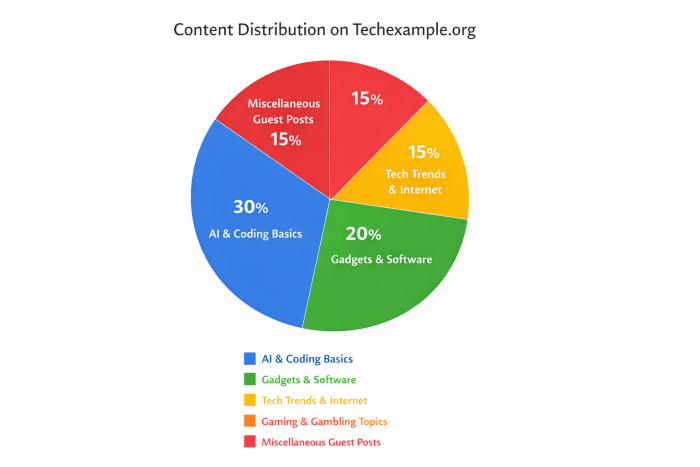
One of the most noticeable traits of Techexample.org is content breadth without depth.
The site covers:
- General AI and automation concepts
- Basic programming or “how it works” articles
- Gadget and software summaries
- Technology trends and internet topics
At the same time, it frequently publishes guest-style content that drifts away from core technology, such as gaming guides, gambling-adjacent topics, or service listings unrelated to tech education. This pattern suggests the platform prioritizes publishing volume and backlink opportunities over a tightly curated editorial mission.
Writing Style and Information Density
From a readability standpoint, the site is easy to consume:
- Short paragraphs
- Simple explanations
- Minimal jargon
- Predictable formatting
This makes it friendly for beginners or casual readers. However, external audits and content reviews consistently note that the articles:
- Rarely include original research
- Do not cite authoritative primary sources
- Avoid advanced comparisons or technical nuance
As a result, the content often provides a surface-level understanding rather than actionable or expert-grade insight.
Transparency, Authorship, and Accountability Signals
Credibility online is heavily influenced by who is responsible for the content. Here, Techexample.org shows notable gaps.
- Most articles are attributed to a generic “admin” profile
- There are no visible author bios or credentials
- No editorial board or expert reviewers are disclosed
- The “About Us” section is brief and non-specific
This lack of identifiable authorship makes it difficult to assess expertise or accountability, especially for readers using the site for learning or decision-making.
Contact Details and Operational Footprint
Techexample.org provides limited contact transparency:
- A generic email address rather than a domain-based one
- A phone number with a +92 country code
- No physical office address
- No registered company information
Additionally, the site relies on Telegram and WhatsApp contact links, which are more commonly associated with guest-post coordination or link sales than with established editorial organizations.
These signals collectively point to a decentralized, low-overhead operation rather than a formally structured media brand.
External Links, Monetization Patterns, and Risk Indicators
A closer look at the site’s footer and outbound links reveals references to gambling, betting, and lottery-related websites. This is a significant indicator of the site’s revenue model.
Such links are typically associated with:
- Paid guest posting
- Backlink sales to restricted or high-risk niches
- SEO-driven content monetization
While not illegal, this practice places the site at a higher risk of search engine penalties and reduces its suitability as a trusted educational reference.
Reputation and Independent Signals
Techexample.org has:
- No meaningful presence on Trustpilot, G2, or similar review platforms
- No verified social media community (LinkedIn, X, Facebook)
- Low to moderate SEO authority
Because of its mixed content quality and lack of editorial transparency, the site is vulnerable to algorithmic demotion, especially under updates focused on helpful content, EEAT (Experience, Expertise, Authority, Trust), and spam reduction.
Trust and Safety Scorecard
Below is a consolidated Trust & Safety Scorecard based on transparency, content integrity, and operational signals.
| Factor | Rating | Notes |
| Website Security (HTTPS, malware) | Good | No phishing or malicious download indicators |
| Content Accuracy | Moderate | Acceptable for basics, unreliable for advanced topics |
| Editorial Transparency | Low | No authors, no expert attribution |
| Authority & Citability | Low | Not suitable for academic or professional citation |
| Monetization Ethics | Low | Heavy guest-post and backlink signals |
| User Safety Risk | Moderate | Safe to browse, but content quality varies |
| Long-Term Reliability | Low | High risk under future search engine updates |
Overall Trust Level: Low to Moderate
Best Treated As: Informational overview source, not an authority.
Who Can Still Benefit From the Site
Despite its limitations, Techexample.org can be useful in specific scenarios:
- Absolute beginners who want a quick, jargon-free explanation
- Readers exploring unfamiliar tech concepts at a high level
- Users looking for casual, non-technical summaries
It works best as a first exposure platform, not a destination for mastery.
Who Should Avoid Relying on It
The site is not well-suited for:
- Developers, engineers, or IT professionals
- Academic research or coursework
- Business decisions requiring verified technical accuracy
- Brands seeking authoritative backlink partnerships
In these cases, reliance on higher-credibility sources is strongly advised.
Final Assessment
Techexample.org is a content-heavy, SEO-driven tech blog designed to attract broad search traffic through simplified explanations and high publishing frequency. While it is generally safe to browse and accessible to beginners, it lacks the transparency, authorship, and depth required for professional or academic trust.
In the broader tech content ecosystem, it represents a “quantity over quality” strategy, useful for surface-level understanding, but insufficient as a standalone learning or reference platform.
Post Comments
Be the first to post comment!





Table of Content
- How the Platform Positions Itself in the Tech Content Space
- Topic Coverage and Editorial Breadth
- Writing Style and Information Density
- Transparency, Authorship, and Accountability Signals
- Contact Details and Operational Footprint
- External Links, Monetization Patterns, and Risk Indicators
- Trust and Safety Scorecard
- Final Assessment
- Comments
- Related Articles