Table of Content
- 1) Maxim AI — Full-Stack Prompt & Evaluation Platform
- 2) LangSmith — Debugging, Tracing & Evaluation Deep Dive
- 3) PromptLayer — Prompt Versioning & Observability
- 4) Langfuse — Open-Source LLM Observability + Prompt Management
- 5) Weights & Biases Prompts — ML-Grade Prompt Experimentation
- 6) PromptPerfect — Automated Prompt Optimization
- 7) Promptfoo — Dev-First Prompt Testing
- Comparison Table: Key Criteria (2026)
- Final 2026 Ranking Rationale
1) Maxim AI — Full-Stack Prompt & Evaluation Platform
1. Primary Purpose-
All-in-one prompt engineering + experimentation + evaluation + observability suite.
2. Core Features-
● Playground++ with versioning & metadata
● A/B tests, canary prompt rollouts
● Cross-model side-by-side prompt comparisons
● Bulk experimentation with variables & model combinations
● Integrated analytics (latency, cost, quality)
3. Use Cases & Workflows-
Example: Product team A/B tests onboarding prompts across 5 LLMs and compares throughput, user satisfaction, and cost impacts — all from one UI.
4. Metrics / Performance Data-
Teams report faster iteration cycles by eliminating manual comparison spreadsheets and separate tooling — reducing time to stable prompt from weeks to days.
5. Strengths & Weaknesses-
Pros: Full lifecycle support, rich analytics, cross-model evaluation
Cons: Can be too heavy for solo developers or simple use cases
6. Pricing & Licensing-
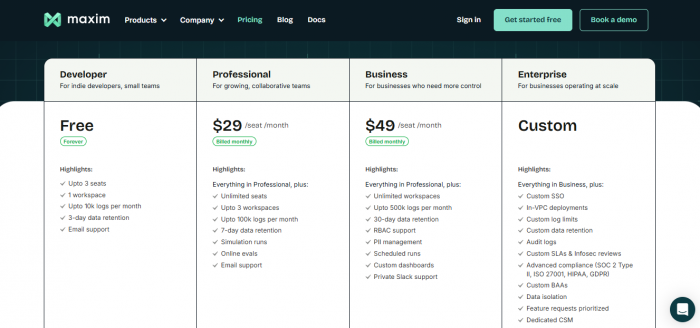
Provides plans for free to developers, for $29/month to professionals, for $49 to business and also provides customs plans to enterprises.
7. Integration Ecosystem-
Supports OpenAI, Anthropic, Bedrock, Vertex AI, and plug-ins for RAG and vector dbs.
8. Who Swears By It-
AI/ML engineering teams in mid to large SaaS and platform companies.
9. Expert Quotes-
Industry forums cite Maxim as one of the “most comprehensive stacks for prompt experimentation at scale.”
Verdict-
Best all-in-one platform for teams that treat prompts like production code.
2) LangSmith — Debugging, Tracing & Evaluation Deep Dive
1. Primary Purpose-
Prompt debugging, execution tracing, versioning, and evaluation.
2. Core Features-
● Prompt Hub with version controls
● Playground with multi-turn context
● Execution trace records (inputs → outputs → tokens)
● Dataset-based test runs with automated metrics
3. Use Cases-
Engineers build complex LangChain workflows and use LangSmith to find where prompt changes break logic.
4. Metrics / Performance-
Teams report faster bug resolution and drift detection in prompt chains.
5. Strengths & Weaknesses-
Strong integration with LangChain
Less suited for teams not using LangChain
6. Pricing-
Tiered plans, often with basic free tier scaling to enterprise licensing.
7. Integration Ecosystem-
Native LangChain + LangGraph focus, extensible to most LLM providers. (Maxim AI)
8. Who Swears By It-
LangChain developers and teams managing multi-step chains.
Verdict-
Best for LangChain projects and complex prompt+chain debugging.
3) PromptLayer — Prompt Versioning & Observability
1. Primary Purpose-
Tracking, versioning, logging, and observability of prompt calls.
2. Core Features-
● Git-style prompt version control
● Execution logs (prompt, response, latency, cost)
● Analytics dashboards
● Rollback & comparison diffs
3. Use Cases-
Track changes across prompt versions in production and regression test outputs before release.
4. Performance Gains-
Teams see ~30% reduction in regressions due to version discipline — compared to ad-hoc engineering notebooks.
5. Strengths & Weaknesses-
Excellent for multi-contributor teams
Doesn’t deeply evaluate semantic quality out of the box
6. Pricing-
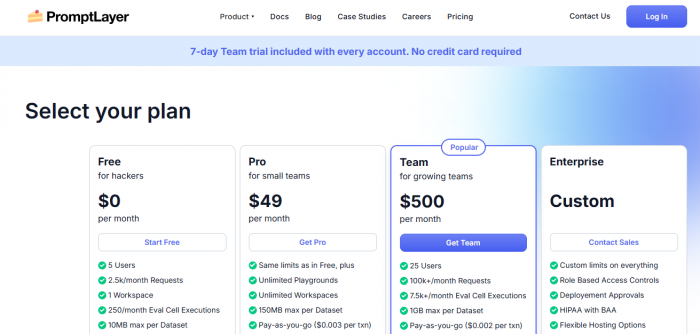
Free and paid tiers (API request-based). (Medium)
7. Integrations-
LangChain, OpenAI, custom APIs. (refontelearning.com)
8. Who Swears By It-
Prompt engineering teams with compliance or audit needs.
Verdict-
Best tool for governance and version discipline
4) Langfuse — Open-Source LLM Observability + Prompt Management
1. Purpose-
Unified open-source platform for trace, prompt storage and evaluation.
2. Core Features-
● End-to-end LLM lifecycle traces
● Prompt versioning + comparison
● Latency, cost, output analysis dashboards
● Human annotations & evaluation sets (Snippets AI)
3. Use Case-
Self-hosted teams needing complete observability with flexible deployment.
4. Strengths & Weaknesses-
Transparent, extensible open-source
Requires infra management
5. Pricing-
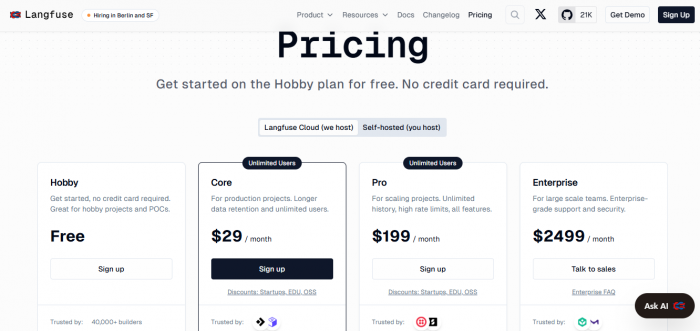
Free open-source; paid support options.
6. Integrations-
OpenAI, LangChain, Flowise, agents. (Snippets AI)
Verdict-
Best for teams needing open infrastructure transparency.
5) Weights & Biases Prompts — ML-Grade Prompt Experimentation
1. Purpose-
Bring experiment tracking discipline from ML to LLM prompt engineering.
2. Core Features-
● Prompt tracking alongside hyperparameters
● Rich visual comparisons & charts
● Artifact versioning
● Collaborative reporting (Maxim AI)
3. Use Cases-
Teams already using W&B for models easily adopt the prompt suite.
4. Strengths & Weaknesses-
Excellent visuals & team reporting
More ML-centric than UI-first
5. Pricing-
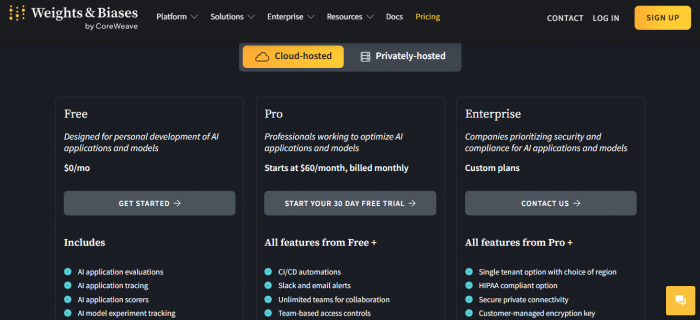
Plans as Free, Pro and Enterprise.
Verdict-
Best if your org already uses W&B for ML workflows.
6) PromptPerfect — Automated Prompt Optimization
1. Purpose-
Automated prompt refinement and optimization across models.
2. Core Features-
● AI-driven prompt refinements
● Side-by-side output comparisons
● Model-agnostic compatibility
● Multilingual support (Prompts.ai)
3. Use Cases-
Non-technical teams enhancing prompt quality without deep engineering.
4. Strengths & Weaknesses-
Very user-friendly
Less control than developer-centric tools
5. Pricing-
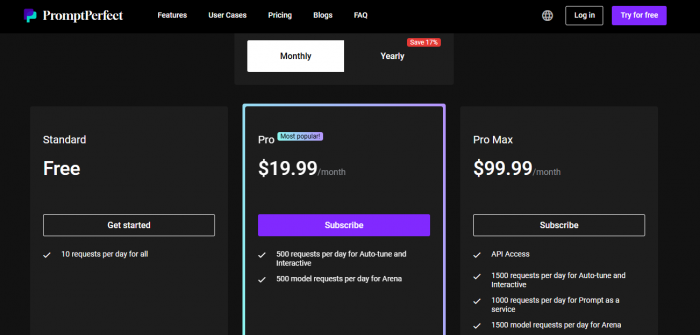
Free plans and paid plans for $19 and $99.
Verdict-
Best for quick optimization without deep engineering overhead.
7) Promptfoo — Dev-First Prompt Testing
1. Purpose-
CLI-first tool for automated regression testing of prompts.
2. Core Features-
● Define tests as code
● Versioned prompt tests
● Integrates with CI/CD
● Command-line focused (Medium)
3. Use Cases-
Testing teams keeping prompt quality gated by automated regressions.
4. Strengths & Weaknesses-
Integrates into dev workflows
No visual UI
5. Pricing-
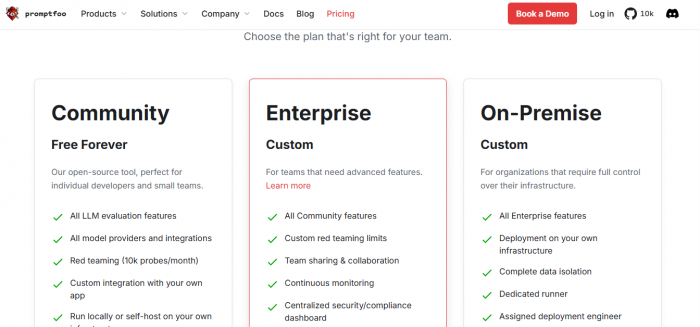
Provides free and Custom plans based on your requirements.
Verdict-
Best for test-driven prompt engineering workflows.
Comparison Table: Key Criteria (2026)
| Tool | Versioning | Eval Metrics | Debugging/Traces | Ease of Use | Best for |
| Maxim AI | Basic prompt version tracking | Solid built-in evaluation metrics | Good tracing and debugging support
| Requires technical familiarity |
Full stack teams |
| LangSmith | Tightly coupled to LangChain workflows | Strong evaluation support for chains | Excellent trace-level visibility
| Steep learning curve if not using LangChain |
LangChain devs |
| PromptLayer | Strong governance and version history
| Limited native evaluation depth
| Basic debugging capabilities | Reasonably easy for teams
|
Teams w/ governance |
| Langfuse | Tightly coupled to LangChain workflows
| Strong evaluation support for chains
| Excellent trace-level visibility
| Setup heavy (self-hosting) |
Self-hosted devs |
| W&B Prompts | Experiment-centric versioning
| Strong metrics via W&B ecosystem | Limited prompt-specific tracing
| Familiar to ML teams |
ML orgs |
| PromptPerfect | Minimal version tracking
| Light evaluation only
| Almost no debugging visibility
| Extremely easy, no technical skills required |
Non-technical users |
| Promptfoo | Simple config-based versions
| Very limited evaluation metrics
| Minimal debugging support
| CLI-oriented, developer-only |
Dev test workflows |
Final 2026 Ranking Rationale
1. Maxim AI — Most complete, reduces iteration cycles and cognitive load across teams. (Maxim AI)
2. LangSmith — Deep debug + trace focus is crucial for complex pipelines. (Maxim AI)
3. PromptLayer — Versioning + observability is essential for enterprise prompt governance. (Medium)
4. Langfuse — Open-source alternative with strong observability. (Snippets AI)
5. Weights & Biases Prompts — Great for teams with existing ML workflows. (Maxim AI)
6. PromptPerfect — Best for rapid optimization with minimal engineering. (Prompts.ai)
7. Promptfoo — Developer-centric test automation for CI/CD. (Medium)
Post Comments
Be the first to post comment!