Table of Content
- The Navigation Tells You More Than the Marketing Copy
- Documentation Is Not About Speed Here, It’s About Defensibility
- Practice Management Is the Real Product
- Telehealth and Patient Tools Exist, But They Are Not the Center of Gravity
- Reviews Point to a Trade-Off, Not a Failure
- The Reality After Looking Past the Surface
- Final Perspective
I didn’t start evaluating Valant by asking whether it had enough features. I started by asking a more uncomfortable question: what kind of practice does this software assume you already are?
After spending time inside Valant’s navigation, reviewing how its clinical, billing, and administrative tools are framed, and cross-checking those signals against real user feedback, it became obvious that Valant isn’t designed for experimentation or minimalism. It’s designed for practices that have already learned, often the hard way, that behavioral health workflows break down quickly when documentation, billing, and compliance aren’t tightly controlled.
This isn’t software built to feel light. It’s software built to feel stable under pressure.
Valant doesn’t try to simplify the realities of behavioral healthcare. Instead, it encodes those realities directly into the system, sometimes at the cost of flexibility, sometimes at the cost of speed. The result is a platform that rewards structured operations and penalizes improvisation.
What follows is not a feature list or a sales pitch. It’s a practical examination of how Valant actually behaves once you look past the marketing, and what that behavior reveals about who it’s really built for, and who it isn’t.
The Navigation Tells You More Than the Marketing Copy
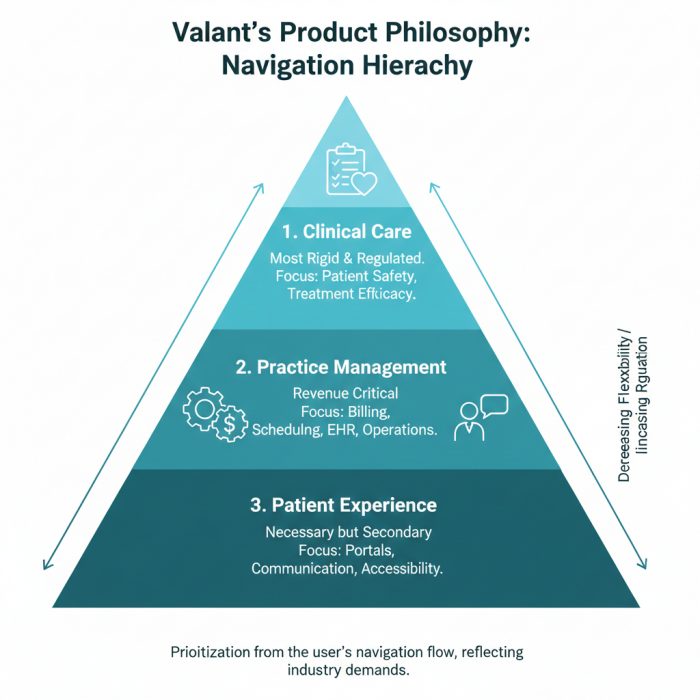
The first reality check comes from simply opening the product menu.
Instead of feature sprawl or generic EHR categories, Valant separates its world into Clinical Care, Practice Management, and Patient Experience. That separation isn’t cosmetic. It reflects a belief that these domains should not bleed into each other.
Clinical work is treated as structured, regulated, and audit-sensitive.
Practice management is treated as revenue-critical and operationally fragile.
Patient experience is treated as necessary, but secondary.
That hierarchy alone explains why Valant feels “heavy” to some users. It isn’t trying to streamline everything into a single smooth flow. It’s trying to contain risk inside clearly defined compartments.
Documentation Is Not About Speed Here, It’s About Defensibility
Valant’s clinical documentation tools are not optimized for expressive freedom. They’re optimized for repeatability, consistency, and reviewability.
The presence of structured treatment planning, standardized assessments, PDMP integration, and clinical reporting tools makes it obvious that Valant assumes documentation will be:
- reviewed
- audited
- billed against
- and possibly challenged
The newer AI Notes Assist doesn’t fundamentally change that philosophy. It accelerates completion, but it doesn’t loosen structure. The AI is there to reduce clerical drag, not to let clinicians improvise.
This is where reality diverges from marketing language.
If a clinician values narrative flexibility over standardized documentation, Valant can feel constraining. But if a practice has ever lost money, or faced scrutiny, because documentation didn’t align with payer expectations, Valant’s rigidity starts to feel intentional rather than limiting.
Practice Management Is the Real Product
If you strip away the branding, Valant behaves less like an EHR and more like a billing-aware operational control system.
Eligibility checks, utilization review, clearinghouse integration, claim assist tools, performance reporting, these aren’t add-ons. They’re foundational. And the recent expansion into full billing services confirms something important:
Valant assumes many behavioral health practices don’t want to “optimize billing.”
They want to stop bleeding money silently.
This focus explains two common user reactions found in reviews:
- Larger practices often say Valant “finally makes billing manageable”
- Smaller practices often say it feels “overbuilt”
Both can be true.
Telehealth and Patient Tools Exist, But They Are Not the Center of Gravity
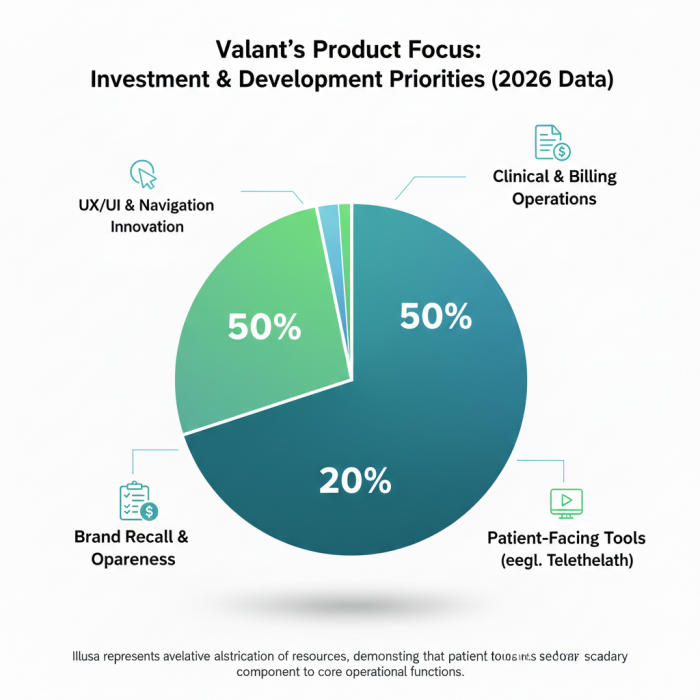
Valant offers telehealth, patient portals, online bill pay, and integrated communications, but none of these are positioned as transformative experiences.
From a reality perspective, this tells me Valant sees patient-facing tools as table stakes, not competitive advantage. They exist to prevent friction, not to delight.
This is not a patient-experience-first platform.
It’s a clinic-stability-first platform.
Practices expecting consumer-grade UX or rapid patient engagement innovation may feel underwhelmed here. Valant is not trying to compete with lightweight therapy apps. It’s trying to ensure continuity and compliance.
Role-Based Paths Reveal the Intended Customer
The “Who Uses Valant” section is unusually blunt. It doesn’t just list job titles, it maps organizational complexity.
Psychiatrists, therapists, billers, owners, managers.
Solo practices, small groups, large organizations, franchises.
Starting, learning, maintaining, growing.
This framing reveals an assumption: practices evolve into complexity whether they want to or not.
Valant positions itself as something you grow into, not something you casually adopt. That’s why onboarding can feel long and the system can feel dense. It’s not built for quick experimentation—it’s built for longevity.
Reviews Point to a Trade-Off, Not a Failure
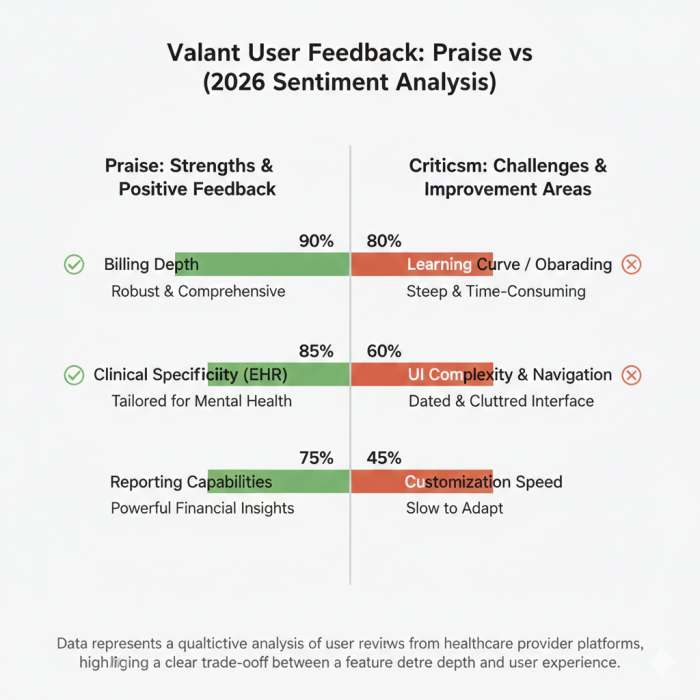
Across Capterra, independent software review platforms, and detailed community write-ups from behavioral health professionals, a remarkably consistent narrative appears. The dominant theme is not that Valant is unreliable, unstable, or technically flawed. In fact, outright claims of system failure are rare. Instead, the recurring observation is that the platform demands adaptation from its users. Clinicians and administrators often describe an onboarding period that requires mental adjustment, workflow restructuring, and a willingness to engage deeply with the system’s structure. This distinction matters. Complaints are not centered on malfunction, but on the effort required to align with the software’s logic.
The praise, when it appears, tends to be highly specific and operationally grounded. Users frequently acknowledge the depth of billing functionality, especially in handling behavioral health nuances such as recurring therapy sessions, insurance verification, and payer-specific documentation expectations. The system’s behavioral health specificity is often highlighted as a differentiator, with structured templates and assessment integrations designed around psychiatric and therapy workflows rather than generic medical charting. Support responsiveness also receives positive mention in multiple discussions, suggesting that once practices commit to the ecosystem, they are not left navigating it alone. Reporting reliability is another consistent strength noted by users who rely on data visibility for revenue tracking, compliance monitoring, and performance metrics.
On the other side of the equation, criticism follows a predictable pattern. The learning curve is frequently described as steep, particularly for smaller practices transitioning from lighter or less structured systems. Interface complexity can initially feel dense, especially when compared to minimalist EHR competitors that prioritize aesthetic simplicity. Pricing is another recurring concern, particularly when compared to more streamlined tools that offer fewer embedded capabilities. Some users also mention slower customization processes, noting that adjustments or configuration changes may not feel instantaneous. However, even these criticisms often acknowledge that the complexity is tied to the system’s structural depth rather than poor engineering.
From an investigative standpoint, this pattern does not represent inconsistency; it represents alignment. The platform appears intentionally designed to front-load effort in order to minimize downstream chaos. Valant demands attention and time early because its architecture is built to reduce long-term operational surprises. It is less concerned with short-term friction and more concerned with protecting practices from compliance gaps, billing errors, and documentation vulnerabilities that can surface months later. In that sense, the cost is measured not only in subscription fees but in cognitive investment during implementation.
The expansion into managed billing services further clarifies Valant’s strategic direction. Moving into billing is not a minor feature addition; it represents a deliberate decision to become operationally embedded within the financial core of a practice. When an EHR vendor manages claims processing, denial resolution, and payer interactions, the relationship shifts from software provider to infrastructure partner. This shift carries tangible implications. Practices become more deeply reliant on a single vendor, but they also reduce the fragmentation that often comes from juggling separate billing companies, clearinghouses, and reporting systems.
For practices already strained by insurance complexities, denial management, and evolving payer requirements, this consolidation can feel like relief. It centralizes accountability and reduces the number of external moving parts that must be coordinated. Predictability increases, even if flexibility narrows. However, for practices that value independence, internal billing control, or the ability to switch vendors quickly, this deeper integration may feel restrictive. The trade-off becomes clear: greater operational stability in exchange for tighter vendor reliance.
Valant does not aggressively market this trade-off as a selling point, but its strategic posture suggests it understands the implications. Rather than positioning itself as a lightweight, easily replaceable tool, it leans into the role of long-term operational backbone. For some organizations, that alignment feels stabilizing. For others, it requires a philosophical shift about how much control they are willing to consolidate within a single platform.
Internal Signals Matter Too
Glassdoor feedback doesn’t show a chaotic or sales-driven culture. It reflects a company focused on healthcare workflows, compliance, and long-term customers rather than rapid experimentation.
That internal stability mirrors the product itself. Valant moves carefully, sometimes slowly, but rarely impulsively.
The Reality After Looking Past the Surface
After reviewing everything, from screenshots to services to user sentiment, my conclusion is simple:
Valant is not an EHR you choose because it looks good.
It’s an EHR you choose because your practice can’t afford operational fragility anymore.
It prioritizes:
- structure over flexibility
- predictability over speed
- compliance over customization
That makes it the wrong choice for some, and the right one for others.
Final Perspective
I don’t see Valant as “best” or “worst.”
I see it as opinionated software for practices that have already felt the cost of chaos.
If a practice is small, cash-based, and values simplicity above all else, Valant will feel excessive.
If a practice is scaling, billing insurance, managing multiple roles, and trying to survive audits and payer complexity, Valant stops looking heavy, and starts looking deliberate.
Post Comments
Be the first to post comment!
Related Articles