Table of Content
- The Direct Answer Explained Clearly
- Why Celsius and Fahrenheit Rarely Match
- The Numerical Relationship Between Celsius and Fahrenheit
- How Temperatures Compare Above and Below −40
- What −40 Actually Means in Physical Terms
- Why People Say “40 Below” Without Units
- Why This Happens Only Once
- Final Conclusion
The Exact Science Behind the Only Temperature Where Both Scales Agree
The question “Which is colder: −40°C or −40°F?” sounds straightforward, yet it reveals one of the rare moments where two entirely different measurement systems arrive at the same numerical answer.
The correct and complete answer is simple:
Neither is colder. −40°C and −40°F are exactly the same temperature.
The Direct Answer Explained Clearly
−40°C = −40°F
This equality is exact, not approximate
It occurs at only one temperature
To understand why, we must look at how temperature scales behave numerically, not emotionally or descriptively.
Why Celsius and Fahrenheit Rarely Match
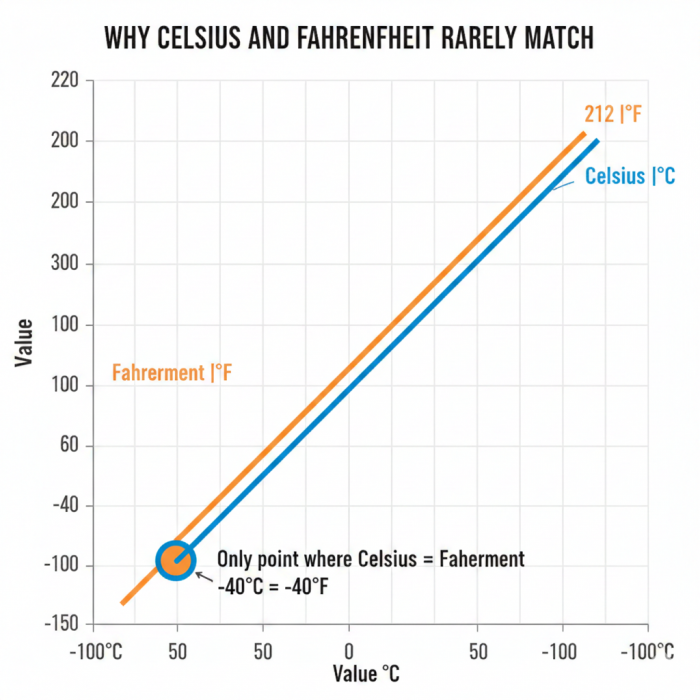
Celsius and Fahrenheit measure the same physical reality, thermal energy, but they use different numerical frameworks.
Two things differ between them:
- Where zero is placed
- How much temperature change one degree represents
Because both scales are linear, these differences guarantee that:
- The numbers will diverge at most temperatures
- The numbers will intersect at one specific point
That point happens to be −40.
The Numerical Relationship Between Celsius and Fahrenheit
The relationship between the two scales is defined by a fixed formula:
F=(C×95)+32F =(C×59)+32
This formula contains two important facts:
- Fahrenheit degrees are smaller (9/5 factor)
- Fahrenheit values are shifted upward by 32 degrees
As temperatures decrease, Celsius values drop faster than Fahrenheit values. This faster numerical decline forces the two scales to cross.
How Temperatures Compare Above and Below −40
| Reference Point | Celsius (°C) | Fahrenheit (°F) |
| Boiling water | 100 | 212 |
| Average human body | 37 | 98.6 |
| Room temperature | 20 | 68 |
| Freezing water | 0 | 32 |
| Same on both scales | −40 | −40 |
| Absolute zero | −273.15 | −459.67 |
Key observations:
Above −40 → Fahrenheit values are numerically higher
Below −40 → Fahrenheit values become numerically lower
The transition happens only at −40
What −40 Actually Means in Physical Terms
At −40, the cold is no longer just uncomfortable, it becomes operationally dangerous.
At this temperature:
- Exposed skin can freeze in 5–10 minutes
- Moisture in breath freezes instantly
- Metals lose ductility and become brittle
- Vehicle batteries may lose over half their capacity
- Fuels, oils, and hydraulic fluids require special formulations
This is the point where human biology and engineered systems begin to fail simultaneously.
Where −40 Occurs in the Real World
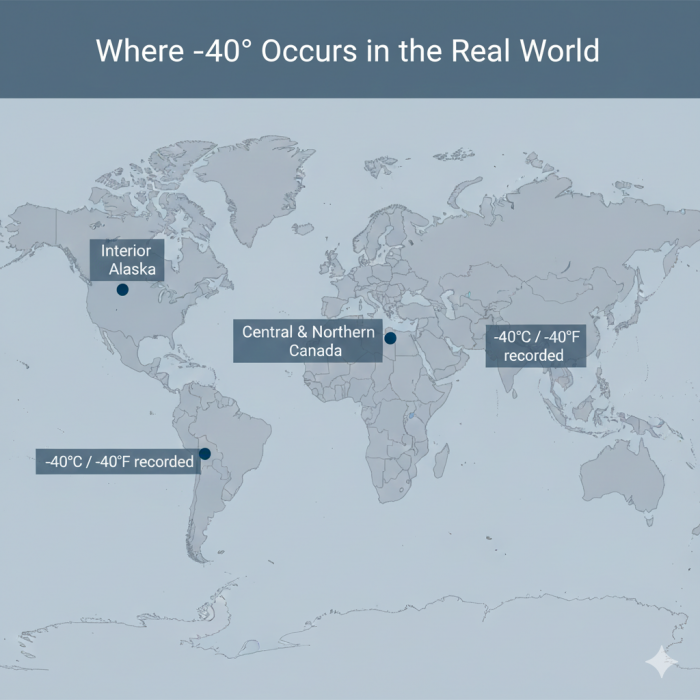
−40 is not theoretical. It is regularly recorded in:
- Interior Alaska
- Central and northern Canada
- Eastern Siberia
In these regions, −40 is recognized as a critical threshold, not a curiosity.
Why People Say “40 Below” Without Units
In places that experience −40, people often say:
“It’s forty below.”
No Celsius. No Fahrenheit.
At −40:
- Both scales show the same number
- Stating the unit adds no information
- The number alone communicates severity
This linguistic habit exists only because −40 is a shared value.
Why This Happens Only Once
Temperature scales are linear systems with:
Different starting points
Different degree sizes
Linear systems with different slopes and offsets can intersect only once.
That single intersection is −40.
Above it, the scales disagree.
Below it, they disagree again.
At −40, they match perfectly.
Final Conclusion
−40°C and −40°F are identical
This equality is mathematically exact
It occurs because of how the two scales are defined
There is only one such temperature
Physically, −40 marks a severe cold threshold for life and technology
So the final, correct answer to the question is not just “neither”, but:
−40 is the only temperature where Celsius and Fahrenheit describe the same physical reality using the same number.
Post Comments
Be the first to post comment!
Related Articles


Millions Still Use Softonic But Should You?
Corey Robson . Feb 27, 2026