Table of Content
- Introduction: A Platform That Rose Fast — and Quietly Shifted
- A Platform Built on Two Promises
- Promise #1: A High-Quality Anime Art Generator
- Promise #2: An Unfiltered AI Chatbot Environment (“The Tavern”)
- The Chatbot Memory Failure Most Users Discover Too Late
- The Core Issue: No Real Long-Term Memory
- Instability Behind the Scenes: Updates, Purges, and Paywalls
- A Pattern of Sudden, Unannounced Changes
- A Trust Score That Reveals Community Friction
- The Split Among Reviewers
- The Business Case: A Platform Divided Against Itself
- Two Products, Two Speeds
- Who Should Approach Yodayo With Caution
- What Yodayo Gets Right (And Why People Stay)
- The Art Generator Keeps the Platform Alive
- The Before-You-Buy Summary
- The Unfiltered Truth
- Final Word: Enjoy What Works — Be Cautious With What Doesn’t
Introduction: A Platform That Rose Fast — and Quietly Shifted
When Yodayo AI began circulating in anime communities in early 2024, it was framed as the next big frontier in digital creativity—a platform where fans could generate breathtaking anime art, build characters, and even chat with AI-driven personalities inside a vibrant, always-awake online world.
It sounded revolutionary.
It was also, unmistakably, seductive.
A year later, Yodayo still commands a loyal and vocal fanbase. Its art-generation tools are widely praised, and industry analysts often cite it as an example of how niche-focused platforms can thrive in a market increasingly dominated by tech giants.
But behind the slick illustrations and community hype, a more complicated story has emerged—one marked by unpredictable updates, inconsistent communication, and a chatbot system that many users describe as fundamentally broken.
This is the side of Yodayo most newcomers don’t see until they’re already invested.
And it’s the side worth understanding before you spend your time, your data, or your money.
A Platform Built on Two Promises

Promise #1: A High-Quality Anime Art Generator
From a business perspective, Yodayo represents a bold bet on the power of specialization. Instead of competing with all-purpose AI tools, it targets a niche that is both highly engaged and rapidly expanding.
Industry researchers estimate the anime economy—spanning streaming, merch, games, and digital art—has crossed the $30 billion mark globally. In that environment, a platform promising specialized tools and community support has a natural advantage.
Yodayo built that advantage on the first of its two core promises:
The Art Studio: Yodayo’s Undeniable Strength
● Fast
● Aesthetically consistent
● Capable of producing images rivaling premium AI models
Community-shared prompts, model variations, and a vibrant creator ecosystem help even beginners produce impressive art from day one.
Promise #2: An Unfiltered AI Chatbot Environment (“The Tavern”)
Unlike mainstream AI companions, Yodayo markets itself as a place where users can roleplay without censorship.
A Playground for Roleplayers
Thousands of community-created characters populate the Tavern—from archetypal anime heroes to entirely original personalities.
At its best, it becomes an endlessly branching interactive fiction world.
But the reality of the Tavern is far less dependable—and, for some users, emotionally damaging.
The Chatbot Memory Failure Most Users Discover Too Late
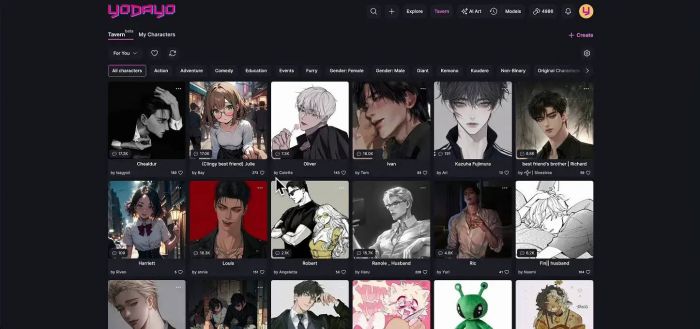
The Core Issue: No Real Long-Term Memory
Yodayo’s biggest issue isn’t a bug, a server failure, or a missing feature.
It’s the absence of lasting memory.
What This Means in Practice
● Chats reset
● Storylines collapse
● Character development disappears
● AI personalities revert to default
● Weeks of emotional investment vanish overnight
This is because Yodayo relies on context-window-only memory, meaning it can’t reliably retrieve earlier events once a conversation becomes long.
Why It Matters
Other AI platforms have already implemented retrieval-based long-term memory systems. Yodayo, despite advertising “better memory” for paid plans, does not appear to have a fully functional version of this.
The Human Impact
Short conversations flourish.
Long narratives implode.
Casual users shrug this off.
Roleplayers often don’t.
Some users described the experience as:
● “betraying”
● “jarring”
● “heartbreaking”
This risk is rarely emphasized to new users.
Instability Behind the Scenes: Updates, Purges, and Paywalls
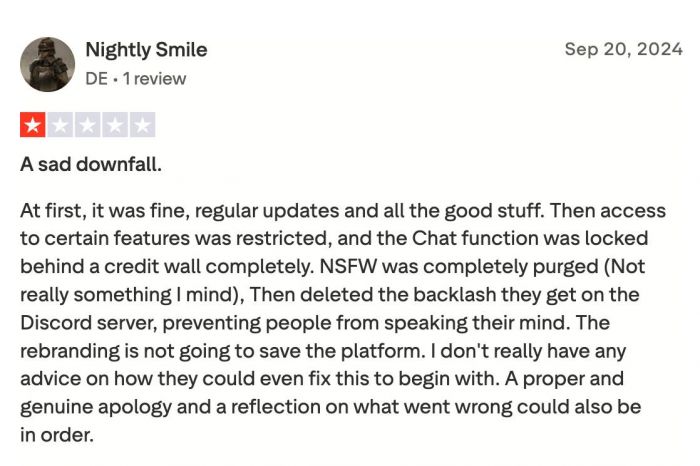
A Pattern of Sudden, Unannounced Changes
Throughout 2024, Yodayo users reported abrupt updates:
● NSFW content removed, then reinstated
● Chat features temporarily locked behind new credit systems
● Model changes altering art styles
● Daily credit adjustments
● “Better memory” labels added without noticeable improvement
The Communication Problem
Many of these updates happened quietly, without clear explanation.
Startups evolve quickly—but rapid, unexplained shifts erode trust.
A Trust Score That Reveals Community Friction
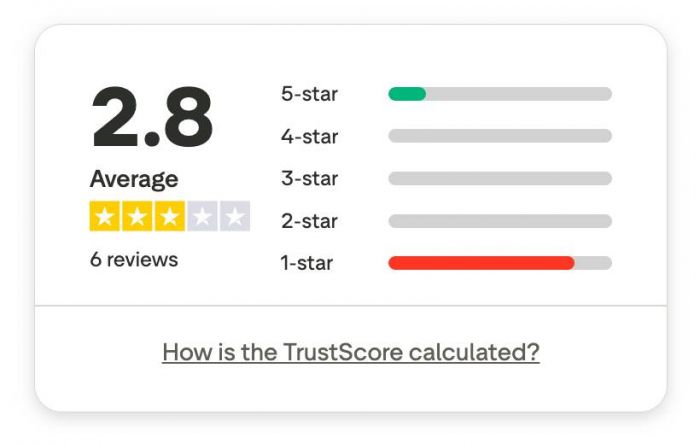
The Split Among Reviewers
Public reviews reveal two sharply different groups:
Group A: Loves the art tools
Group B: Feels misled by monetization or chatbot failures
Analyst Perspective
Experts tracking consumer trends in the AI market warn about platforms with:
● unclear credit systems
● vague premium benefits
● shifting algorithm behavior
● insufficient communication
Yodayo fits squarely into this pattern.
The Business Case: A Platform Divided Against Itself
Two Products, Two Speeds
Yodayo’s development team faces a classic problem:
The Art Generator
● Polished
● Scalable
● Community-driven
● Stable
The Tavern Chatbot
● Volatile
● Memory-limited
● High maintenance
● Emotionally unpredictable
This creates asymmetrical product risk—one weak feature undermining the entire platform’s trustworthiness.
Who Should Approach Yodayo With Caution
1. Long-Term Storytellers or Roleplayers
If you want multi-chapter arcs, expect disappointment. The memory simply doesn’t hold.
2. Emotionally Vulnerable Users
People who bond with AI companions may find continuity breaks emotionally damaging.
3. Power Users Considering Paid Plans
Subscriptions improve art speed—not chat memory reliability.
4. Creators Expecting Stability
Yodayo’s rapid, unpredictable changes can break workflows or art styles overnight.
What Yodayo Gets Right (And Why People Stay)
The Art Generator Keeps the Platform Alive
To be fair and accurate:
Yodayo’s art generator is excellent.
Why Users Still Love the Platform
● Accessible for beginners
● Generous free tier
● Strong community
● Beautiful anime-focused results
This is why Yodayo continues to grow despite its issues.
The Before-You-Buy Summary
The Unfiltered Truth
Here is what every new user deserves to know:
✔ Yodayo is fantastic for AI art.
✘ Yodayo is unreliable for AI chat.
⚠ Yodayo is inconsistent as a platform.
If you come for the art, you’ll likely be thrilled.
If you come for the Tavern, you may regret the emotional investment.
If you come for long-term stability, expect sudden changes.
Final Word: Enjoy What Works — Be Cautious With What Doesn’t
For a niche platform with enormous potential, Yodayo’s future depends on whether it can align its promises with consistent delivery—and whether it can rebuild user trust that instability has worn down.
Until then, the safest approach is simple:
Use the art tools freely.
Treat the chat tools skeptically.
And think carefully before you pay.
Post Comments
Be the first to post comment!
Related Articles