Table of Content
- What I Used Yoodli For (The Real Test Setup)
- The First Thing Yoodli Exposed: My Fillers Were Worse Than I Thought
- The Most Practical Feature: Real-Time Nudges
- Roleplays Felt Useful, But Not Always “Human-Real”
- The Analytics Reports: Good When You Use Them Like Training Data
- What I Didn’t Like
- Who I Think Yoodli Is For
- My Personal Rating
- Final Verdict: I’d Use It Again, But For the Right Reason
I didn’t try Yoodli because I wanted “motivation” to speak better.
I tried it because I wanted something measurable.
I’ve sat through enough interviews, client calls, and internal leadership discussions to know the usual problem: you think you sounded fine… until you hear yourself later and realize you were rushing, filling every pause with “um,” and answering simple questions with five unnecessary side roads.
So I tested Yoodli the way most people will actually use it:
- quick practice before a high-stakes conversation
- repeat roleplays to tighten delivery
- live call nudges to stop bad habits mid-call
- post-session reports to see if improvement is real or imagined
This is what happened.
What I Used Yoodli For (The Real Test Setup)
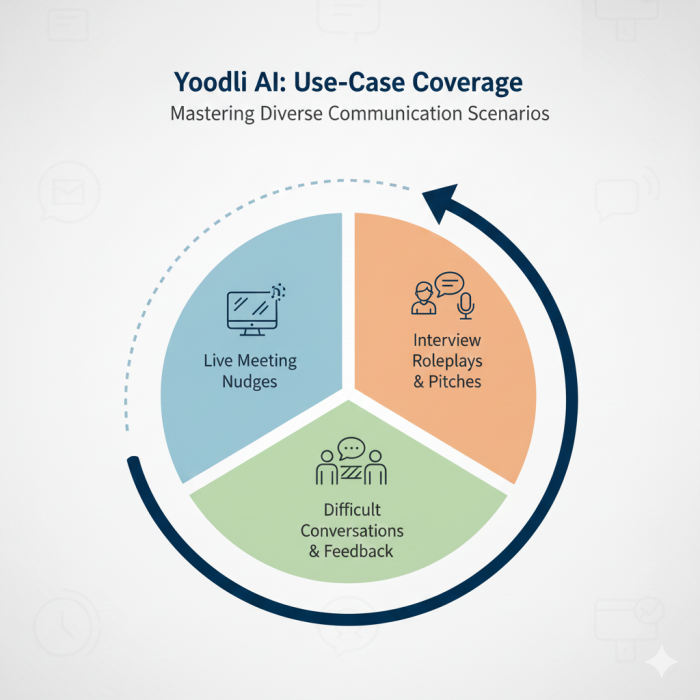
I tried Yoodli across three situations that tend to expose communication issues fast:
1) Interview-style roleplays (pressure + follow-ups)
I picked roleplays that force concise answers, because rambling is my default when I’m thinking live.
2) A “difficult conversation” simulation
The kind where you can’t sound emotional, defensive, or unclear. These are the conversations where tone and pacing matter more than content.
3) Live nudges during actual calls
Not because I wanted to “cheat,” but because I wanted to know if it genuinely changes behavior in the moment.
The First Thing Yoodli Exposed: My Fillers Were Worse Than I Thought
The filler-word count is the first metric that hits you.
Not because it’s a “cool AI feature.”
Because it’s brutally specific.
I assumed I had a mild filler habit.
Yoodli made it obvious I had patterns:
- fillers spiked when I started explaining or giving examples
- fillers showed up most when I tried to soften statements (“like… you know… kind of…”)
- fillers increased right before I made a key point (which means I was hesitating)
What makes this useful is not the count itself, it’s the repeatability.
After 3–4 sessions, I could see exactly where my speaking fell apart.
The Most Practical Feature: Real-Time Nudges
Post-session feedback is helpful.
But real-time nudges are what actually changed my behavior faster.
During Zoom/Teams-style calls, the nudges show up privately:
- slow down
- stop fillers
- pause before answering
It’s subtle enough that it doesn’t distract the call, but noticeable enough that it breaks autopilot.
This was the part I didn’t expect:
I started catching myself before the tool even nudged me.
That’s the point of training tools. The best ones teach you to stop needing them.
Roleplays Felt Useful, But Not Always “Human-Real”
Yoodli roleplays are strong for pressure practice because the AI asks follow-ups instead of letting you escape with safe answers.
But I noticed something important:
What it does well
- forces you to speak under time pressure
- makes you practice structure (because rambling gets flagged)
- gives you measurable improvement over repetitions
Where it feels limited
- it doesn’t deeply judge the strategy of what you’re saying
- it focuses more on delivery than persuasion
- it won’t tell you if your sales pitch is emotionally compelling or logically tight
So if your goal is: “Help me sound clearer and more confident,” roleplays help.
If your goal is: “Help me craft a winning narrative,” Yoodli is not that tool.
The Analytics Reports: Good When You Use Them Like Training Data
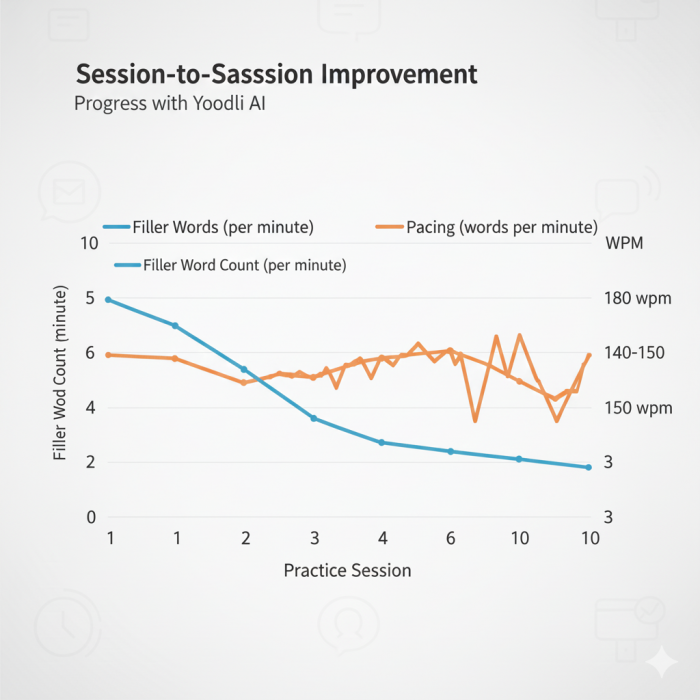
The post-session analytics are the most “serious” part of the product.
I treated them like this:
- pick one metric per week (fillers, pacing, clarity)
- improve it intentionally
- check trend lines across sessions
That’s when the tool becomes valuable.
If you just look at the report once, nod, and close it, you’ll feel informed but not improved.
The reports are best for:
- seeing whether your “improvement” is real
- noticing habits you don’t hear while speaking
- building consistency across repeated practice
What I Didn’t Like
1) It’s delivery-heavy, not intent-heavy
If you’re in sales or leadership, there’s a big difference between:
sounding clear and sounding persuasive
Yoodli improves the first reliably. The second is outside its scope.
2) Some feedback can feel overly “metric-driven”
Sometimes I wanted insight like:
“Your answer was correct but emotionally flat.”
Instead, I got:
“You spoke fast and used 11 filler words.”
That’s not wrong. It’s just not the full picture.
3) You need repetition to feel the payoff
This is not a one-session magic tool.
The benefit compounds after multiple sessions.
If you’re not going to practice repeatedly, you won’t get much more than awareness.
4) Support experience is mixed for individuals
Based on user patterns you shared, individual (non-enterprise) users sometimes face slow support responses for billing/tickets. That matters if you care about quick resolution.
Who I Think Yoodli Is For
I’d recommend it most for:
- job seekers who want structured interview practice
- professionals who lead meetings and want cleaner delivery
- speakers who need measurable feedback instead of vague coaching
- people who learn by data, not motivation
I’d tell you to skip it if:
- you want deep persuasion coaching or sales deal intelligence
- you expect a “coach that writes your script”
- you won’t practice repeatedly
My Personal Rating
My rating: 4.4 / 5
Here’s how I score it:
What earned the score
- real-time nudges (high impact)
- measurable habit change (fillers + pacing improve fast)
- low-pressure roleplay practice
- analytics that actually help when used consistently
What kept it from being a 5
- limited strategic/intent coaching
- metric feedback can feel “cold” at times
- support responsiveness can be inconsistent for individuals
Final Verdict: I’d Use It Again, But For the Right Reason
If you treat Yoodli like a “confidence app,” you’ll be disappointed.
If you treat it like a communication performance tracker, a tool that shows patterns and forces habit change, it’s genuinely useful.
It helped me do the thing most people struggle with:
not just knowing what’s wrong, but catching it while it’s happening.
That’s rare.
Post Comments
Be the first to post comment!
Related Articles