Table of Content
- 1. Evolution of AI in Music Creation: What Changed Technically?
- 2. How AI Abstracts Away Traditional Bottlenecks:
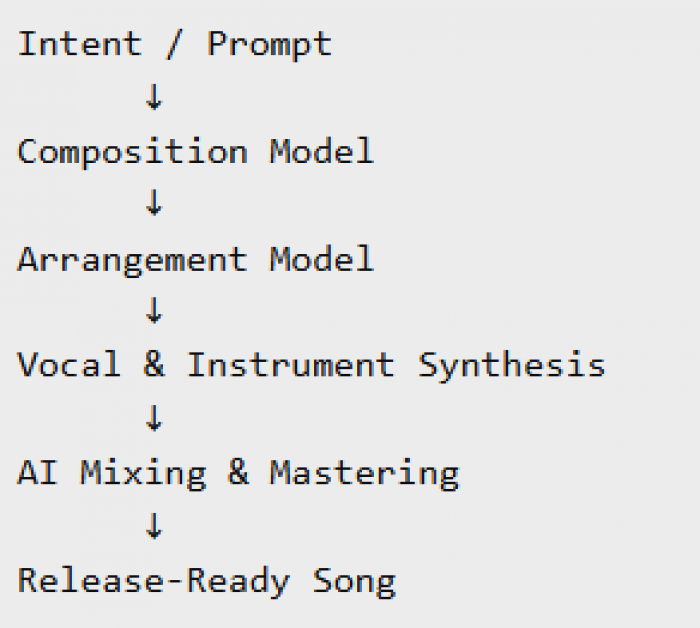
- 3. AI Capabilities Across the Music Pipeline :
- 4. Before vs After: Comparative Effort Analysis :
- 5. Quantitative Indicators :
- 6. AI Music Tool Ecosystem :
- 8. Constraints That Still Exist :
- 9. IP, Originality & Commercial Implications :
- 10. Why Is This Disruptive (Not Just Convenient)?
- 11.How music creation roles are changing?
- Final Insight
1. Evolution of AI in Music Creation: What Changed Technically?
Then: Narrow, Fragmented AI-
Early AI music systems (pre-2018):
● Rule-based composition or symbolic models
● Required strong music theory input
● Generated short, rigid MIDI patterns
● No understanding of structure, timbre, or emotion
Now: Foundation Models for Audio-
Modern systems (2023–2026) are built on:
● Large-scale audio foundation models (trained on millions of songs)
● Multimodal transformers (text → music → audio)
● End-to-end waveform generation (no MIDI required)
● Diffusion and latent audio models for realism
Key technical shift:
AI no longer generates instructions for music — it generates music itself.
This removed the need for human mediation between idea → composition → sound.
2. How AI Abstracts Away Traditional Bottlenecks:
| Traditional Bottleneck | What Humans Did Before | What AI Does Now |
| Music theory | Chords, scales, harmony | Learned implicitly from data |
| Instrumentation | Hire musicians / VST expertise | Generates full arrangements |
| Recording | Studio, microphones | Synthetic audio generation |
| Mixing | Technical engineering | Automated balancing & EQ |
| Mastering | Specialist service | One-click mastering models |

3. AI Capabilities Across the Music Pipeline :
3.1 Ideation & Composition-
AI capabilities:
● Melody generation
● Chord progression inference
● Song section structuring (verse, chorus, bridge)
Impact: eliminates creative blank-page problems and theory dependency.
3.2 Arrangement & Instrumentation-
AI now:
● Selects instruments automatically
● Applies genre-appropriate voicings
● Handles transitions and dynamics
Previously: arrangement required years of listening + trial-and-error.
3.3 Vocal Synthesis & Style Transfer-
Capabilities:
● Natural-sounding synthetic vocals
● Style conditioning (genre, emotion)
● Melody-to-vocal mapping
Key change: vocals are no longer the hardest or most expensive component.
3.4 Mixing, Mastering & Polishing-
AI systems perform:
● Loudness normalization
● Spectral balancing
● Stereo imaging
● Compression & EQ decisions
This collapses what was once a specialized profession into an automated step.
4. Before vs After: Comparative Effort Analysis :
Production Requirements Comparison
| Dimension | Traditional Workflow | AI-Driven Workflow |
| Time to demo | Weeks | Minutes |
| Time to release-ready track | Months | Hours |
| Required skills | Music + audio engineering | Prompting + taste |
| Team size | 3–10 people | 1 person |
| Cost per song | $1,000–$10,000+ | $0–$50 |
AI compresses skill, time, and cost simultaneously, which is rare in creative domains.
5. Quantitative Indicators :
While exact numbers vary, industry data and case studies consistently show:
● Time reduction: 80–95% faster production cycles
● Cost reduction: 90%+ reduction for demos and marketing tracks
● Iteration speed: Dozens of variations per hour vs 1–2 per day
These gains compound: faster iteration → better final output with less effort.
6. AI Music Tool Ecosystem :
| Category | Role in Simplification |
| Text-to-music generators | Replace composition + arrangement |
| Stem generators | Enable flexible edits without re-recording |
| AI vocal engines | Remove vocalist dependency |
| AI mixing/mastering | Eliminate technical post-production |
| Generative DAWs | Unified creation environment |
Net effect: the entire pipeline collapses into a single interface.
7. Practical Scenarios Where AI Makes Music “Easy” :
● Content creators: background music in minutes
● Marketing teams: custom brand tracks without agencies
● Game studios: rapid prototyping of soundtracks
● Filmmakers: temp scores that rival final music
● Artists: fast demo iteration before human refinement
In all cases, AI replaces infrastructure, not creativity.
8. Constraints That Still Exist :
| Constraint | Why It Persists |
| Creative sameness | Models converge to averages |
| Fine-grained control | Hard to specify micro-details |
| Emotional intent | Still subjective |
| Originality boundaries | Learned from past data |
Ease does not equal unlimited artistic depth.
9. IP, Originality & Commercial Implications :
Key realities:
● Training data opacity raises ownership questions
● Outputs may be legally usable but ethically debated
● Style imitation blurs originality
Shift: value moves from execution to concept, identity, and distribution.
10. Why Is This Disruptive (Not Just Convenient)?
This change:
● Breaks the scarcity of production skill
● Commoditizes background and functional music
● Decouples music creation from musicianship
Industries built on gatekeeping technical ability are structurally destabilized.
11.How music creation roles are changing?
For Musicians
● Less value in basic production
● More value in uniqueness, performance, and brand
For Producers
● Shift from technician → curator, editor, director
For Non-Musicians
● Music becomes a general-purpose expressive medium, like text or images
Final Insight
AI didn’t just make music creation faster — it collapsed an entire professional pipeline into a single abstraction layer.
That is why song creation now feels effortless, and why this shift permanently changes who can create music, how fast, and at what cost.
Post Comments
Be the first to post comment!