Table of Content
- The Core Claim: “Free, Unlimited Anime, No Strings Attached”
- Claim: “Same Experience as the Original Zoro.to”
- Claim: “HD Streaming With Minimal Ads”
- Claim: “Safe to Use, We Don’t Host Any Files”
- Claim: “Bigger Library Than Paid Platforms”
- Claim: “Community-Driven, Like the Old Zoro”
- Claim: “If It’s Popular, It Must Be Legit”
- Why Users Keep Returning Anyway
- Zoro TV vs Legal Platforms: A Trade-Off, Not a Contest
- Final Perspective: Understanding the Gap Between Promise and Reality
Free anime streaming sites don’t grow because of clever branding. They grow because they make very specific promises that paid platforms still struggle to match.
Zoro TV, and the many sites now using the “Zoro” name, are a perfect case study of this gap between claims and reality.
The Core Claim: “Free, Unlimited Anime, No Strings Attached”
The most powerful claim associated with Zoro TV is simple:
Watch thousands of anime episodes for free, instantly, without subscriptions.
On the surface, this appears true.
Most Zoro-named sites provide:
- No login requirement
- Immediate playback
- Large libraries that rival paid platforms
- Popular ongoing series and back catalogs
Reality check:
The content is free, but the cost is shifted. Instead of money, users pay with:
- Attention (ads)
- Time (redirects)
- Risk (malicious prompts)
There are strings attached, they’re just not visible upfront.
Claim: “Same Experience as the Original Zoro.to”
Many current Zoro TV domains imply continuity with the original Zoro.to experience users remember.
Reality:
There is no single successor.
What exists today is:
- A fragmented ecosystem of clones
- Sites copying UI elements, not infrastructure
- Inconsistent video hosts and mirrors
Two “Zoro TV” sites can look identical and behave completely differently under the hood.
Claim: “HD Streaming With Minimal Ads”
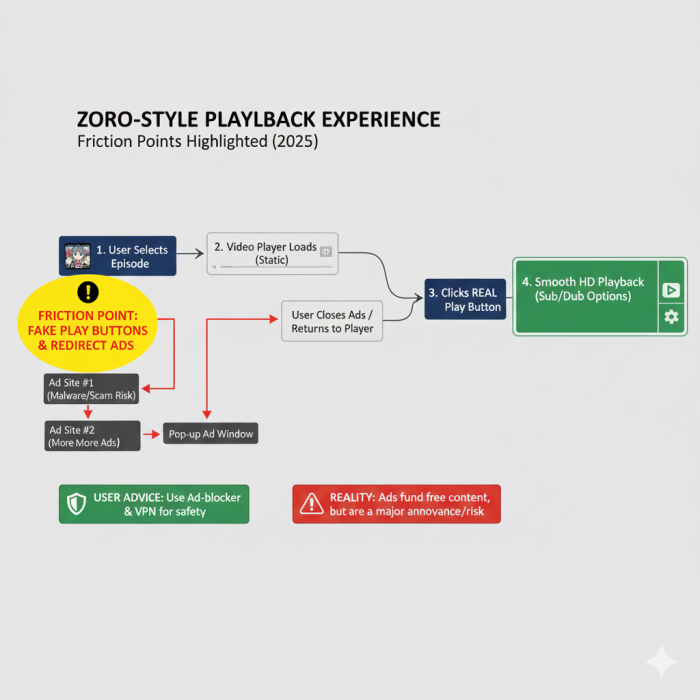
Zoro-style sites often advertise:
- 1080p playback
- Fast buffering
- “Fewer ads than competitors”
Reality:
The video player itself is usually fine.
The problem is everything around it.
Common user complaints include:
- Fake play buttons layered over the real player
- Redirects triggered by simple clicks
- Auto-opening new tabs during episode navigation
The ads aren’t just annoying, they’re structurally integrated into the experience.
Claim: “Safe to Use, We Don’t Host Any Files”
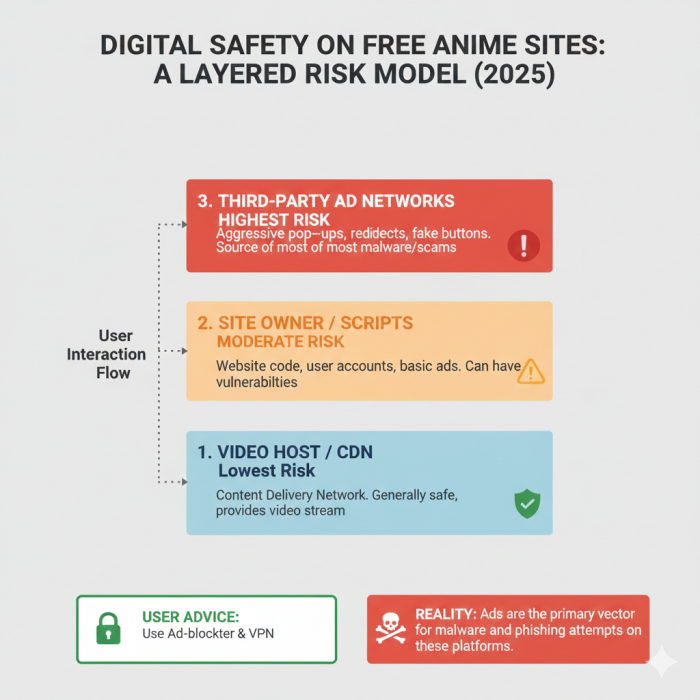
Almost every Zoro TV clone includes a disclaimer saying it:
- Does not host content
- Only embeds third-party streams
Reality:
This disclaimer is about legal distancing, not user safety.
While the site may not host files:
- It still controls ad scripts
- It still chooses redirect partners
- It still determines what code runs in your browser
Safety issues reported by users overwhelmingly come from ad networks, not video files.
Claim: “Bigger Library Than Paid Platforms”
This is one claim that is largely true.
Compared to legal services like Crunchyroll or Netflix, Zoro-style sites often have:
- More niche anime
- Older, out-of-license titles
- OVAs and specials missing elsewhere
Reality:
The library is larger, but also unstable.
Episodes disappear.
Links break.
Entire series vanish when mirrors go offline.
You gain breadth, but lose reliability.
Claim: “Community-Driven, Like the Old Zoro”
Original Zoro.to had:
- Comment sections
- Watchlists
- MyAnimeList syncing (briefly)
Many clone sites still show UI placeholders for these features.
Reality:
Most community features today are:
- Cosmetic
- Poorly maintained
- Sometimes removed entirely after domain changes
The “community” feeling is mostly nostalgia.
Claim: “If It’s Popular, It Must Be Legit”
Zoro TV pages often rank high in search results for:
- Episode numbers
- Anime A–Z lists
- Ongoing series
This creates a perception of legitimacy.
Reality:
Search visibility ≠ trustworthiness.
These pages rank because:
- Demand is high
- Competition is fragmented
- Content updates are frequent
None of that guarantees safety, legality, or longevity.
Why Users Keep Returning Anyway
Despite all of this, Zoro-style sites continue to thrive.
Why?
Because they solve problems legal platforms still haven’t fully fixed:
- Regional content gaps
- High subscription stacking costs
- Missing niche titles
- Delayed releases in some regions
Until those gaps close, the demand remains.
The Real Risk Profile (Not the Scare Version)
Let’s be realistic, not alarmist.
Lower risk activities
- Watching an embedded stream
- Browsing episode lists
Higher risk activities
- Clicking download prompts
- Accepting browser notification requests
- Installing “recommended players” or extensions
Most negative experiences start with one bad click, not passive viewing.
Zoro TV vs Legal Platforms: A Trade-Off, Not a Contest
| Aspect | Zoro-Style Sites | Legal Platforms |
| Cost | Free | Paid |
| Library size | Very large | Curated |
| Stability | Unpredictable | High |
| Safety | Variable | Strong |
| Longevity | Short-term | Long-term |
This isn’t about which is “better.”
It’s about what risk level you accept.
What Zoro TV Really Represents
Zoro TV is no longer a destination.
It’s a pattern:
- A familiar interface
- A rotating domain
- A recurring promise of free access
Every time one site disappears, another appears to fill the same role.
Final Perspective: Understanding the Gap Between Promise and Reality
Zoro TV’s biggest strength is also its biggest weakness.
It promises everything:
- Free
- Unlimited
- Easy
- Instant
The reality is more nuanced:
- It works, until it doesn’t
- It’s usable, if you’re cautious
- It’s convenient, at a cost that isn’t monetary
If you approach Zoro-style sites with clear expectations, you won’t be surprised.
If you expect them to behave like licensed platforms, you will be disappointed.
Post Comments
Be the first to post comment!
Related Articles