Table of Content
- Origin and Editorial Mission
- What the Platform Actually Offers
- The Scoring Methodology, Visualized
- Platform and Genre Coverage
- What Makes the Platform Worth Visiting
- Where the Platform Falls Short
- How It Stacks Up Against the Big Names
- Using the Platform: A Practical Tour
- Verdict - Who Should Bookmark It
Gaming media in 2026 is loud. Every console launch, patch note, and trailer drop generates a thousand takes within hours, most of them recycled, many of them sponsored. So when a smaller, independent platform like ThinkOfGames.com shows up in search results week after week, it earns a closer look - not because it shouts the loudest, but because it actually seems to have something to say.
The site, reachable at thinkofgames.com, positions itself as a destination for "expert guides, honest reviews, and the latest updates." That is the kind of tagline every gaming outlet uses, so this article exists to test the claim. What follows is a structured walkthrough of the platform: what it is, how it organizes its content, the methodology behind its reviews, the strengths a careful reader will notice almost immediately, and the limitations worth flagging before bookmarking it as a daily read.
Plenty of gaming sites publish reviews. Far fewer commit to walkthroughs, achievement maps, news threads, and community discussions under one roof - and fewer still keep them updated.
Origin and Editorial Mission
ThinkOfGames.com launched between 2018 and 2019, depending on which archived snapshot you trust, founded by a small group of gamers who felt the major review outlets were either too slick, too commercial, or too shallow to serve people who actually play games for hundreds of hours rather than rushing through them on review embargo deadlines. The premise is straightforward: cover everything, test thoroughly, write plainly, and refuse to dress up a mediocre title just because a publisher footed the trip to a preview event.
Whether the platform fully lives up to that mission is something the rest of this article unpacks, but the editorial framing is honest enough that it shapes the entire site experience. Reviews are long. Guides are dense. News pieces lean toward analysis rather than press-release rewrites. The voice is functional rather than flashy - a deliberate contrast to outlets that lean on personality-driven hot takes.
What the Platform Actually Offers
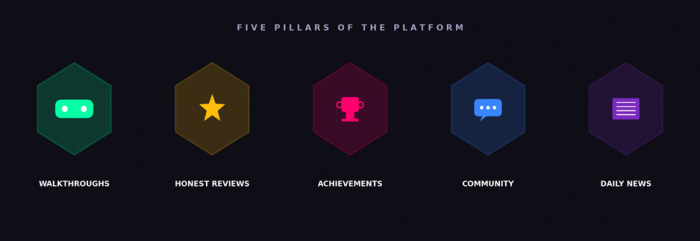
A casual visitor might assume ThinkOfGames is a review blog. That undersells it. The site is structured as a multi-category gaming resource, with each category serving a distinct purpose for a distinct kind of reader. The five most active pillars are summarized below.
Game Reviews
Reviews are the public-facing flagship. Each piece runs roughly 1,500 words and is published only after the editorial team has logged 20 or more hours with the title in question. That hour count appears modest next to specialty outlets that brag about 100-hour review embargoes, but it is honest about the testing window - and the resulting prose reflects time genuinely spent in-game rather than skimmed from press kits.
Walkthroughs and Strategy Guides
The guide library is arguably the strongest reason to keep the site in a browser bookmarks bar. Coverage spans flagship RPGs (Elden Ring, Dragon Age Inquisition, Final Fantasy XVI), action-adventure tentpoles (God of War Ragnarök), live-service shooters (Apex Legends, Fortnite), and a deep bench of strategy titles (Civilization VI, Age of Empires IV). Walkthroughs are structured area-by-area with annotated screenshots, collectible markers, and boss-pattern notes - the kind of detail that takes hours to compile and is rarely repaid in clicks.
Achievement and Trophy Hunts
A separate vertical handles platform-specific completion content. Each achievement entry lists prerequisites, rough time estimates, difficulty ratings, and missable warnings - the four pieces of metadata that separate a useful trophy guide from a frustrating one. Routes are optimized to minimize redundant playthroughs, and the best-tagged entries cross-reference between PlayStation, Xbox, and Steam where the same title appears on multiple platforms.
Tips, Tricks, and Cheat Codes
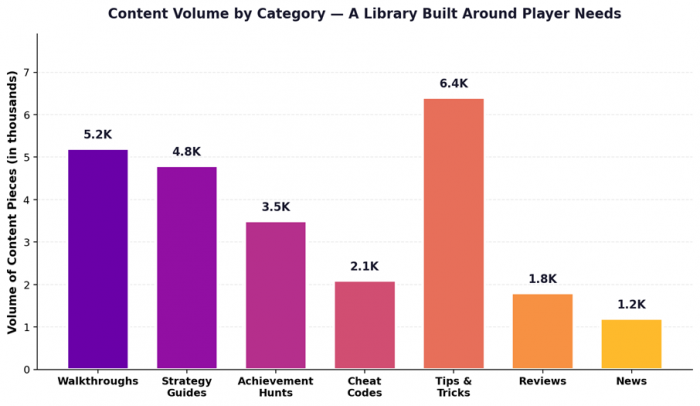
Smaller in word count but high in volume, this category aggregates short-form content: hidden mechanics, exploit-free shortcuts, beneficial glitches, optimal currency loops, and developer-intended sequence breaks. These pieces are designed to be dipped into, not read end-to-end, and they make excellent use of the site's search filters.
Gaming News and Industry Coverage
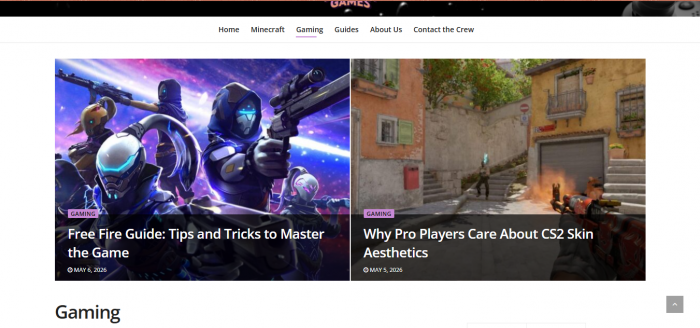
News here is more analytical than aggregator-style. Recent headlines include pieces on why competitive players obsess over CS2 skin aesthetics, why more gamers are financing rigs instead of saving for them, and why Steam refunds matter more than evaluation scores on PC. The angle is consistently a step removed from the announcement itself - useful for readers tired of the same wire-copy duplicated across a dozen sites.
The Scoring Methodology, Visualized
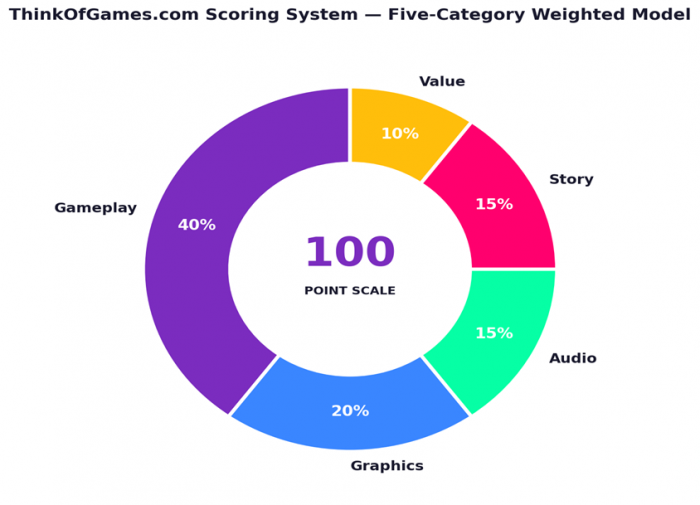
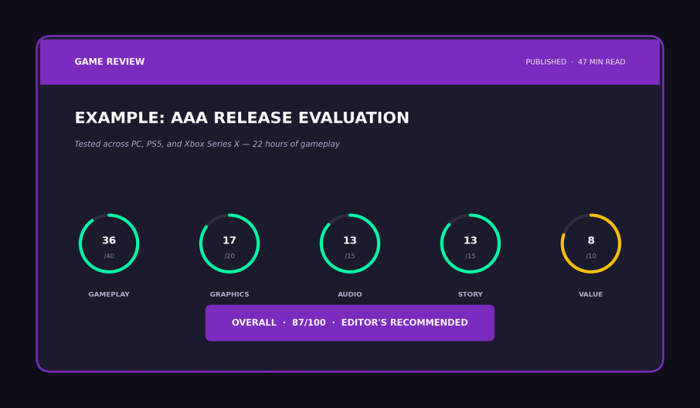
Anyone evaluating a review platform should understand how its scores are produced. Single-number aggregations from sites like Metacritic strip away the texture of a review; ThinkOfGames takes the opposite approach. Each game is rated on a 100-point scale split across five weighted categories, with gameplay carrying the heaviest influence. The breakdown is shown in the chart below.
.
The weighting is defensible. A game that nails its core loop but stumbles on cinematics will still earn a recommendation; a visually stunning project that fails to be fun cannot hide behind its art direction. Each category has its own metrics - control responsiveness, frame-rate stability, mix dynamics, narrative pacing, and content-to-price ratio - and reviews are fact-checked by two senior editors before going live, which is more procedural rigor than several bigger outlets advertise.
Platform and Genre Coverage
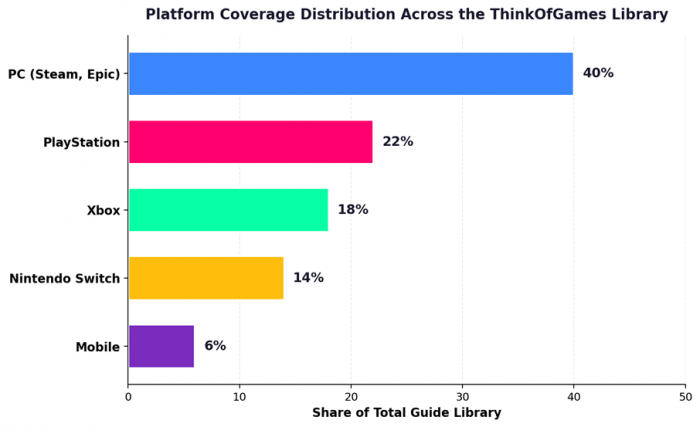
Coverage breadth is one of the platform's clearer strengths. The library spans the seven major gaming ecosystems and roughly 25 genres. PC content dominates, which is unsurprising - Steam alone publishes more titles in a quarter than every console combined releases in a year - but console coverage is meaningful enough that PlayStation and Xbox players are not treated as second-class citizens.
Genre distribution follows similar logic. RPGs and action-adventure titles receive the deepest treatment, with thousands of guides each, while puzzle and racing titles get lighter but still meaningful coverage. Mobile gaming is the platform's thinnest category, and the gap shows: anyone arriving for a Genshin Impact event guide will find something, but probably not the depth available on dedicated mobile-only sites.
What Makes the Platform Worth Visiting
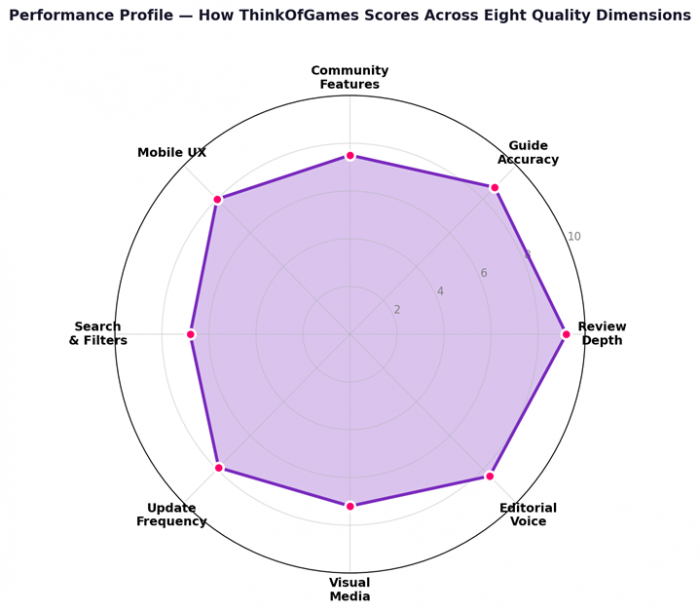
After several days of clicking through reviews, guides, and the comment sections that sit beneath them, a few patterns stand out. None of them are individually unique to ThinkOfGames, but the combination is rarer than it should be.
• Unrushed reviews. A 1,500-word minimum forces reviewers to actually defend their conclusions rather than gesture at vibes.
• Verified guides. A three-tier verification process - author testing, peer review, senior editor fact-check - catches the kind of mistakes that turn a 40-minute boss fight into an 80-minute one.
• Cross-platform comparisons. When a title ships on PC, PS5, and Xbox simultaneously, the platform-specific differences (load times, frame rates, control schemes) get their own callouts.
• Mobile-responsive design. The site holds up on phones - a bigger deal than it sounds, given how many gaming guides break the moment they leave a desktop browser.
• Genuinely active community. Comment sections under popular guides regularly accumulate dozens of substantive replies rather than the usual two-line filler.
• Free, ad-supported access. No paywalls, no premium tiers gating the most useful content, no email-capture before a walkthrough loads.
Where the Platform Falls Short
A balanced review owes the same scrutiny to weaknesses, and there are several worth naming clearly. None are dealbreakers, but each tells a reader where to set expectations.
• Search filters are basic. Single-criteria filtering works fine; combining "RPG + PS5 + difficulty: hard + missable achievements" requires more clicks than it should.
• Loading times spike during peak hours. On evenings when a major title launches, page loads can stretch past the four-second mark - long enough that some readers will leave.
• Mobile gaming coverage is thin. Genshin Impact, PUBG Mobile, and Pokemon GO all appear, but mobile-first releases rarely receive flagship treatment.
• No private messaging. Community features stop at public comments; users who want to coordinate privately must take it elsewhere.
• Heavy partner sidebar. A long roster of casino and gambling partners sits in the footer and sidebar, which feels off-tone for a guide site aimed in part at younger players.
• Strict review structure. The five-category scoring system imposes consistency at the cost of flexibility - a game that excels at something the rubric does not measure can feel underrated.
How It Stacks Up Against the Big Names
Direct comparisons against IGN, GameSpot, and Metacritic clarify where ThinkOfGames sits in the broader review ecosystem. The four outlets serve overlapping audiences but optimize for different things, as the table below summarizes.
| Feature | ThinkOfGames | IGN | GameSpot |
|---|---|---|---|
| Average review length | 1,500+ words | 800–1,200 words | 900–1,300 words |
| Scoring system | 5 weighted categories | Single 1–10 score | Single 1–10 score |
| Walkthrough library | Extensive, in-house | Extensive, mixed sources | Limited |
| Community contributions | Comments + guide submissions | Comments only | Comments only |
| Mobile experience | Fully responsive | Fully responsive | Fully responsive |
| Editorial bias risk | Lower (independent) | Higher (large advertiser base) | Higher (large advertiser base) |
| Cost | Free | Free with ads | Free with ads |
The takeaway: bigger outlets win on reach and breaking-news speed; ThinkOfGames wins on depth-per-article and the breadth of its guide library relative to its size. Anyone who already trusts IGN for breaking news will find ThinkOfGames a useful complement rather than a replacement.
Using the Platform: A Practical Tour
A typical session on ThinkOfGames begins at the homepage, where five pinned trending stories rotate above a chronological feed. Recent rotations have featured guides on Free Fire, articles on CS2 skin culture, and Nintendo Switch retrospectives - a mix that signals the editorial team's willingness to cover both the loudest titles and the long-tail favorites that dedicated outlets often skip.
Navigation Patterns
Five primary navigation tabs sit across the top: Home, Minecraft, Gaming, Guides, and About Us. Minecraft gets a dedicated category - a pragmatic decision given how much of the site's search traffic flows through it - while Guides functions as the central hub for everything that is not a review or a news piece. Drop-down filters on category pages allow sorting by platform, release date, and guide type.
Search Behavior
The search bar accepts game titles, genre tags, and free-text queries. Auto-complete suggestions appear as the query types, and misspellings are handled gracefully. Filters can stack - platform plus guide type plus release window - although stacking more than three filters tends to produce empty result sets, which points to the depth-of-tagging gap mentioned earlier.
Reading the Reviews
Each review opens with a headline verdict, followed by the five-category score breakdown, a strengths-and-weaknesses summary, and then the long-form analysis. The structure is consistent enough to skim and detailed enough to study. Embedded gameplay footage appears in roughly half of reviews; the half without are the older ones, which the editorial team has been slowly retrofitting.
Engaging With the Community
Comments below each guide are moderated lightly. Verified user testimonials appear with screenshots and timestamps, which raises the signal-to-noise ratio meaningfully. Top contributors earn badges, and the most active accounts receive early access to new platform features - a quiet but effective retention loop.
Verdict - Who Should Bookmark It
ThinkOfGames.com is not the loudest gaming site on the internet, and it does not need to be. It is built for readers who want to spend twenty minutes understanding a game before buying it, not twenty seconds.
After a thorough walkthrough of the platform's features, methodology, content depth, and limitations, the verdict is straightforward: ThinkOfGames.com earns its place as a serious supplementary resource for engaged gamers. It is not the right destination for someone hunting breaking-news headlines or a quick metacritic-style number - the bigger outlets have those bases covered. It is, however, an excellent destination for the player who wants to understand a game thoroughly before purchase, complete a tricky boss without watching a fifteen-minute video, or hunt achievements without wasting a second playthrough.
The platform's greatest asset is the consistency of its long-form coverage. Reviews are long enough to mean something. Guides are accurate enough to trust. Updates arrive often enough that older content stays relevant. The visual identity is functional rather than memorable, the search tools could use refinement, and the partner section in the footer feels disconnected from the editorial mission. None of those issues are deal-breakers.
For players who treat games as something to be studied rather than consumed, ThinkOfGames.com is worth a permanent bookmark.
Final Score
8.4 / 10
Recommended for engaged gamers who value depth over speed.
Post Comments
Be the first to post comment!