The Bradman Story, the Match Context, and the Full Reality Check
From time to time, cricket trivia throws up a claim that sounds almost impossible:
“A batsman once scored a century in just three overs.”
In an era where even the fastest T20 centuries take 30 balls or more, the idea of 100 runs in three overs feels like pure exaggeration. Yet this claim refuses to die, and unlike many viral myths, it has a real historical origin.
The player in question was Don Bradman, and the year was 1931.
This article explains exactly what happened, how the overs were counted, why the feat is real but unofficial, and how it compares to modern cricket records.
First, What Does “Three Overs” Actually Mean?
This is the most misunderstood part of the story.
Today, an over consists of 6 legal balls.
But in Australia during the early 20th century, overs were often 8 balls long.
So when historical accounts say Bradman scored a hundred in three overs, they mean:
3 overs × 8 balls = 24 balls
Not 18 balls, as modern fans often assume
That distinction alone explains why the feat is extraordinary, but not physically impossible.
The Match: Date, Setting, and Purpose
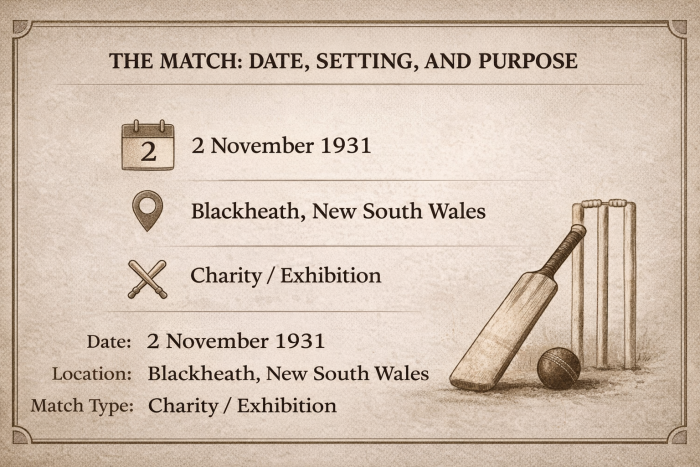
When and where did it happen?
Date: 2 November 1931
Location: Blackheath, New South Wales, Australia
Type: Charity / exhibition match
This was not:
- A Test match
- A first-class game
- A domestic league fixture
It was a friendly exhibition game, staged largely for entertainment and fundraising.
That matters, because cricket’s official records only recognize performances from sanctioned competitions.
Bradman’s Role in the Match
By 1931, Bradman was already a global star:
He had made his Test debut in 1928
- He had scored multiple double centuries
- His dominance over bowlers was already legendary
In exhibition games, Bradman often batted with complete freedom, unconstrained by match pressure or selection consequences. These matches frequently became showcases of his attacking ability.
The Innings: How the Century Was Scored
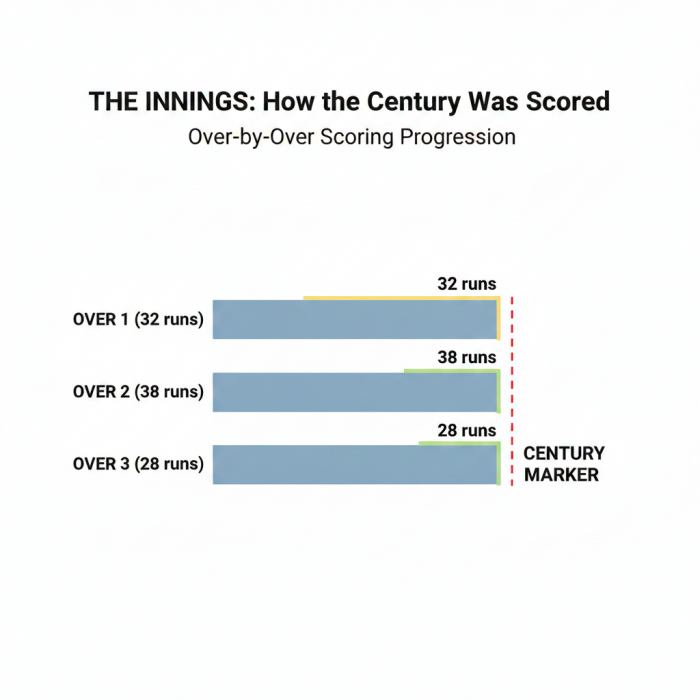
While full ball-by-ball scorecards don’t exist (common for that era), multiple reconstructions agree on the broad pattern.
Over-by-Over Breakdown (8-ball overs)
Over 1
- Bradman attacked immediately
- Heavy use of lofted shots
- Approx. 30–35 runs
Over 2
- Bowling quality deteriorated under pressure
- Multiple boundaries in succession
- Approx. 35–40 runs
Over 3
- Century reached before the over ended
- Bradman reportedly crossed 100 within 22–24 balls
Across the three overs, Bradman hit a flurry of:
- Fours
- Sixes
- Aggressive strokes rarely seen at the time
By the end of his innings, he reportedly scored well over 200 runs, with some reconstructions suggesting a final score of 256.
Strike Rate Context (Why This Was Insane Even Then)
Let’s put the numbers into perspective.
100 runs off 24 balls = strike rate ~416
Even modern T20 superstars rarely exceed 250–300 over short bursts
In 1931, this was done:
- With heavier bats
- On uncovered pitches
- Without modern protective gear
Even allowing for exhibition conditions, the scoring rate was decades ahead of its time.
Why This Is Not an Official Record
Despite how remarkable it sounds, this innings does not appear in official cricket record books. Here’s why.
1. Match Status
The game was a charity/exhibition match, not governed by official competition rules.
2. Overs Format
Modern cricket statistics assume 6-ball overs. Historical records involving 8-ball overs don’t map cleanly onto current metrics.
3. Documentation Limits
There is:
- No official scorecard
- No full ball-by-ball record
- No governing-body validation
Because of this, statisticians classify the innings as historical anecdote, not an official record.
Comparison With Modern Fastest Centuries
This is where the contrast becomes clear.
Fastest Official ODI Century
AB de Villiers
31 balls
South Africa vs West Indies (2015)
Fastest Recognized T20 Centuries
Typically 30–35 balls
Achieved under professional, televised conditions
Even the fastest modern centuries:
- Take more balls
- Occur on flatter pitches
- Use lighter bats
- Benefit from powerplay field restrictions
Bradman’s feat, even unofficial, stands apart.
Why the Story Keeps Going Viral
The claim resurfaces regularly because:
“Three overs” sounds simple and shocking
Social media often omits the 8-ball over context
Short-form videos compress nuance into headlines
Bradman’s reputation amplifies believability
This combination turns a true but technical story into a misleading viral claim.
Claims vs Reality
| Popular Claim | Reality |
| Century in 3 overs | Yes, but 3 8-ball overs |
| 18-ball century | No verified evidence |
| Official world record | Exhibition match |
| Modern equivalent exists | No recognized match has matched it |
What This Says About Bradman’s Legacy
Bradman’s greatness isn’t defined by this single innings—but the story fits perfectly with what we know about him:
- He dominated bowlers psychologically
- He adapted instantly to weak attacks
- He scored at speeds unimaginable for his era
- His average of 99.94 remains untouched
The 3-over century story survives because it reflects who Bradman was, even if it doesn’t belong in record books.
Final Verdict
Yes, Don Bradman did score a century in three overs in 1931.
But:
- The overs were 8 balls long
- The match was exhibition-level
- The feat is historically documented but not officially recorded
So when the question is asked:
“Who scored a century in just 3 overs?”
The most accurate answer is:
Sir Don Bradman, under exhibition conditions, in an era of 8-ball overs, producing one of cricket’s most legendary yet unofficial feats.
Post Comments
Be the first to post comment!