Quick answer Droven.io is a free, editorially independent knowledge platform that publishes plain-language guides on artificial intelligence, automation, machine learning, cloud computing, and cybersecurity for a mostly US audience. It is not a software product, an online course, or a vendor you buy from it is a place to understand a technology category before you spend money on tools, hires, or consultants. |
The short version (TL;DR)
After working through Droven.io's public pages and comparing its coverage against the main alternatives, here is where I landed:
• What it is: A broad, beginner-to-intermediate technology explainer site centered on AI and digital transformation.
• Who it's for: Business owners, marketers, founders, students, and junior tech professionals who want orientation, not a SaaS dashboard.
• Biggest strengths: Clear writing, genuinely free access, and topic breadth that helps you connect AI, automation, cloud, and security.
• Biggest limitations: A still-growing content library, limited public information about the company, and no hands-on tooling.
• My verdict: A useful first stop for research best paired with specialist sources before any high-stakes decision.
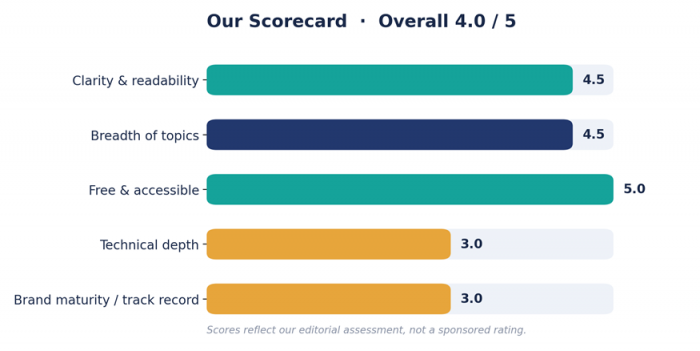
Figure 1. Our editorial scorecard for Droven.io. Strong on accessibility and breadth; weaker on technical depth and brand track record.
How I evaluated Droven.io
To keep this review honest and useful, I assessed the platform the way I would assess any technology publication a reader might rely on:
1. Scope check. I reviewed the site's stated positioning and category structure to confirm what it is and what it isn't.
2. Coverage audit. I mapped the main topic pillars and looked for whether content goes beyond surface-level definitions into use cases, risks, and trade-offs.
3. Comparison. I positioned it against established names TechCrunch, Gartner, Product Hunt, Towards Data Science, and generic AI tool-review sites to see where it adds distinct value.
4. Trust review. I checked what is publicly verifiable about the company and flagged where the evidence is thin.
5. Reader fit. Finally, I asked who actually benefits, and at which stage of a technology decision.
| A note on transparency: This review is independent and unpaid. Droven.io did not commission, review, or approve it. Where information about the company is limited, I say so rather than filling gaps with assumptions. |
What is Droven.io, exactly?
The single most common point of confusion is the category. The name sounds like a SaaS startup, so people arrive expecting a tool they log into. That expectation is wrong, and getting it right changes everything about how you use the site. Droven.io is a content and knowledge platform closer to a well-organized technology magazine than to a piece of software. Its value comes from articles, guides, and category pages that explain how modern technology works and where it fits in a business.
The platform also goes by a few names in the wild “droven io,” “drovenio,” and the companion property droven-io.com but they all point to the same idea: a single hub that ties AI, automation, cloud, and security together for readers who want the big picture without a computer-science background.
What Droven.io is not
It is easier to understand the platform by ruling out what it isn't:
• Not a SaaS tool. There is no dashboard, no workflow engine, and nothing to “run.” It explains workflows; it doesn't execute them.
• Not an online course. There are no enrolments, certificates, or locked modules just open articles.
• Not a vendor or affiliate funnel. It doesn't sell its own software, and its positioning is editorial rather than a thinly disguised sales page.
• Not a chatbot like ChatGPT. You don't ask it questions in real time. It's a library of human-written explainers, not a generative assistant.
Where the name comes from
If “Droven” looks unusual, that's intentional. It draws on an older, non-standard past-participle form of the verb drive an informal regional ancestor of “driven.” The choice is meant to signal a platform that is driven by curiosity and purpose, and in a market full of near-identical names like “TechPulse” or “AI Weekly,” the oddness is at least memorable.
To make the category unmistakable, here is how a knowledge platform differs from the two things people most often mistake it for:
| Knowledge platform (Droven.io) | SaaS tool | AI assistant (e.g. ChatGPT) | |
|---|---|---|---|
| What you get | Articles, guides, explainers | Software you operate | Real-time generated answers |
| Main job | Help you understand a topic | Help you complete a task | Respond to your prompts |
| You log in? | No open access | Yes account required | Yes account required |
| Best stage | Research & orientation | Execution | Drafting & Q&A |
| Cost | Free | Usually paid / subscription | Free + paid tiers |
Table 1. Droven.io sits in the “understand it first” column, not the “do the work” column.
Who is behind Droven.io?
What's publicly known
This is where a careful review has to slow down. Droven.io describes itself as a US-based platform, and it has been written about across a number of smaller publications but detailed, independently verified company information is limited. Founder names, a confirmed founding date, funding history, and a public team aren't documented in the usual databases as of this writing.
Here is an honest fact sheet based on what can be confirmed publicly:
| Detail | What's publicly known |
|---|---|
| Platform name | Droven.io (also “droven io,” “drovenio”) |
| Web properties | droven.io and droven-io.com |
| Location | United States (stated) |
| Primary focus | AI & technology knowledge / education |
| Founded | Not publicly confirmed |
| Founders / team | Limited public information |
| Funding | Not documented on major databases |
| Third-party coverage | Present across several publications |
Is that a red flag? Not on its own. Plenty of legitimate, newer publications simply haven't invested in a large public profile, and a thin paper trail is common for early-stage content sites. But it does shift the burden of proof. As guidance on
evaluating early-stage companies regularly points out, the absence of public documentation doesn't prove anything negative it just means more of your evaluation has to come from direct engagement and corroboration.
Practically, that means treating Droven.io as a helpful starting point rather than a final authority exactly the standard you'd apply to any single source during research. (More on that in Section 7.)
The problem Droven.io is trying to solve
The platform's whole reason for existing is a gap you've probably felt yourself. In 2026 there is no shortage of AI tools or AI news there's a shortage of clear, neutral context. Vendors push demos, social feeds overflow with hype, and marketing language routinely obscures what a product actually does.
| The core insight: most teams don't fail at AI because the technology isn't ready. They fail because they start without a clear use case, clean data, operational readiness, or a realistic picture of what they're adopting. |
Droven.io positions itself as the resource that closes that gap a plain-language layer between vendor brochures and academic papers. The promise is that you can get oriented without booking a sales call or wading through documentation written for engineers.
What Droven.io actually covers
The site organizes a wide but connected set of topics around one anchor: how emerging technology affects real businesses and careers. In practice it breaks down into six pillars.
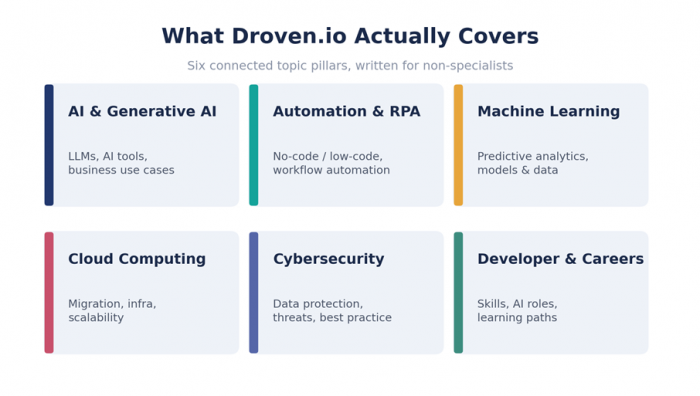
Figure 2. The six topic pillars that make up most of Droven.io's coverage.
1) Artificial intelligence & generative AI
The heart of the platform. Expect explainers on large language models, generative AI, AI ethics, and most usefully concrete business applications. The strongest pieces go past “AI improves efficiency” to show specific workflows: customer-support triage, lead scoring, document review, and internal knowledge search.
2) Business automation & RPA
Among the most-read topics on the site. Coverage spans workflow automation, robotic process automation, and no-code / low-code approaches that shrink repetitive work with an emphasis on where automation cuts cost without breaking the customer experience.
3) Machine learning & data
ML content is most valuable when it connects theory to business outcomes, and that's the angle here: predictive analytics for churn or demand, recommendation systems for ecommerce, and the data-quality realities behind them. The aim is to explain what goes in, what comes out, and what to do with the result.
4) Cloud computing

Guides on migration strategy, infrastructure planning, scalability, and cloud security the practical context that explains why so many modern tools run as web platforms rather than desktop software.
5) Cybersecurity
As AI adoption and security increasingly overlap, this pillar covers data protection, threat awareness, identity and permissions, and everyday best practices. The best framing here isn't panic it's better decisions about what data should never be pasted into a random tool.
6) Developer & career resources
Finally, content for people building their skills: programming resources, AI career paths, and how to move into fields like prompt engineering or automation strategy. This is what makes the site useful beyond an executive audience.
How Droven.io compares to the alternatives
Droven.io competes in a crowded space, so the fair question is what it offers that bigger names don't. The difference comes down to focus: it aims for an evergreen, plain-language education layer rather than breaking news or deep technical analysis.
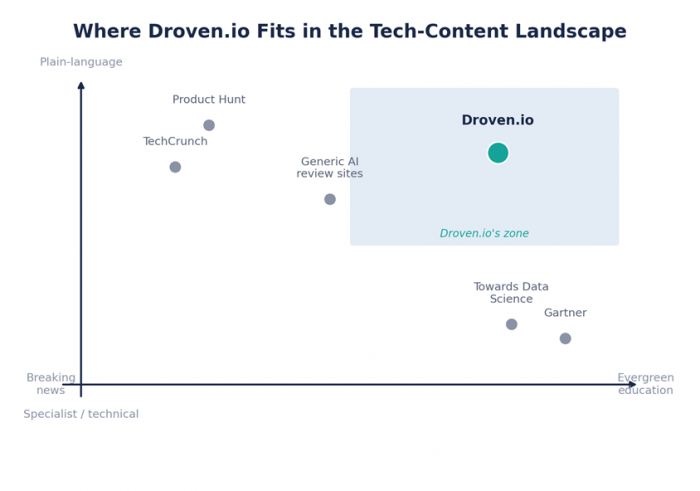
Figure 3. Droven.io occupies the evergreen + plain-language quadrant its clearest differentiator.
| Platform | Primary focus | Best for |
|---|---|---|
| Droven.io | Plain-language AI & business-tech education | Owners & decision-makers getting oriented |
| TechCrunch | Tech news & startup funding | Readers who want breaking news |
| Gartner | Enterprise research & analysis | Large enterprises with budget |
| Product Hunt | New product launches | Early adopters hunting tools |
| Towards Data Science | Technical ML & data writing | Practitioners and engineers |
| Generic AI review sites | Tool rankings & comparisons | Quick product shortlists |
Droven.io vs TechCrunch
TechCrunch is built for speed funding rounds, launches, and announcements. Droven.io is built for understanding, with evergreen explainers that stay useful months later. Different jobs entirely.
Droven.io vs generic AI tool-review sites
Most review sites rank products and stop there. Droven.io spends more time on the surrounding context what a category is for, what risks come with it, and what questions to ask which is what you actually need before a shortlist means anything.
Droven.io vs ChatGPT
A common question, and a simple answer: ChatGPT generates tailored responses on demand but can be confidently wrong; Droven.io offers static, human-written articles you can read end-to-end. Many readers use both the article for grounding, the assistant for follow-up questions.
What I liked
• Clarity. Complex topics are translated into language a non-engineer can follow the single most important quality for this kind of site.
• Genuinely free. No paywall, no demo gate, no subscription to read the library. For students, startups, and small businesses that's a real advantage.
• Topic breadth that connects. Because AI, automation, cloud, and security are covered together, you can follow how one decision affects the others instead of reading them in isolation.
• A clean reading experience. Straightforward navigation and an uncluttered layout make it easy to move between related articles.
• US-market relevance. Coverage is framed around American innovation hubs and business realities, which is useful if that's your market.
Where it falls short
A trustworthy review names the weak spots too. These are the ones worth knowing before you rely on the platform:
• The library is still growing. Compared with established publishers, some topics lack depth, and you'll occasionally hit an explainer where you wanted the next level of detail.
• Limited public track record. As covered in Section 2, the thin public information about the company means you can't lean on a long, verifiable reputation yet.
• Not a hands-on tool. If you arrive expecting software to implement something, you'll need a separate platform this is education, not execution.
• Breadth can cap depth. Covering many topics well is hard; for technical implementation or compliance-grade questions, you'll still need specialist sources.
• Currency matters. AI, tools, and regulations move fast, so always check an article's date before acting on tool names, pricing, or rules.
Who should use Droven.io and who shouldn't
| A great fit if you are… | Probably not for you if you… |
|---|---|
| A business owner exploring AI for the first time | Need a software product to operate |
| A marketer tracking AI and automation trends | Want managed IT or hands-on implementation |
| A founder researching the US tech landscape | Only read breaking technology news |
| A student building foundational knowledge | Need deep, compliance-grade technical detail |
| A junior developer mapping career paths | Require a vetted enterprise research provider |
Table 2. Match the platform to your stage. It rewards people who need orientation, not execution.
How to get the most out of it
The smartest way to use Droven.io is as a map, not the territory a place to get oriented before you go deeper with specialist sources. In practice, that looks like a simple four-stage flow:
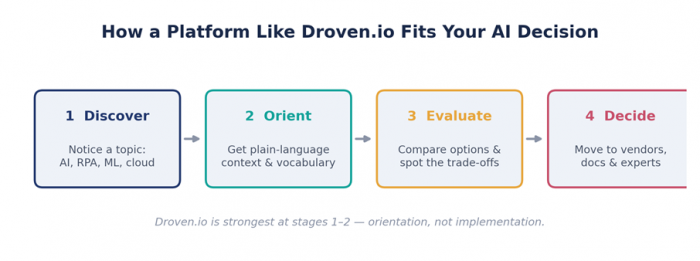
Figure 4. Use Droven.io for stages 1–2, then validate with specialist sources before deciding.
A quick example. Say you run a small service business and want to automate customer support. Instead of jumping straight to vendor comparisons, you'd use a platform like this to learn what AI can realistically automate, which customer data should never go into a random tool, and why most modern tools are cloud-based. That context turns a vague question “should we use AI?” into a sharp one: “which repetitive support tasks can we automate without exposing sensitive data?”
From there, move outward: vendor documentation for implementation, specialist security sources for risk, and qualified professionals for anything legal or compliance-related.
Is Droven.io free, safe, and legit?
Free? Yes. The library is open, with no subscription or demo booking required to read it.
Safe to read? It's a content site, so the usual web-hygiene rules apply don't paste sensitive business data into any tool an article mentions until you've vetted that tool yourself.
Legit? It maintains active websites and has third-party coverage, which is consistent with a genuine, growing publication. What's missing is the depth of independently verified company detail you'd get from an established name so verify specific claims against primary sources, exactly as you would anywhere else.
The verdict
Droven.io is one of the more useful free starting points for anyone trying to make sense of AI and automation in 2026. It won't replace specialist research, and it isn't a tool you'll operate but as a plain-language orientation layer, it does a genuinely helpful job. If you're a solo founder, a growing startup, a student, or a non-technical professional, it's worth bookmarking and returning to whenever you need a clear answer about the technology shaping your work.
Bottom line: a strong first stop best used alongside vendor docs, specialist sources, and hands-on testing when the decision really matters.
Post Comments
Be the first to post comment!