The Quick Verdict
Short version: SimplifyDiggs.com is easy to land on and easy to read. The design is tidy, pages open into a familiar magazine-style layout, and at a glance it looks like a real publisher. Stay longer than a few minutes, though, and the seams appear the topics sprawl in every direction, the writing leans on a repeatable formula, and there is very little to tell you who is actually behind any of it. Best for: a quick, surface-level read on a popular topic. Think twice for: research, buying decisions, or anything that needs a credible, accountable author. Overall score: 5 / 10 a competent surface stretched over a thin foundation. |
What SimplifyDiggs.com actually is
At its core, SimplifyDiggs is a broad content website rather than a focused publication. One domain covers cars, consumer tech, online gaming, travel, personal finance, business tips, lifestyle, and more, with fresh articles dropped into each category. There is nothing inherently wrong with a general-interest site; plenty of large outlets cover many beats well. The question this review keeps returning to is simpler: is the breadth the result of an editorial plan, or just a wide net cast to catch search traffic?
First impressions: it looks the part
Credit where it is due. The first impression is genuinely decent. Navigation is sensible, the homepage is laid out cleanly, category pages are organised, and the typography is comfortable. Set against the cluttered, ad-choked content farms that flood search results, SimplifyDiggs feels almost restrained, and nothing in those opening moments waves a red flag.
That polish is precisely why the deeper problems take a while to register. The packaging buys the content more trust than it has earned, and only sustained reading starts to chip away at it.
Where the cracks show: an identity that never forms

Range without a thread: categories that never connect into a single identity.
The trouble starts the moment you move between categories. In one short session you can drift from an emotional account of supercar ownership, to a beginner’s poker primer, to an explainer on enterprise cloud tools, to generic small-business advice. The jumps are jarring, and they expose something important the site has plenty of range but no point of view.
Publications that last tend to develop a recognisable character: a subject they own, an audience they speak to, a consistent editorial sensibility. SimplifyDiggs never settles into one. Automotive sits beside finance sits beside gaming with no connective thread, and the categories feel assembled to fill slots rather than chosen because the site has something to say. After a while it reads less like a magazine and more like clicking through an inventory. The experience turns transactional, and that missing centre becomes the site’s defining trait.
Four signals worth watching
None of the following is damning on its own. Stacked together, though, they paint a consistent picture of what SimplifyDiggs is built to do.
Signal 1 Luxury-car coverage that is a little too glossy
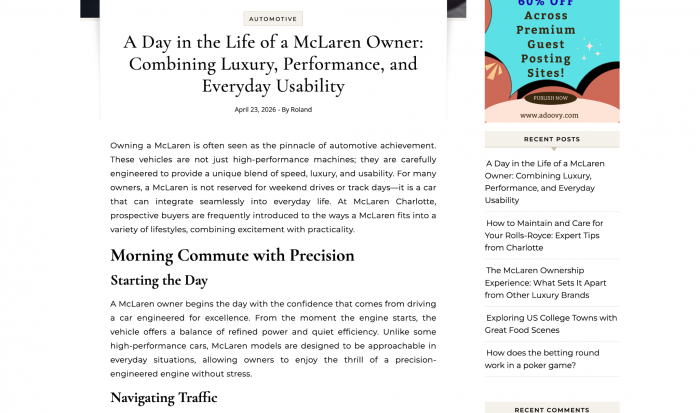
Polished, aspirational and quietly promotional the automotive section’s tell.
The automotive section is the most revealing corner of the site. A cluster of pieces orbits high-end vehicles McLaren ownership in particular and references to one specific dealership (McLaren Charlotte) recur often enough to notice. The tone here shifts sharply from the site’s plainer tech writing: it turns aspirational, cinematic and carefully flattering.
The first read is pleasant. By the third, the pattern is hard to unsee. Ownership is described almost entirely in glowing terms, while the inconveniences, running costs and maintenance realities any honest owner’s guide would mention are softened or skipped. The writing behaves less like independent analysis and more like brand storytelling. Nothing on the page openly declares a sponsorship and that is exactly the problem. The content carries the gloss of marketing while wearing the costume of editorial. The credibility issue is not that marketing exists; it is that the line between editorial and promotion is never drawn for the reader.
Signal 2 Older tech posts expose the SEO playbook

Old tech posts follow the same search-first template, over and over.
If the car content is the showroom, the older technology articles are the blueprint. Posts on subjects like wireless sensor networks, content-delivery pricing and data-visualisation tools follow a template you have met a thousand times: a headline aimed at a long-tail query, a broad and cautious introduction, a few generously padded explainer sections, and a tidy conclusion that adds little.
These pieces are not unreadable for a complete beginner they are serviceable. But they rarely show first-hand testing, original data or a perspective you could not get by skimming three other pages. The writing is engineered for discoverability rather than insight, and once you recognise its shape (broad intro, generic summaries, repetitive subheads, lightweight wrap-up) the whole site starts to look like a publishing system tuned to rank, not a place built to inform.
Signal 3 One writer who somehow covers everything
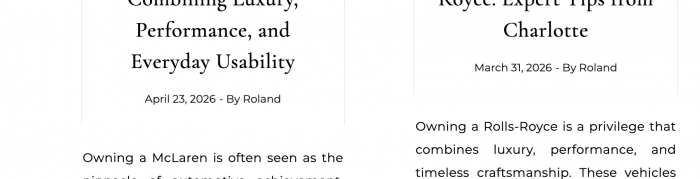
One byline, presented as the authority on nearly every topic on the site.
Check the bylines and a strange detail emerges: a large share of the catalogue is credited to a single recurring name. That one author is presented as the voice behind supercars, online gaming, cloud infrastructure, business software, travel, finance and lifestyle alike.
The name itself is not the issue the math is. Real expertise is narrow, and credible publications spread coverage across contributors who actually know their fields, then show it through stated credentials and background. Here, one identity is positioned as the authority on nearly everything, with little visible evidence of the experience that would justify it. After enough pages the byline stops reading like an author and starts reading like a system label: a slot filled, rather than a person accountable for the work.
Signal 4 The guest-post engine behind it all

Guest posts and link placements point to the real business model.
The detail that ties the whole picture together is small and easy to miss: signs of guest-posting and publishing-marketplace activity sit in plain view. Spot them, and the rest of the site clicks into focus. The sprawling categories, the keyword-shaped headlines, the promotional-feeling car features and the endless unrelated niches all line up behind a single business model one built on organic search traffic, backlink placement, sponsored slots and scalable visibility.
Seen through that lens, the mystery evaporates. SimplifyDiggs does not look designed to earn a loyal readership through reporting or expertise. It behaves like content infrastructure, where each article is first and foremost an asset that exists to rank and to host links. That is a perfectly legitimate way to run a website but it is a very different thing from a publication, and readers deserve to know which one they are reading.
The trust problem: thin proof behind a polished front

No clear ‘About’, no visible standards little for a reader to verify.
For a site that weighs in on cars, gambling, cloud software, money and travel, the most glaring gap is the absence of a real About page. There is little to explain who runs it, what its editorial mission is, or why it should be trusted across such a sweep of subjects. Without that, SimplifyDiggs reads less like a transparent publisher and more like an anonymous operation, leaving you to judge it by its layout and article count alone. A clear ownership statement, an editorial policy and genuine author backgrounds would change the picture considerably.
Run the site through the lens search engines themselves lean on Experience, Expertise, Authoritativeness and Trust, usually shortened to E-E-A-T and the same theme repeats: plenty of presentation, not much proof.
| E-E-A-T dimension | Signal | What this review found |
|---|---|---|
| Experience | Weak | Articles seldom show hands-on testing or first-hand observation. |
| Expertise | Weak–moderate | Readable enough, but the spread of unrelated topics undercuts any claim of real depth. |
| Authoritativeness | Weak | With coverage scattered so widely, the site never builds authority in any single field. |
| Trust | Weak | No About page, unclear ownership, sparse author detail and no visible editorial standards. |
The scorecard
Pulling the assessment together across the dimensions that matter most for a content site:
| Category | Score | Quick read |
|---|---|---|
| Design & layout | 8/10 | Modern, tidy and easy on the eye |
| Editorial consistency | 4/10 | Categories pull in every direction |
| Content depth | 5/10 | Usable, but rarely insightful |
| Trust & transparency | 4/10 | Little to verify who is behind it, or why |
| SEO dependence | 9/10 | Search optimisation clearly drives the publishing |
| Reading experience | 7/10 | Smooth, uncluttered browsing |
| Subject authority | 4/10 | Spread too thin to specialise |
| Overall reliability | 5/10 | Fine for browsing, shaky for expertise |
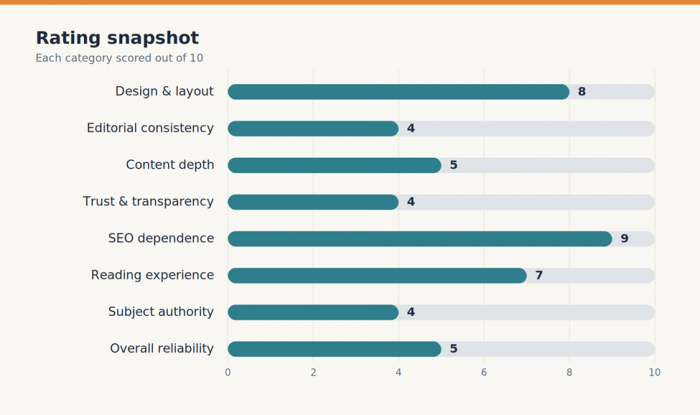
How the site scores across the dimensions that matter.
So, should you use SimplifyDiggs.com?
SimplifyDiggs is not a scam, and it is not a broken website. It produces readable articles, keeps a clean and pleasant interface, and presents itself well enough to pass a quick sniff test. The honest issue is authenticity. It behaves less like a publication with a genuine editorial mission and more like a scalable content network designed to monetise search visibility across as many topics as it can reach. The luxury-car section in particular feels commercially steered, while the older tech content reveals the traffic-first formula underneath.
If you have arrived from a search and just want a fast, basic orientation on a topic, the site can do the job. If you are after authoritative reporting, specialist depth or a source you can stand behind, it feels thinner the longer you stay. Read it for a quick overview then verify anything that actually matters somewhere with a name, a track record and something to lose.
Post Comments
Be the first to post comment!