Eight of the most common false claims about the independent 3D animator - and what the primary record actually shows.
Most coverage of this creator is wrong about at least one important fact. Some of it is wrong about several. The errors aren't deliberate, but they propagate - one wiki cites another, a third-party article inherits the same assumption, a content farm scrapes the lot, and within a year the misinformation outweighs the correctly sourced material in search results.
This piece is built backwards from that problem. Each section opens with a false claim that genuinely circulates online and dismantles it using the creator's own public statements or the technical evidence in the work itself. No section asserts anything that isn't sourced.
The eight myths covered:
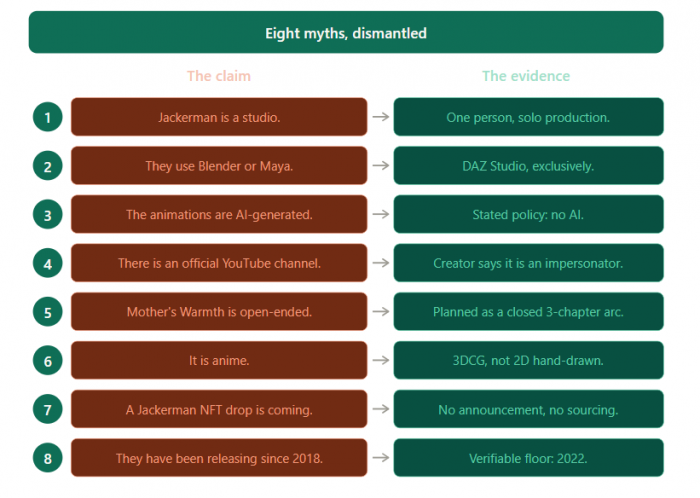
Figure 1. The eight claims covered in this piece and the verified correction for each.
MYTH 1 | “Jackerman is a studio - Jackerman Studios - with a team of animators.” |
| REALITY | It's a single person. There is no studio. |
Several third-party articles, particularly content-farm-style summaries, refer to a "Jackerman Studios." No such studio is registered, credited, or referenced anywhere by the creator. The phrase appears to be a fabrication that propagated across SEO-driven sites.
The primary evidence points the other way. The creator handles writing, character modeling, scene assembly, animation, rendering, and audio mixing as a single individual. External voice actors are contracted for specific productions, but the core production chain runs through one person. This is consistent with how the work is announced, paced, and updated in public posts.
SOURCE Creator's public production updates on X (@JackermanDev); inconsistency check across third-party coverage.
MYTH 2 | “The animations are made in Blender, Maya, or some other professional animation suite.” |
| REALITY | DAZ Studio. Exclusively. And that's the unusual part. |
DAZ Studio is built primarily for still-image rendering and character composition - not for character animation. Its native keyframing and rigging tools are limited compared to dedicated animation software like Blender, Maya, or Cinema 4D. Most professional animators who use Daz character assets export them into a separate animation environment.
Jackerman, by contrast, builds the entire body of work inside DAZ Studio. Backgrounds in specific releases have been identified as paid Daz 3D marketplace assets - for example, the "Weekend Parking Lot" asset used as the background in the Southern Hospitality installment "Sunday Surprise." The technical workflow is unusual enough that it is itself part of what makes the case interesting in indie 3D animation discussions. The chart below shows where the production time actually goes.
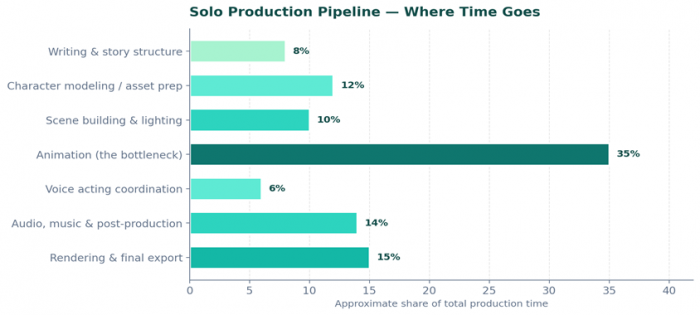
Figure 2. Approximate share of production time across stages for a solo Daz Studio animator. Animation dominates because DAZ Studio is not designed for motion work.
SOURCE Daz 3D marketplace asset listings; NamuWiki technical breakdown; community discussion of solo Daz Studio workflows.
MYTH 3 | “Jackerman's animations are AI-generated - it's just a generative-AI pipeline with a pseudonym.” |
| REALITY | Stated policy is "No AI." The technical evidence backs it up. |
The creator's public X bio includes the exact phrase "No AI." That single line is the most-cited policy statement the creator has made in writing. It is repeated across the creator's public-facing channels.
The technical record corroborates the statement. Generative AI video pipelines produce characteristic temporal inconsistency artifacts - face drift between frames, background morphing, hand-count instability - that are absent from Jackerman's output. Scenes are visibly composed by hand, with stable character models repeated across multiple releases over time. Paid Daz 3D marketplace assets recur identifiably across works. This is not how AI generation behaves.
The misattribution is becoming more common as third-party coverage gets lazy about distinguishing between traditional 3DCG and AI-generated 3D content. Both involve a computer and neither involves a pencil, but they are not the same medium.
SOURCE Public bio on X (@JackermanDev); technical comparison of frame consistency.
MYTH 4 | “There's an official Jackerman YouTube channel - the one that comes up first when you search.” |
| REALITY | It's an impersonator. The creator has said so directly. |
A YouTube channel using the Jackerman name does appear at or near the top of YouTube search results for the term. It is not the real creator. The actual creator has stated this publicly on the channel's own About page, in language that leaves no room for interpretation:
"I do not post anything on my YouTube channel, the account you see posting videos on here is someone impersonating me, profiting off my work, and taking credit for my animations."
Treating that YouTube channel as a legitimate source is one of the most common factual errors in coverage of this creator. The real distribution surface runs through subscription-based creator platforms, not YouTube.
SOURCE Direct statement on the YouTube channel "About" page, authored by the creator.
MYTH 5 | “Mother's Warmth is an open-ended ongoing series. New chapters whenever.” |
| REALITY | It's a closed three-chapter arc. Chapter 3 is the finale. |
Mother's Warmth is structured as a finite three-chapter narrative, not as an open-ended episodic series. Chapter 1 released at roughly 10 minutes; Chapter 2 at roughly 20 minutes; Chapter 3 is planned at approximately 30 minutes as the conclusion of the arc.
The closed structure is unusual for independent 3D animators, who typically favor open-ended series for steady supporter revenue. The decision to commit to a three-chapter arc - with progressively longer chapters and a defined endpoint - represents a deliberate narrative-first production choice rather than an indefinite content-treadmill model.
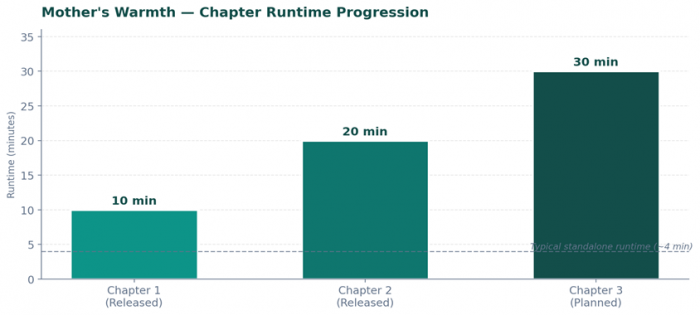
Figure 3. Mother's Warmth chapter runtimes against the typical 4-minute standalone short. The series is built as a planned escalation, not an open-ended run.
SOURCE Creator's public production updates on X; chapter runtime targets stated in supporter posts.
MYTH 6 | “Jackerman makes anime.” |
| REALITY | It's 3DCG. Not anime. The medium itself is different. |
Anime is, by definition, 2D hand-drawn animation produced in the Japanese animation tradition. Jackerman's work is 3D computer-generated imagery rendered out of DAZ Studio. The two are different media that share almost no production overlap.
Some character-design choices in Jackerman's catalog may carry anime-style influences - large eyes, stylized hair shapes, certain expression conventions - but stylistic borrowing does not change the medium. Calling this work "anime" is roughly equivalent to calling a Pixar film "Disney 2D animation" because both involve cartoon characters.
SOURCE Technical evidence (3DCG render output, DAZ Studio production environment); standard industry definition of anime.
MYTH 7 | “There's a Jackerman NFT drop coming.” |
| REALITY | No announcement. No primary source. The story doesn't exist. |
Articles speculating about a "Jackerman NFT" collection have appeared on cryptocurrency-adjacent sites. None of them cite a primary source. None of them quote the creator. None reference a contract address, a marketplace listing, or an announcement date. The story originates with content-farm SEO targeting the intersection of "Jackerman" and "NFT" as search terms, not with any actual project.
The creator has made no statement about NFTs in any direction. The absence of an announcement is not the same as an upcoming drop. Treating speculative crypto-blog content as evidence of a real project is a pattern that has produced rumors about hundreds of creators who have no actual NFT involvement.
SOURCE Absence of any primary statement; pattern recognition across speculative crypto-coverage content farms.
MYTH 8 | “Jackerman has been releasing animation since the late 2010s.” |
| REALITY | The verifiable floor is 2022. Earlier claims are not sourced. |
Public posts on the creator's X account @JackermanDev date from at least 2022, including production-status updates that reference specific works by name. Earlier release activity may exist, but it is not clearly documented in primary public sources. The 2022 floor is the earliest point at which the creator's own statements provide verifiable evidence.
Fan timelines occasionally claim earlier start dates - 2019, 2018, even further back. These dates are typically inferred from file timestamps on third-party mirror sites or from upload dates on the impersonator YouTube channel. Neither is reliable evidence of when the real creator started releasing work. Treating mirror-site timestamps as a release-date source is the same category of error as treating a Wikipedia mirror as a source for Wikipedia.
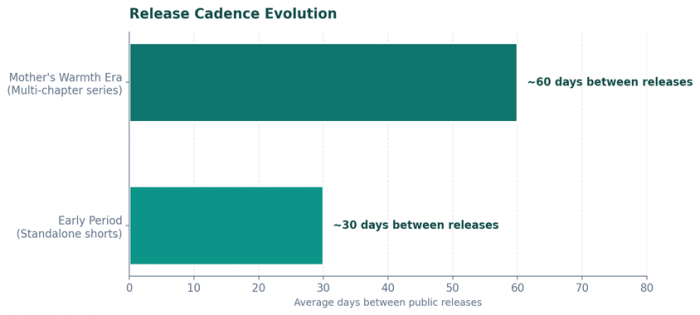
Figure 4. Verified release cadence across two production eras. The data point that doesn't exist in this chart - the pre-2022 record - is the point.THE PATTERN
Eight different myths. One mechanism.
Every false claim covered above traces back to the same path: a content farm makes an unsupported assertion, a competing site scrapes it, a third source treats the second as a citation, and within a year the error outranks the primary record in search results. The creator's own statements posted publicly, dated, and easily verifiable sit below the noise.
The corrective pattern is also consistent. Each myth collapses the moment a primary source is consulted: the X bio, a chapter announcement, a YouTube About page authored by the creator, an asset listing on Daz 3D. The evidence is not hidden. It is just not where SEO funnels readers.
VERDICT
The catalog is a solo 3DCG production rendered in DAZ Studio. That technical choice is unusual enough to be the most interesting fact about the work, and almost no third-party coverage gets it right.
It is not anime. Not AI-generated. Not a studio operation. Not an NFT project. Not active on YouTube. Not verifiable before 2022. Mother's Warmth is a closed three-chapter arc, not an open-ended series.
Every other framing currently in circulation is either inferred from secondary sources or invented outright. Journalists, researchers, and aggregator sites should treat the X account (@JackermanDev) and the YouTube About-page disclaimer as the primary record for this creator. Everything downstream of those two sources is commentary, and most of it is wrong.
Post Comments
Be the first to post comment!
Related Articles