Table of Content
- Big Picture: How Each Tool Thinks About SEO
- Keyword Research: Volume vs “Will This Actually Get Clicks?”
- Backlinks: Link Audits vs Link Hunting
- Technical SEO: Health Score vs Clean Diagnostics
- Rank Tracking: Operational Monitoring vs “Nice Add‑On”
- Content, AI and PPC: Where Semrush Pulls Away
- UX, Learning Curve and Community
- Pricing and Value: What Do You Actually Get for Your Money?
- Practical Verdict: Who Should Choose What in 2026?
Semrush and Ahrefs dominate serious SEO conversations, but they no longer compete as identical tools with different logos. One is now a marketing command‑center that happens to be strong at SEO, while the other is still an SEO specialist’s scalpel built for deep search and link analysis. Choosing correctly is really about matching their strengths to how you work, not chasing a single “winner.”
Big Picture: How Each Tool Thinks About SEO
Before you get lost in feature lists, you need to understand their philosophies.
Semrush is built as an all‑in‑one marketing platform. It wraps SEO together with PPC research, social media, content planning, competitive traffic analytics, and now a growing layer of AI assistance. In a typical day, you can jump from keyword research to Google Ads spies, social tracking and content briefs without leaving the ecosystem.
Ahrefs is built as an SEO‑first intelligence suite. Its core revolves around crawling the web, mapping backlinks, understanding keyword and click potential, and showing you how content and links drive organic traffic. It does one thing exceptionally well: help you win Google search with better content and better links.
Positioning snapshot
| Aspect | Semrush | Ahrefs |
| Core identity | Marketing platform with SEO at the center. | SEO and backlink intelligence engine. |
| Typical buyer | In‑house marketing teams, agencies, growth leads. | SEOs, link builders, technical consultants, publishers. |
| Main playground | SEO + PPC + content + social + competitor intel. | Organic traffic, links, content, technical SEO. |
Once you lock this lens in, the rest of the comparison becomes much clearer.
Keyword Research: Volume vs “Will This Actually Get Clicks?”
Both platforms can surface more keywords than you will ever use, but they emphasise different questions. Semrush asks, “How big is the market and where is the money?” Ahrefs asks, “If you rank, how much traffic will you realistically get?”
Semrush’s Keyword Magic Tool is built for scale. You drop in a seed keyword and it explodes into thousands of ideas grouped by topics, questions, and modifiers. You can cut the list by intent, country, SERP features, CPC, competition and even paid search data, which is gold when you need an SEO + PPC keyword map instead of just a blog ideas sheet.
Ahrefs’ Keywords Explorer, on the other hand, is obsessed with reality. It combines search volume with click metrics, return rate, traffic potential and a difficulty score that SEOs often treat as more trustworthy in competitive SERPs. Instead of just telling you that a keyword has 10,000 searches, it nudges you toward topics where people still click organic results—and away from SERPs completely dominated by ads or zero‑click answers.
Keyword research comparison
| Factor | Semrush | Ahrefs |
| Keyword generation | Very large lists, strong grouping and filters. | Deep, high‑quality lists based on massive crawls. |
| PPC insights | CPC, competition, PLA, ad data tightly integrated. | Limited; mainly organic‑first viewpoint. |
| “Real traffic” focus | Volume and intent are strong; less emphasis on click behaviour. | Strong emphasis on clicks and traffic potential per topic. |
| Best for | Hybrid SEO + PPC campaigns, topic clusters. | SEO content that must convert to organic traffic. |
If you live inside Google Ads as much as Google Search Console, Semrush feels natural. If your whole game is ranking content and squeezing maximum traffic out of each article, Ahrefs’ keyword philosophy is more aligned with you.
Backlinks: Link Audits vs Link Hunting
Links are where many people form emotional loyalties to these tools. Semrush and Ahrefs both maintain gigantic backlink indices, but they serve different link workflows.
Semrush treats backlinks as one pillar of a broader website health and competitive visibility strategy. Its link database is huge and powers modules like Backlink Analytics, Backlink Audit, and the Link Building Tool. You can quickly identify toxic links, integrate with Google Search Console, generate disavow files, and manage outreach lists all in one place. This is especially handy for agencies who must report on “link health” alongside rankings and traffic.
Ahrefs is built like a link hunter’s cockpit. Site Explorer exposes every important angle: new and lost links, referring domain quality, anchor text patterns, top pages by links, outgoing links, and competitor link gaps. SEOs frequently cite Ahrefs as still being slightly ahead in backlink freshness and the way its UI surfaces link opportunities for broken link building, resource pages and digital PR. Combined with Content Explorer, it becomes a discovery engine for both linkable assets and the people who might link to you.
Backlink capabilities side‑by‑side
| Use case | Semrush | Ahrefs |
| Toxic link detection | Dedicated Toxic Score, disavow exports, integrated audits. | Basic spam detection but less “disavow workflow” emphasis. |
| Outreach workflow | Built‑in link building campaigns and prospect lists. | Powerful discovery; outreach workflow usually handled in other tools. |
| Broken link building | Possible, but less native. | Very strong via broken pages and outgoing link reports. |
| Link gap vs competitors | Clear competitor comparison features. | Excellent link intersect and competitor link reports. |
If you need a link audit and management layer that non‑SEOs can understand, Semrush is attractive. If you are in the trenches doing link prospecting and outreach all day, Ahrefs still feels more purpose‑built.
Technical SEO: Health Score vs Clean Diagnostics
On technical SEO, both tools have matured into highly capable crawlers. The difference is style.
Semrush’s Site Audit functions like a doctor that hands you a detailed medical report plus a plain‑English summary. It checks hundreds of issues: crawlability, HTTPS, hreflang, internal linking, Core Web Vitals, structured data, and more. Then it gives you an overall health score, buckets issues by severity, and increasingly uses AI to explain what a problem is and how to fix it. Marketing managers love this because they can forward reports to devs or clients without translating everything themselves.
Ahrefs’ Site Audit, by contrast, is more like the clean, minimalist lab dashboard that a specialist loves. It surfaces errors, warnings and notices with clear graphs, filters and trends, but doesn’t try to turn it into a full project management system. The interface focuses on what matters for organic performance without burying you in cross‑channel noise.
Technical SEO comparison
| Aspect | Semrush | Ahrefs |
| Issue coverage | Very broad, from basics to Core Web Vitals and JS issues. | Broad and deep for classic technical SEO issues. |
| Reporting style | Health score, AI explanations, business‑friendly. | Clean charts, developer‑friendly diagnostics. |
| Integration | Tight with rank tracking, projects, content data. | Tight with Site Explorer and organic performance data. |
| Best suited to | Teams needing to align SEOs, devs, and marketers. | SEOs who already know what they’re looking for. |
For most sites, either will do the job. Your choice is more about whether you need “explain this to the CMO” or “give me clean data and I’ll handle the rest.”
Rank Tracking: Operational Monitoring vs “Nice Add‑On”
Rank tracking is one area where Semrush tends to feel like the main tool, and Ahrefs like a welcome bonus.
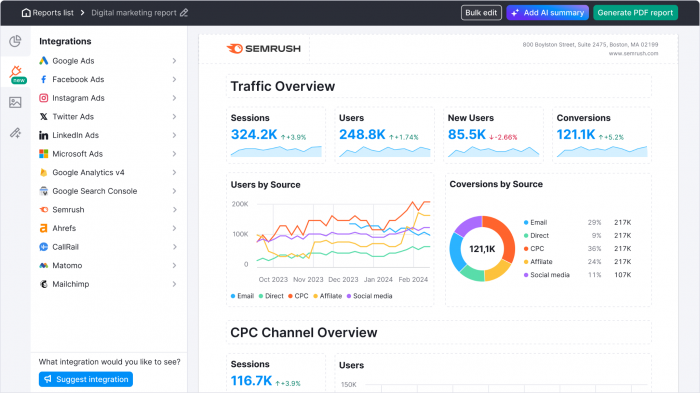
Semrush’s Position Tracking gives you daily or scheduled updates for your keywords, broken down by location, device, and SERP features. Even on the Pro plan, you can track a solid chunk of core terms across multiple projects, which is critical if you’re reporting to clients or stakeholders every week. Visibility scores, share of voice, and cannibalisation insights are built to support ongoing decision‑making, not just vanity graphs.
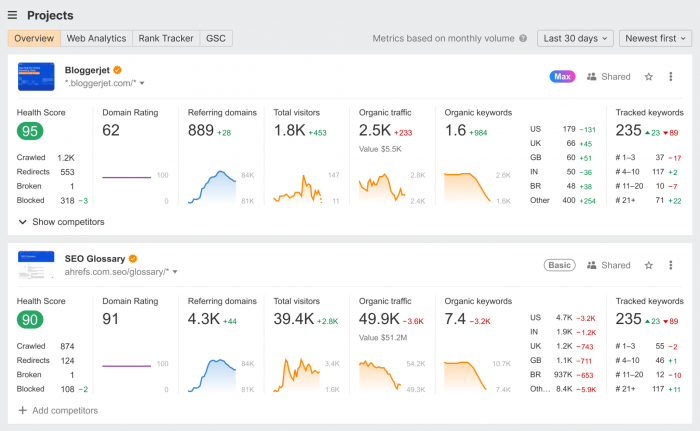
Ahrefs’ Rank Tracker is reliable and integrates well with its keyword and backlink data, but the experience is shaped by overall plan limits and a credit system. It’s more than enough for monitoring your core terms and seeing trends, yet it isn’t usually the reason someone pays for Ahrefs; it’s one part of the toolkit rather than the centerpiece.
Rank tracking summary
| Factor | Semrush | Ahrefs |
| Keyword allocations | Generous even on entry tier for daily tracking. | More conservative; constrained by credits and plan size. |
| Reporting depth | Visibility, SERP features, local/mobile splits. | Solid trends and positions, less “marketing theatre”. |
| Ideal use | Agencies, brands with reporting cycles. | SEOs who mostly need snapshots and trends. |
If your business lives and dies on rank reports, Semrush will usually feel like the safer single‑tool choice.
Content, AI and PPC: Where Semrush Pulls Away
The biggest divergence between the two platforms now shows up in content marketing and paid campaigns.
Semrush has built a full content and AI layer on top of its SEO core. You can brainstorm topics, evaluate search intent, auto‑generate briefs, check drafts with an SEO Writing Assistant, and in some workflows even draft with AI using data‑driven suggestions. Add its tools for content audits, topical clustering and AI visibility tracking, and content teams can live inside Semrush from ideation to post‑publish optimisation.
For PPC, Semrush offers competitive ad research, keyword cost data, display ad examples, PLA insights, and tools that help you map organic and paid coverage together. This is extremely valuable for performance marketers and full‑funnel teams who don’t want SEO and PPC operating in silos.
Ahrefs sees content through an SEO lens rather than a marketing‑ops lens. Content Explorer, Top Pages, and Content Gap are among the best tools to understand which topics, formats and pages attract links and organic traffic. For SEOs designing linkable assets or authority hubs, this is gold. However, Ahrefs does not try to be your PPC planner or your end‑to‑end content production stack.
Content & PPC differences
| Area | Semrush | Ahrefs |
| Content workflow | Topic research → briefs → AI drafts → optimisation tools. | Content discovery and gap analysis for SEO. |
| AI layer | Multiple AI helpers around content and visibility. | Some AI utilities; not a full content suite. |
| PPC & ads | Strong PPC and display analytics, keyword + ad intel. | Limited; focuses on organic. |
| Best for | Marketing teams handling SEO, PPC and content end‑to‑end. | SEOs and publishers focused purely on organic growth. |
If your job description includes the word “marketing” more than “SEO,” Semrush is built with you in mind. If it’s the other way around, Ahrefs still feels like home.
UX, Learning Curve and Community
How it feels to live inside these tools every day matters.
Ahrefs is praised again and again for being clean and predictable. Each core tool does one thing well, the navigation is straightforward, and screens rarely feel overcrowded. That minimalism makes it easier for new SEOs, freelancers and consultants to get value quickly, even if they never exhaust all the features.
Semrush can feel busier when you first log in. The dashboard surfaces many modules at once: SEO, PPC, social, content, competitive research, and more. For some users, that density is empowering; for others, it’s overwhelming. The trade‑off is power. Once teams build standard operating procedures around Semrush, the breadth becomes a strength because everyone—from SEO to paid media to content—can work from the same data environment.
Both companies maintain extensive blogs, academies and communities. Semrush’s educational ecosystem leans more into broad digital marketing, while Ahrefs’ content is legendary for clear, technical deep dives that appeal to SEO practitioners.
Pricing and Value: What Do You Actually Get for Your Money?
On paper, Ahrefs often looks a bit cheaper at the entry level, but Semrush can replace more separate tools. The right choice depends on how “SEO‑only” your stack is.
Approximate public pricing for 2026 looks like this:
| Tier | Semrush (approx) | Ahrefs (approx) |
| Entry | Pro ≈ 139–140 USD/mo | Lite ≈ 108–129 USD/mo |
| Mid | Guru ≈ 249–250 USD/mo | Standard ≈ 208–249 USD/mo |
| High | Business ≈ 449–499 USD/mo | Advanced ≈ 449 USD/mo and above |
The way value plays out is more interesting than the raw numbers:
● Semrush can often replace: one SEO suite, a PPC research tool, part of a social analytics stack, and chunks of a content marketing platform. For a small team or agency, that consolidation can make the total software bill lower even though the single subscription is higher.
● Ahrefs is extremely good value if you treat it as “the SEO engine” and already have other tools for PPC, content production, analytics and reporting. For niche site builders or SEO‑only consultants, the Lite or Standard plan often delivers a very high return.
If you’re budget‑constrained and want one tool to cover as many marketing bases as possible, Semrush is usually the safer bet. If your world is 90% SEO and you’re comfortable stitching together other tools for the remaining 10%, Ahrefs is often the cleaner, cheaper choice.
Practical Verdict: Who Should Choose What in 2026?
For a solo content creator or affiliate publisher, Ahrefs is usually the more efficient first buy. You get world‑class keyword and backlink data, clean technical audits, and a content discovery engine that can fuel authority sites for years. If you later decide to scale PPC or broader analytics, you can layer those on with separate tools.
For an in‑house marketing team or a brand where SEO is just one channel among many, Semrush generally makes more sense. The ability to tie together SEO, PPC, social and content into one reporting and planning environment is difficult to replicate with separate tools and manual spreadsheets.
For agencies, the answer often splits by service:
● A technical SEO or link‑building shop can happily live inside Ahrefs, complemented by custom reporting and outreach tools.
● A full‑service or performance agency handling everything from PPC to content strategy will extract more value from Semrush because it becomes the central operating system for client work.
Finally, many mature teams simply use both: Semrush as the marketing “hub” and Ahrefs as the specialist SEO microscope. If you’re writing a comparison article, that’s a powerful closing message: not “Semrush vs Ahrefs” but “Semrush and Ahrefs” for teams that can justify the budget.
Post Comments
Be the first to post comment!