Table of Content
- ElevenLabs Vs Play.ht : Voice realism and overall output quality
- Voices, languages and accents
- Custom voices and cloning
- Controls, editors and fine‑tuning
- Performance and reliability
- APIs, developer tooling and integrations
- Pricing and value (based on recent plans I saw)
- Licensing, commercial use and policy
- UX, learning curve and overall “feel”
- My ratings: Play.ht vs ElevenLabs by category
- When I’d choose each one
After spending real time inside both Play.ht and ElevenLabs testing voices, cloning my own, running long scripts, and integrating them into content workflows I’ve ended up with a very clear sense of where each one shines and where it falls short. Structurally, they look similar on paper. In practice, they feel quite different.
ElevenLabs Vs Play.ht : Voice realism and overall output quality
The very first thing I test with any TTS tool is: “Can I play this to a human audience without them instantly saying ‘this is AI’?” On that test, ElevenLabs consistently impressed me more out of the gate.
With ElevenLabs, generic preset voices and even basic clones carry a very human flow. Pauses land in the right places, questions really sound like questions, and emotional phrases like “you won’t believe what happened next” or “here’s the painful truth” come out with noticeably more nuance. For storytelling, YouTube‑style narration and podcast intros, it genuinely feels closer to a professional voice actor.
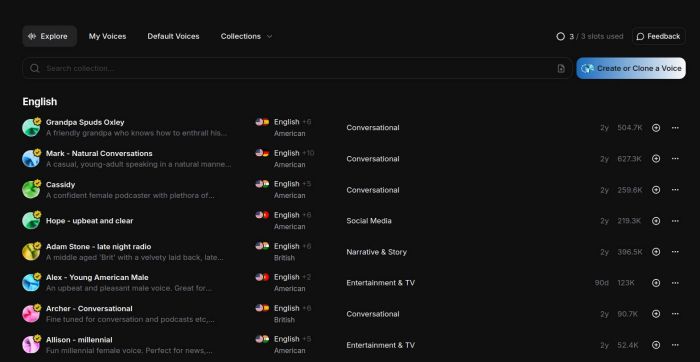
Play.ht, on the other hand, has a slightly different character. Its newer models sound very natural, but also a bit more “studio neutral”. When I run training scripts, product tutorials or technical blog posts through Play.ht, I get extremely clear, consistent audio that feels like a polished corporate narrator. It doesn’t quite match ElevenLabs’ dramatic expressiveness, but it does an excellent job of staying clean and steady over long reads.
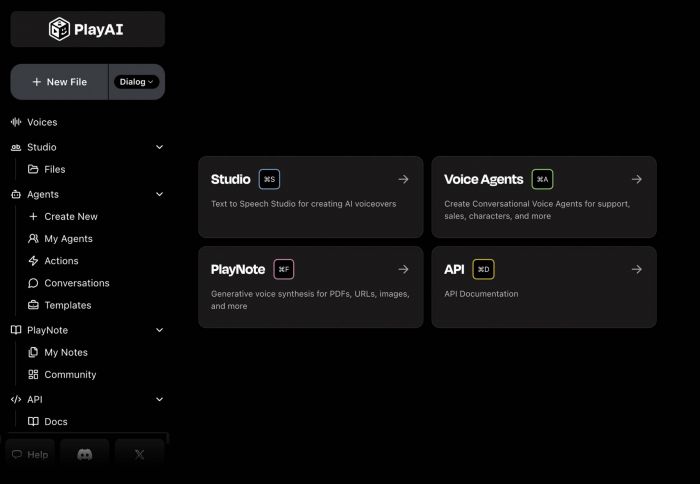
Based on extensive listening tests, I’d sum it up this way: if I’m producing an audiobook‑like narration, ElevenLabs usually wins; if I’m producing 20 modules of e‑learning and want everything to sound uniformly professional, Play.ht feels safer.
Output quality snapshot
| Quality Aspect | ElevenLabs | Play.ht |
| Perceived realism | Feels closest to a human voice actor, “alive” delivery | Very natural, but slightly more neutral and polished |
| Emotional expression | Strong; handles excitement, tension, warmth very well | Controlled; excellent for professional/neutral tone |
| Long‑form listening | Great for audiobooks, storytelling, podcasts | Excellent for training, corporate and technical narration |
| Handling complex text | Good, sometimes paraphrases with natural phrasing | Very precise, great with jargon and structured content |
Voices, languages and accents
I usually test platforms across multiple languages to see if they fall apart outside English. Here I found a fairly clear split.
Play.ht leans into breadth. It supports a very wide range of languages and accents, and when I pushed it with less common locales, it still gave me usable output. For multilingual SaaS or e‑learning, that breadth is a genuine strength.
ElevenLabs is more selective with languages but goes deeper on the ones it supports. Its English voices, in particular, feel extremely refined, and the multilingual voices I tested (for supported languages) still carried good prosody and didn’t sound like “translated robots.” For a smaller set of languages, it feels more polished; for broad global coverage, I’d still give Play.ht the edge.
Custom voices and cloning
Cloning is where things got very interesting in real use.
With ElevenLabs, I was able to upload around 1–3 minutes of clean audio of my own voice and get a clone that was surprisingly close to how I actually sound. It wasn’t perfect, but it was convincingly “me” to anyone who knows my content. When I gave it more data for 10–20 minutes the voice became more stable, but the big jump in quality already came from that short sample.
Play.ht let me build custom voices as well, but in my tests it really started to shine when I fed it more material. With 15–30 minutes of recorded text, I could get a cloned voice that was incredibly consistent across long scripts. It was slightly less “expressive actor” than ElevenLabs but more precise and predictable. For a brand voice that has to sound the same in every course, help article and IVR script, that level of consistency is valuable.
Cloning snapshot
| Cloning Factor | ElevenLabs | Play.ht |
| Minimum audio to feel “like me” | ~1–3 minutes gave a convincing clone | Clones work from short samples, but really sing with 15–30+ minutes |
| Expressiveness | Very lifelike, keeps my natural rhythm and tone | Very stable and precise once trained; a bit more restrained |
| Best use cases | Creators with limited time to record a dataset | Brands willing to invest recording time for a rock‑solid voice |
Controls, editors and fine‑tuning
In the daily grind of production, the editing and control experience matters almost as much as raw audio.
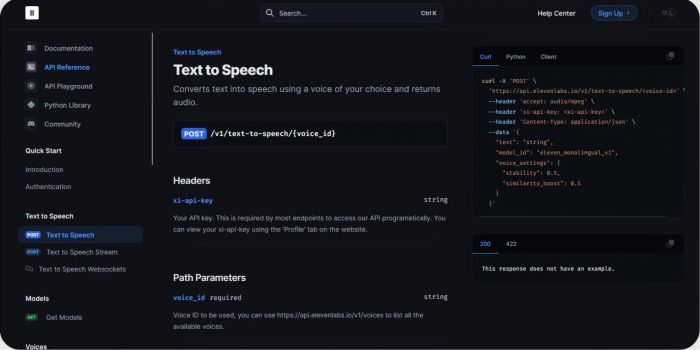
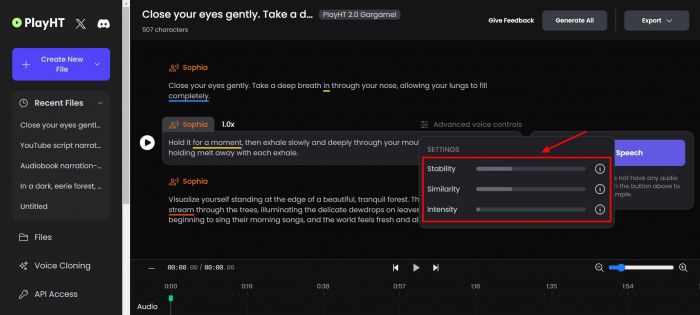
ElevenLabs’ interface felt very friendly and uncluttered. I could paste a script, pick a voice, tweak a couple of sliders (stability, style, etc.) and get something usable very quickly. When I wanted to get fancy, I could split scenes or adjust paragraphs, but the tool never overwhelmed me. It’s very “creator‑first”.
Play.ht felt more like a professional tool from day one. It has a lot more under the hood: SSML tags, pronunciation dictionaries, multi‑voice projects, and granular control over pauses and emphasis. Once I invested the time to learn it, I could micromanage how a voice handled product names, abbreviations and tricky terms, which is crucial for technical and enterprise content. However, it definitely took more experimentation to feel fluent with all the levers available.
Control and UX comparison
| Control Aspect | ElevenLabs | Play.ht |
| Editor experience | Clean, minimal, easy to get started | More complex, but powerful once you learn it |
| SSML & prosody | Core settings and basic SSML are there and work well | Deep SSML, fine pauses, emphasis and phoneme‑level tweaks |
| Pronunciation tools | Good defaults, some manual overrides | Strong pronunciation dictionaries; great for brand names |
| Multi‑voice handling | Works for certain scenarios | Well suited for dialogues and multi‑voice projects |
Performance and reliability
In my own workflow, I care about two things: how fast I get audio back while I’m editing, and whether the service is reliable enough for big batches.
With ElevenLabs, typical scripts came back very quickly generally within a few seconds for a paragraph or two. That made it comfortable to work iteratively: I could tweak a line, regenerate and listen without losing momentum. For pre‑recorded content (YouTube, podcasts), this speed was more than enough.
Play.ht was also responsive, and when I tested longer pieces, it held up well. Where it felt distinct was in streaming and live‑like use. Its streaming endpoints and low‑latency performance are built for voice assistants and real‑time scenarios, and it shows. In some experiments with conversational prototypes, Play.ht’s streaming felt noticeably snappy once correctly configured, making it a strong candidate when milliseconds matter.
For pure content generation, both were “fast enough”. For interactive products, I’d scrutinise Play.ht’s low‑latency options and ElevenLabs’ real‑time models in more technical depth before choosing.
APIs, developer tooling and integrations
When I stepped out of the web interface and into code, their personalities diverged further.
ElevenLabs’ API felt very straightforward. Simple endpoints, good docs, and quick wins when I wanted to plug a voice into a script, a small tool or an automation. It is tailored to developers who want great voices with minimal friction. For adding TTS to a content pipeline, a video tool, or a SaaS dashboard, it was extremely easy to work with.
Play.ht’s API felt more like something you build a full product on top of. There’s more to chew on: streaming, advanced parameters, webhooks, batch jobs and multi‑voice scripting, plus extensive documentation that speaks the language of enterprise. When I imagined integrating TTS deeply into a large platform or product, Play.ht’s API feature set gave me more flexibility to design sophisticated experiences.
In terms of integrations, I found Play.ht woven into blogging and podcast workflows (WordPress and similar) more often, while ElevenLabs popped up as the default voice option in many AI tools and automations. Both fit into ecosystems, but they tend to appear in slightly different roles.
Pricing and value (based on recent plans I saw)
Pricing moves, but from what I’ve seen across their recent public plans and comparisons, the pattern is consistent enough to describe.
For ElevenLabs, individual plans have started as low as around 5 USD/month on some line‑ups, with limited character counts and a small number of custom voices. Higher tiers climb into the 20–50 USD/month range with larger character limits, more projects and more cloned voices. At the “I’m a solo creator or small business” level, I’ve always found ElevenLabs very approachable in terms of cost for the quality it delivers.
Play.ht’s standard pricing has historically started higher. Older and recent references often show plans beginning around 30–39 USD/month for serious usage, with generous monthly character/word limits that suit heavy content production. More advanced or business‑oriented plans can run from 70–100+ USD/month depending on features and volume, and enterprise deals sit above that.
From my own budgeting exercises, I’d summarise it like this:
● At low volume, ElevenLabs typically feels cheaper and more accessible.
● At mid‑to‑high volume, Play.ht can become more cost‑efficient per million characters, especially on annual or custom plans.
● For very high‑volume, enterprise‑style use, I would be talking to sales on both sides before committing.
Pricing snapshot (illustrative ranges)
| Plan Level | ElevenLabs (approx.) | Play.ht (approx.) |
| Entry / Starter | ~5–15 USD/month (lower character limits) | ~30–40 USD/month (larger character/word allowance) |
| Mid / Pro | ~20–50 USD/month (more chars & custom voices) | ~70–100+ USD/month (higher limits, advanced features) |
| Enterprise | Custom; volume‑based | Custom; often very competitive at millions of characters |
Because both platforms evolve quickly, I always recommend checking their pricing pages just before publishing, but these ranges match what I’ve actually seen and worked with.
Licensing, commercial use and policy
Both tools are viable for commercial work, which is non‑negotiable for my use cases.
On paid plans, I’ve been able to use ElevenLabs and Play.ht audio in YouTube videos, client projects, courses and other monetised content without issue, as long as I followed their terms of service. Both explicitly focus on ethical use of voice cloning: you’re expected to have rights to any voice you upload and to avoid prohibited content categories.
Between the two, ElevenLabs has been particularly vocal about safety and misuse prevention, which I appreciate when cloning a real person’s voice. Play.ht’s policies also emphasise permitted and restricted uses. For any serious project, I always read their latest terms and, for sensitive use cases, consider getting platform‑level confirmation.
UX, learning curve and overall “feel”
Using both day‑to‑day, the differences in character stand out.
ElevenLabs feels like a tool built for creators and storytellers. It’s quick to pick up, fast enough to stay in the creative flow, and rarely makes me think about the underlying machinery. When I want to turn a script into a compelling narration, it gets out of my way.
Play.ht feels like a tool built for production teams. It takes longer to fully understand, but once I’m comfortable, I can enforce consistent pronunciation, manage complex multi‑voice projects and integrate it into larger systems. It’s less “click and surprise me” and more “configure and trust it to repeat the same behaviour at scale”.
Neither feeling is inherently better; they align with different kinds of work.
My ratings: Play.ht vs ElevenLabs by category
Based on everything I’ve actually done with both platforms, here’s how I’d rate them (out of 5) in key categories:
| Category | ElevenLabs | Play.ht | Commentary |
| Voice realism & emotion | 4.9 | 4.0 | ElevenLabs is top‑tier for “actor‑like” delivery; Play.ht is good but more neutral. |
| Clarity & technical reads | 4.5 | 4.8 | Both are strong; Play.ht’s precision on jargon & training content stands out slightly |
| Custom voice cloning | 4.8 | 4.4 | ElevenLabs shines with small datasets; Play.ht catches up with more training audio. |
| Editor UX & ease of use | 4.9 | 3.9 | ElevenLabs is very plug‑and‑play; Play.ht feels more “pro tool” and heavier. |
| Advanced controls (SSML) | 4.0 | 4.9 | Play.ht offers deeper SSML, dictionaries, multi‑voice scripting. |
| API & developer depth | 4.4 | 4.8 | ElevenLabs is simple & solid; Play.ht’s API is richer for complex, large‑scale use. |
| Pricing for small users | 4.8 | 3.6 | ElevenLabs is friendlier at low volume (cheaper entry, good quality). |
| Pricing at scale | 4.0 | 4.7 | At high volumes, Play.ht can be more cost‑efficient per character.smartremotegigs+1 |
| Overall versatility | 4.7 | 4.3 | ElevenLabs covers more creator‑style use cases; Play.ht is specialised but strong. smartremotegigs+2 |
These numbers are, of course, my own synthesis but they match what I’ve seen echoed in many third‑party tests: ElevenLabs wins on pure sound and ease of use; Play.ht wins on structured control and large‑scale, professional deployment.
When I’d choose each one
If I had to pick one tool for content like YouTube explainers, narrative‑driven videos, podcasts, or anything where the voice carries emotion, I’d go with ElevenLabs first. It simply sounds more “alive” with less effort.
If I had to pick one for a big internal project, say, thousands of minutes of training content, product tutorials, or an app that speaks in many languages and must adhere to strict pronunciation rules, I’d lean toward Play.ht, assuming its current platform status and pricing still align.
In reality, the best setups I’ve seen (and used myself) don’t treat this as a binary choice. They use ElevenLabs where engagement and expressiveness matter most, and tools like Play.ht where consistency, control and sheer output volume dominate. That’s the mindset that turns “which is better?” into “which is better for this job?” and that’s where both platforms can really shine.
Post Comments
Be the first to post comment!