$11B AUDIOBOOK MARKET, 2025 | ~26% ANNUAL GROWTH RATE | 80%+ TYPICAL COST CUT VS STUDIO |
THE BRIEFING
Three things decide whether an AI audiobook tool is right for you: how human it sounds, how much it costs, and how little it fights you across 30,000 words.
Hiring a professional narrator is still the gold standard for performance-heavy fiction. It is also slow and expensive. AI narration flips that equation, turning a process that once took weeks and thousands of dollars into one that takes an afternoon and a small monthly fee.
The catch is that no single tool wins on every front. The most realistic voice is not the cheapest. The cheapest is not the easiest to use. The easiest end-to-end workflow is not always the most flexible. So instead of crowning one winner, this guide maps five strong options to the jobs they are genuinely best at, from premium fiction narration down to a free route for authors already on Apple Books.
WHY THIS MATTERS NOW
The audience is growing, and the production math finally favors the author
Two forces make 2026 a sensible time to produce an audiobook: demand keeps climbing, and the cost of getting in has collapsed.
A market on a steep climb
GLOBAL AUDIOBOOK REVENUE, USD BILLIONS
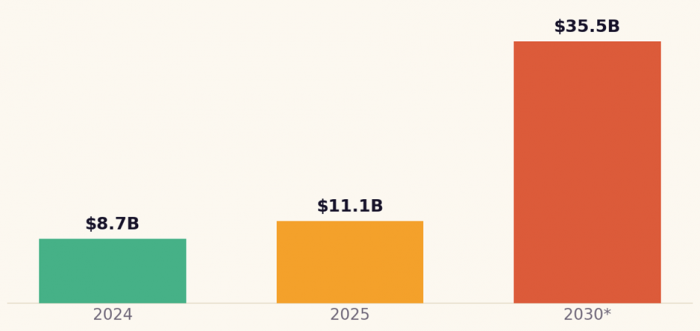
*Projection. Source: Grand View Research, ~26% CAGR (2025 to 2030). Other firms place 2025 near $11B with similar growth.
Studio cost vs AI cost
TO PRODUCE ONE 6 TO 8 HOUR AUDIOBOOK
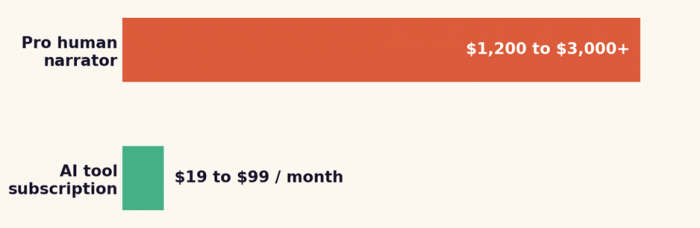
~60 sales to break even on an AI-narrated title | 320 to 800 sales needed to recoup a human narrator |
Source: indie-author cost breakdowns, 2026, at roughly $3.75 royalty per sale.
READ THIS FIRST
What separates audiobook-grade narration from plain text-to-speech
A voice can sound great in a 10-second clip and fall apart over a full chapter. These are the things worth testing before you pay for anything.
▸ Naturalness over distance. It should read like a person reading a book, with real breathing and pauses, not a virtual assistant reading search results.
▸ Emotional range. Fiction and memoir need tension, warmth, and excitement carried by tone alone. Cheaper models drift into a flat, pleasant monotone.
▸ Long-form consistency. The voice must hold the same quality across tens of thousands of words, not just the first paragraph.
▸ Pronunciation control. You will need to fix character names, places, and jargon. Good tools offer phonetic editing instead of fighting you on every term.
▸ Chapter workflow. The best tools detect chapters and export clean, per-file audio in reading order, so you are not stitching clips by hand.
▸ Commercial rights and specs. Check that you can legally sell the output, and that files meet store specs. Many platforms now accept AI audio with disclosure.
THE LINEUP
Five tools, five different jobs
Each entry below is the strongest pick for a particular kind of author and budget. Read them like tracks: you are looking for the one that fits your book.
TRACK 01
ElevenLabs
Best for emotional realism
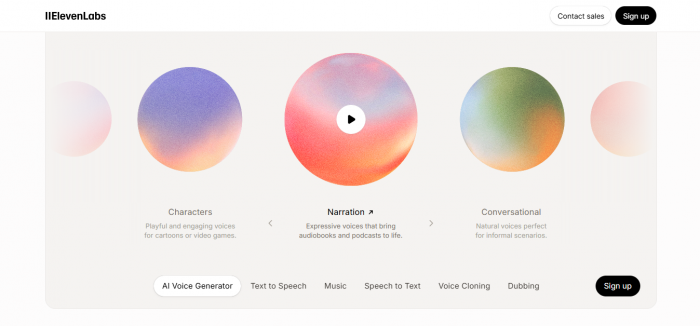
ElevenLabs is the name most reviewers reach for when the question is pure voice quality. Its Studio feature is built for long-form audio, holding emotion, pacing, and emphasis across an entire book rather than a short clip. For first-person fiction, memoir, or anything that lives or dies on delivery, it sets the bar.
STRENGTHS + Most natural, expressive long-form narration + Professional Voice Cloning to narrate in your own voice + 192 kbps output and 29+ languages | WATCH-OUTS ! Credit system can be confusing to budget ! The highest-quality model uses credits faster ! Overages add up in busy months |
| Free: $0 (no commercial) · Starter: $6/mo · Creator: $22/mo · Pro: $99/mo |
TRACK 02
Murf AI
Best all-round value
Murf hits the sweet spot of features and price for most creators. It ships with built-in character assignment, so you tell it which voice speaks which line of dialogue and it handles the switching. Add phonetic pronunciation fixes, emotion controls, and a library of royalty-free background tracks, and you can take a clean manuscript to a finished 6 to 8 hour audiobook in well under an hour.
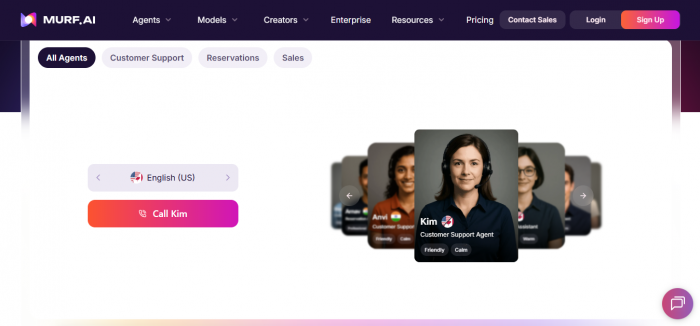
STRENGTHS + 200+ voices with dialogue character assignment + Commercial rights on the entry paid plan + ACX-compliant export and phonetic editing | WATCH-OUTS ! Free tier (~10 min) is for evaluation only ! Emotion can feel slightly corporate or flat ! A few minutes of processing per section |
| Free: ~10 min · Creator Lite: $19/mo · All in: ~$228/yr |
TRACK 03
Speechify
Best for speed and scale
If you are producing a lot of non-fiction, Speechify is the workhorse. It processes a full chapter in roughly 30 to 60 seconds, carries the largest voice library here at over 1,000 voices across 60 languages, and handles PDFs better than most text-only tools. Pick a voice, run the manuscript, done.
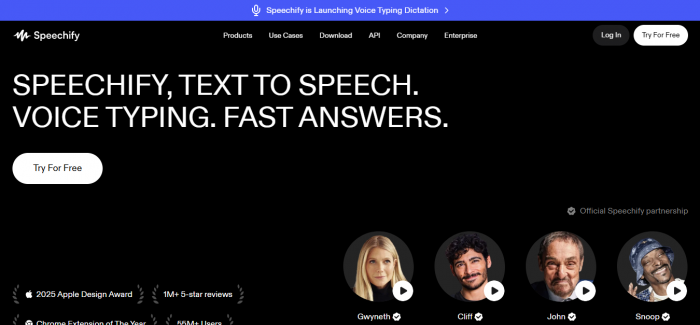
STRENGTHS + Fastest processing on this list + 1,000+ voices, 60 languages, reads PDFs + ACX-compliant export for distribution | WATCH-OUTS ! Commercial use needs the higher Studio tier ! Multi-character fiction is manual work ! Emotional depth still trails ElevenLabs |
| Premium: $11.58/mo · Voice Over Studio: $24/mo · Cloning: ~$249/yr |
TRACK 04
Google Cloud TTS & Amazon Polly
Best for tight budgets
The two big cloud engines win on raw price. They offer decent, scalable neural voices at the lowest per-word cost in this guide, and you pay only for what you generate rather than a fixed monthly ceiling. For a large catalog or a technically comfortable author, that adds up to real savings.
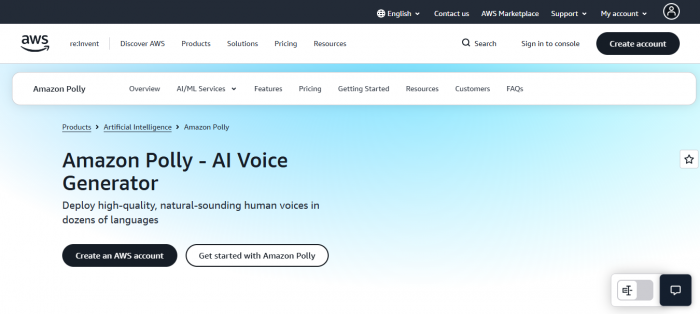
STRENGTHS + Lowest cost per word, pay as you go + Scales cleanly to big catalogs + Solid, reliable neural voice quality | WATCH-OUTS ! Not an end-to-end audiobook tool ! No chapter detection or built-in editor ! Some technical setup required |
| Pricing: usage based · Cheapest at volume · Bring your own editor |
TRACK 05
Apple Books Digital Narration
Best free route
For eligible authors, Apple turns your ebook into a narrated audiobook at no upfront cost, with distribution built straight into Apple Books. It is the lowest-risk way to test whether your title has an audio audience before spending on a premium tool. Google Play Books offers a similar free AI-narrator route with disclosure.

STRENGTHS + No upfront cost for eligible titles + Distribution baked into the store + Great for validating demand first | WATCH-OUTS ! Eligibility rules on rights and category ! Locked to one ecosystem ! Fewer voices and less fine control |
| Cost: $0 upfront · Revenue share via store · Eligibility required |
THE MIXING BOARD
All five, side by side
A quick reference once you know roughly what you are after. The green note marks where each tool clearly leads.
| TOOL | BEST FOR | VOICE REALISM | COMMERCIAL ENTRY | WORKFLOW |
|---|---|---|---|---|
| ElevenLabs | Fiction, memoir, emotion | Top of class | $6/mo (Starter) | Strong (Studio) |
| Murf AI | Non-fiction, multi-voice | Very good | $19/mo | Strong, guided |
| Speechify | High-volume, multilingual | Very good | $24/mo (Studio) | Good, fastest |
| Cloud TTS / Polly | Budget, large catalogs | Good | Usage based | Engine only |
| Apple Books | Free testing on Apple | Good | $0 upfront | Store-integrated |
LOWEST MONTHLY COST TO SELL COMMERCIALLY
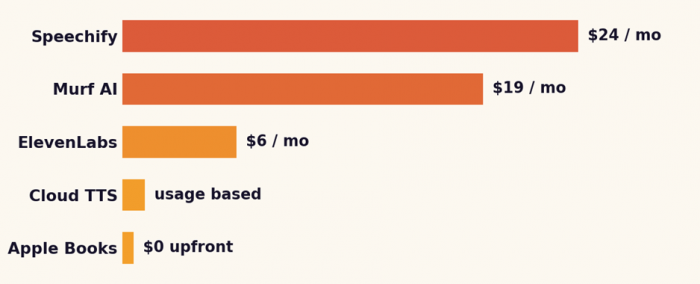
Entry price for commercial output. ElevenLabs Starter is the cheapest paid commercial tier, though most authors land on Creator ($22) for cloning and higher quality.
PICK YOUR MIC
Match your book to a tool in one line
You write fiction or memoir Performance carries the book, so realism wins over price. The emotional swings and character moments need a voice that can actually act. → Start with ElevenLabs | You write non-fiction or business You want a clean, guided path from manuscript to finished file, with commercial rights and easy pronunciation fixes, at a fair price. → Start with Murf AI |
You produce at high volume Speed and a deep multilingual voice library matter more than squeezing out the last drop of emotion. You are shipping often. → Start with Speechify | You are cost-first or technical You have a large catalog or coding comfort, and you would rather pay per word and bring your own editing workflow. → Start with Cloud TTS or Polly |
You just want to test the water Your ebook is already on Apple Books and you would like an audiobook live with zero upfront spend to see if it sells. → Start with Apple Books | You want your own voice Voice cloning lets the book sound like you. Confirm consent and commercial terms first, and never clone anyone else without permission. → ElevenLabs or Speechify cloning |
FROM MANUSCRIPT TO MASTER
The five-step production path
Whichever tool you choose, the workflow is similar. Most disappointing AI audiobooks come from skipping step one, not from the voice.
1. Clean the text. Fix typos, standardize headings and spacing, and remove stray links. AI reads exactly what is on the page.
2. Structure by chapter. Break the manuscript into clear chapters so the tool can produce files in the right reading order.
3. Pick and tune the voice. Choose a narrator, set pace and emphasis, and fix pronunciation of names, places, and jargon.
4. Generate and review. Render chapter by chapter and listen back. Regenerate any passage that lands awkwardly.
5. Export and distribute. Export to spec, then publish to the stores that accept AI audio, disclosing AI narration where required.
WHERE TO SELL IT
The distribution map changed in your favor
For years, the big retailer would not accept AI narration, which kept many indie authors out. That has loosened. A growing set of stores now take AI-narrated audiobooks, usually with a simple disclosure that the narration is synthetic.
Selling direct to readers can also keep a much larger share of revenue than the traditional royalty split, so it is worth weighing wide distribution against direct sales for your title.
| Spotify for Authors · Apple Books · Google Play Books · Kobo · Direct |
Before you buy
Pricing, voice counts, and store policies in this space change quickly, often every few months. Treat the numbers here as a snapshot from June 2026 and confirm the current details on each tool’s own site before committing. Always check commercial rights and voice-cloning consent terms, and never clone a real person’s voice without clear permission.
Sources: Grand View Research, Fortune Business Insights, and Coherent Market Insights (market size and growth); ElevenLabs, Murf AI, and Speechify published pricing; Inkfluence AI, PublishDrive, and independent author cost breakdowns (2026).
Post Comments
Be the first to post comment!
Related Articles


Grubby AI vs WriteHuman: Which One Should You Use?
Ridge Harper . Jun 30, 2026