The short answer
Here is the quick version, because most people reading this just want a recommendation. Akool and Remaker both swap faces well, but they are built for different people. Akool is the studio tool: the cleanest video swaps, output that survives a paid ad or a client review, and a full generative video suite wrapped around the core feature. You pay a monthly subscription for that. Remaker is the pocket tool. It runs in a browser and on your phone, charges a few dollars for a pack of credits, and turns around quick image swaps that look great on social.
| Short answer: if your work ends up in a paid ad, a client deliverable, or a video real customers will watch, choose Akool. If you mostly swap faces in photos for fun or light social content and you hate subscriptions, choose Remaker. |
At a glance, here is how the two line up.
| Akool | Remaker | |
|---|---|---|
| Best for | Marketers, agencies, ecommerce, video pros | Casual creators, social media, hobbyists |
| Core strength | Studio-grade video face swap | Fast, cheap image face swap |
| Pricing model | Subscription, plus credits | One-time credit packs |
| Starting paid price | Around $30 a month (about $21 annual) | $2.99 for 150 credits |
| Free tier | Trial, watermark, 720p | Daily free credits, watermark-free images |
| Resolution ceiling | Up to 4K, higher on top tiers | HD on paid plans |
| Mobile apps | No dedicated app | iOS and Android |
| Platforms | Web and API | Web, iOS, Android |
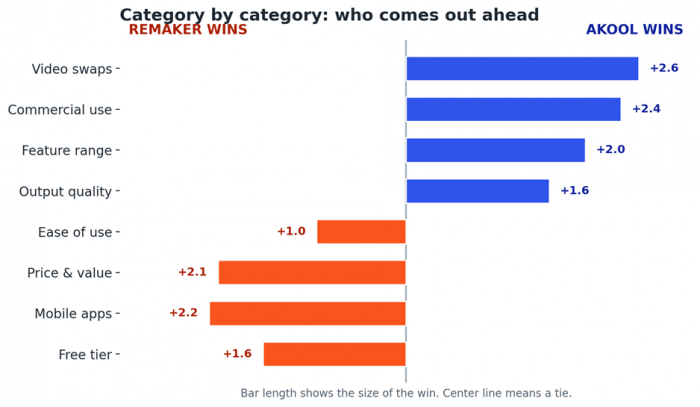
Figure 1. How the eight categories split between the two tools.
Across the eight categories I tested, the split is clean. Akool takes the ones that matter for professional output: video, raw quality, breadth of features, and commercial readiness. Remaker takes the ones that matter for everyday users: price, the free tier, mobile access, and a gentler learning curve. Almost nobody needs all eight. You need the four that match your work.
Two tools, built for two different people
Akool launched in 2022 out of Palo Alto and grew quickly, landing near the top of the 2025 Inc. 5000 list on the back of reported revenue around forty million dollars. It runs face-swap campaigns for brands you have heard of, and it trains its own models rather than wrapping someone else's. That choice shows up in the product. Face swap is one feature inside a larger suite that also covers talking avatars, video translation across more than 150 languages, image generation, and live streaming avatars you can drive in a video call. The pitch is simple: film one ad, then use AI to produce dozens of localized variants without booking another shoot.
As you read in Many Remaker Reviews, it approaches the same problem from the opposite direction. It is a browser-based, credit-driven app with matching iOS and Android clients, and it got popular the way these tools usually do, through a viral face-swap reel on TikTok. Picture a Canva-style dashboard where every button fires an AI model instead of opening a template. Face swap is the headline, but the platform also includes an image upscaler that reviewers consistently praise, background removal, AI headshots, text-to-image art, and image-to-video animation. You sign up once, top up credits, and reach for whichever tool you need. There is no separate subscription per feature.
_1771314491.webp)
Figure 2. Casual and image-first versus professional and video-first.
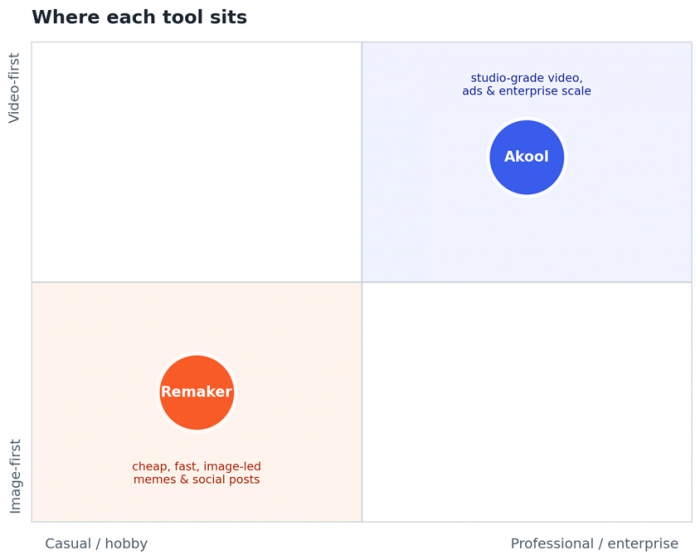
Remaker lives in the casual, image-first corner. Akool sits in the professional, video-first one. The gap between those two dots is the whole decision, and the rest of this piece walks through it.
The whole comparison on one chart
Before getting into specifics, here is the entire comparison in a single picture. The scores reflect my own testing and the consensus from independent reviews, rated out of ten on each axis.
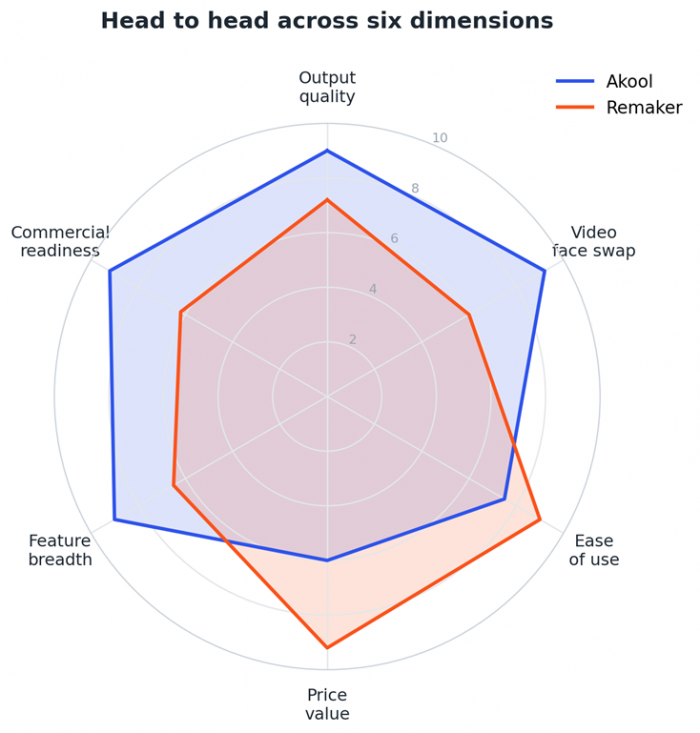
Figure 3. Capability scores out of ten, based on testing and independent reviews.
The shapes say it plainly. Akool reaches toward quality, video, features, and commercial use. Remaker swells toward price and ease. The overlap in the middle is real shared ground: both are easy to start, and both turn out believable single-image swaps for casual use. From here, the comparison comes down to which of those strengths you actually need.
Start with video, because that is where they split
If you only read one section, make it this one. Video is the single difference most likely to decide which tool you should buy, because it is where the two stop being comparable at all.
Akool was built around video face swap. Upload a base clip of someone talking to camera plus a target photo, and it replaces the face while holding expressions, lip movement, lighting, and shadows across the entire clip. It keeps resolution, it copes with motion, and higher tiers push toward longer clips and very high output quality. This is the feature brands actually license. Akool notes that Coca-Cola benchmarked it against rivals before choosing it, and while that is a vendor claim, independent reviewers land on a similar verdict for video specifically.
Remaker can swap faces in video too, with three catches worth knowing. The feature sits behind paid credits despite being marketed as free, longer high-definition clips take a while to render because the work is genuinely heavy, and the result fits short social clips far better than polished, client-facing video. For a quick reel, it does the job. For anything headed to a big screen or a paid media budget, it is the wrong tool.
On video, Akool is not just ahead. It is in a different class.
On a single photo, it is closer than you think
Drop a clear, well-lit photo into either tool and both hand back a swap most people would not question at a glance. This is the part Akool's marketing tends to undersell.
Remaker blends skin tone and lighting capably and handles group photos with several faces better than most free tools. In side-by-side tests by independent creators, its main weakness shows up at the jawline and hairline, where the edge of the new face can look slightly soft.
Akool pulls ahead as the source gets harder. Awkward angles, strong shadows, and high-resolution output are where its in-house models earn their keep, and it sidesteps the blurry, pixelated artifacts cheaper engines leave around teeth and eyes. One caveat lands on both tools: like nearly every face swapper, neither rebuilds hair to match the new face, so a swap onto a very different hairstyle can still read as off.
For everyday photos, give it to Akool by a nose, with Remaker far closer than its price tag suggests.
What each one actually costs
The two tools price themselves on opposite logic, so compare the models, not just the numbers.
Remaker sells one-time credit packs and runs no subscription. New accounts start with 30 credits, plus a daily allowance that begins at 5 free credits and climbs to 10 with consecutive logins. When you need more, packs run from $2.99 for 150 credits up to $19.99 for 1,000, with the $9.99 530-credit pack listed as the popular pick. Image downloads come watermark-free, which is rare at this price, and credits sit in your account until you spend them, so the tool costs nothing in the months you skip it.
Akool charges a monthly subscription, with paid plans starting around $30 a month, or closer to $21 a month on annual billing, which carries a 30 percent discount. Higher tiers climb toward enterprise pricing in the hundreds. Inside a plan, individual tasks still draw on credits, with a face swap costing a few credits per image. There is a free trial, but its exports carry a watermark and cap out at 720p.
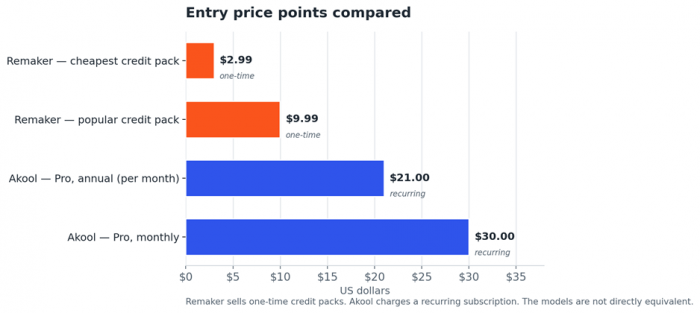
Figure 4. Representative entry prices. Note the different billing models.
The real question is fit, not the sticker. Swap faces now and then and Remaker can cost you a few dollars a year. Produce constantly and Akool's subscription stops feeling steep while its quality starts paying for itself. Thirty dollars a month for the occasional meme is absurd. The same thirty dollars to ship a week of localized ad variants is a steal.
Here is the detail behind those numbers.
| Akool | Remaker | |
|---|---|---|
| Free option | 3-day trial, watermark, 720p | 30 credits, plus 5 to 10 daily |
| Entry paid | Around $30 a month | $2.99 for 150 credits |
| Popular paid | Pro and Pro Max tiers | $9.99 for 530 credits |
| Higher end | Business and enterprise, hundreds a month | $19.99 for 1,000 credits |
| Billing | Recurring subscription | One-time purchase |
| Watermark-free | Paid plans only | Free image downloads |
On cost and flexibility, Remaker wins outright.
Which is easier to just pick up
Both are genuinely beginner-friendly, so this comes down to small things. Neither needs installs, editing experience, or a manual. You upload a base image, add the face you want, and generate.
Remaker has two edges. Its dashboard is lighter and less cluttered because it does fewer things, so the first swap is quicker to find. And it ships real iOS and Android apps, which means you can swap faces from your phone without opening a browser. For a tool people reach for on impulse, that counts.
Akool stays approachable but carries more surface area. Avatars, translation, live camera, and image generation all share the same workspace, so there is simply more to scan past on the way to face swap. Its live camera mode, which pipes a transformed feed into video calls, also needs some platform-specific setup. None of it is hard, but Remaker is the one you would hand to a total beginner.
For pick-up-and-go simplicity, the edge is Remaker's.
What you get beyond the face swap
Face swap is the reason you showed up, but both tools want to be more than that, and this is where Akool's ambitions show.
Akool surrounds the swap with a production pipeline: talking avatars, lifelike AI presenters, video translation with synchronized lip movement in more than 150 languages, AI product backgrounds, image-to-video, and voice cloning. For a marketing team, that consolidation is the actual selling point, since one platform can localize a campaign from start to finish.
Remaker's extras lean toward image polish rather than video production. Its image upscaler is, by several accounts, the best tool on the platform, turning grainy photos crisp. Background removal, AI headshots, and text-to-image art fill out the rest. Reviewers are less kind to its object replacer, which can produce odd results. The pattern is consistent: Akool grows outward into video and avatars, Remaker grows outward into image editing.
Feature for feature, the two surfaces look like this.
| Capability | Akool | Remaker |
|---|---|---|
| Image face swap | Strong | Strong |
| Video face swap | Studio-grade | Basic, paid credits |
| Multi-face swap | Yes | Yes |
| Talking avatars | Yes | Talking photo only |
| Video translation | 150+ languages | No |
| Live streaming avatars | Yes | No |
| Image upscaler | Yes | Yes, a standout |
| Background removal | Yes | Yes |
| AI image generation | Yes | Yes |
| Mobile apps | No | iOS and Android |
| API access | Yes | Limited |
For sheer breadth, Akool again, though Remaker's upscaler is a genuine standout.
One thing to get right before you start
Face-swap tools sit on an obvious ethical line, and both companies know it. Putting someone's face onto an image or video without their permission can violate their privacy and, depending on where you live and what you make, the law. One rule covers almost every case: swap faces you have the right to use, never pass off fabricated footage as real, and do not use the technology to mislead, harass, or impersonate. Treat it as a creative tool, not a weapon.
Which one is right for you
Choose Akool if:
• You produce video face swaps, especially for ads, UGC, or client work.
• Output has to look professional on a big screen, with no visible artifacts.
• You want one platform for swaps, avatars, translation, and image generation.
• You publish often enough that a monthly subscription pays for itself.
• You need API access to build face swap into your own product.
Choose Remaker if:
• You mostly swap faces in photos for social posts, memes, or fun.
• You would rather pay a few dollars once than commit to a subscription.
• You want to work from your phone with a dedicated app.
• You value watermark-free image downloads on a tight budget.
• A genuinely good image upscaler in the same place is a welcome bonus.
The bottom line
There is no overall winner here, and any review that crowns one is answering the wrong question. Akool and Remaker solve different problems for different people.
Akool is the better tool when your output is video or it represents your business. It earns its subscription through quality, video performance, and a suite that turns one shoot into a whole campaign. Remaker is the better tool when you swap faces casually and want speed, mobility, and a cost that rounds to zero in a quiet month.
So drop the which-is-better framing and ask what you are making. If the answer involves a paid video or a client, it is Akool. If it involves a laugh and a quick post, it is Remaker. Match the tool to the job and neither will let you down.
Post Comments
Be the first to post comment!
Related Articles


Grubby AI vs WriteHuman: Which One Should You Use?
Ridge Harper . Jun 30, 2026