~67% True-match rate in independent testing | ~23% False-positive rate (about 1 in 4 hits) | From $6 Credit-based, settled in crypto | 15–30s Typical time per search |
Reverse face search has quietly become one of the most useful and most uncomfortable tools on the modern internet. Romance and confidence scams drain over a billion dollars from consumers every year, and almost all of them start the same way: a borrowed photo attached to a fake name. FaceCheck ID promises to break that pattern. Hand it a single face and it tries to show you everywhere that same face has surfaced online dating profiles, social accounts, news stories, even mugshot and offender registries.
The truth about FaceCheck sits somewhere between the breathless product demos and the privacy panic. It is genuinely better than the free tools most people reach for first, especially on bad photos. It is also less reliable, less convenient, and more legally limited than its reputation suggests. This review pulls together independent accuracy data, current pricing pulled straight from the company, the privacy fine print, and an honest comparison with the alternatives, so you can decide whether it belongs in your toolkit. The only external link in this guide points to FaceCheck ID's official site.
What Is FaceCheck ID?
FaceCheck ID is a facial-recognition search engine built to do one narrow thing well: locate where a specific person appears online using nothing but a photograph. It launched in 2022 and is operated by a company called Tech Solutions, registered in Belize. Unlike general image tools such as Google Lens or TinEye which look for copies of the same picture by matching colour, shape and composition FaceCheck is purpose-built to match faces. It reads the geometry of a face (the spacing of the eyes, the shape of the nose, the line of the jaw) and hunts for that same face across entirely different photos, angles and lighting. That is why it can connect a blurry group snapshot to a polished headshot when a pixel-matching tool simply cannot.

Three limits are worth fixing in your mind before you start. FaceCheck will not:
• Reach private or locked accounts. It only sees publicly indexed pages.
• Hand you a name, phone number or address. It returns image matches and source links, nothing more.
• Confirm an identity for you. Verifying who the person actually is remains your job and the company says so explicitly.
FaceCheck ID at a glance
| Attribute | Detail |
|---|---|
| Tool type | Facial-recognition / reverse face-search engine |
| Launched | 2022 (operated by Tech Solutions, Belize) |
| What it searches | Public social media, news, blogs, video stills, plus mugshot and sex-offender registries |
| Result speed | About 15 to 30 seconds per search |
| Match score | 0 to 100, grouped into four confidence bands |
| Free tier | Yes blurred previews; credits unlock clear images and links |
| Payment | Settled in cryptocurrency (Bitcoin, Litecoin, Solana) |
| Platform | Web only no official app, but a developer API exists |
| Returns personal data? | No image matches and source URLs only |
How FaceCheck ID Works
Under the hood, FaceCheck follows the same broad pipeline as most modern face-search engines. When you upload a photo it detects the face, then converts its measurable features into a numerical fingerprint what the field calls a face embedding. That fingerprint is compared against a large, constantly shifting index of pre-processed faces (reported figures range from several hundred million to roughly a billion images, though the number is self-reported), and the closest matches come back with a confidence score, usually within 15 to 30 seconds. Free users see the results immediately, but the previews stay blurred until credits are spent to unlock the clear images and source links.
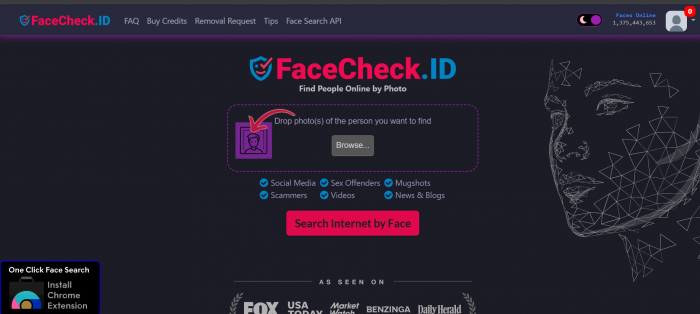
The score is the part most people misread. It runs from 0 to 100 and is a similarity estimate, not a verdict. A flat 100 means the identical photo was found; a high-but-not-perfect score means the facial geometry is a close statistical match, not proof that two pictures show the same human. FaceCheck sorts every result into four colour-coded bands:
| Band | Score | How to treat it |
|---|---|---|
| Certain | 90–100 | Near-certain, but still confirm against a second source |
| Confident | 83–89 | Usually the same person; verify before relying on it |
| Uncertain | 70–82 | A possible lead, not a conclusion |
| Weak | 50–69 | Often a look-alike or false positive; do not rely on it |
Red flags: the safety layer
One feature worth knowing about is the red-flag warning. When an uploaded face matches an image from a high-risk source scam-reporting sites, sex-offender registries, mugshots, most-wanted lists, escort or adult content, or a large number of social profiles using different names at a confidence score of 83 or higher, FaceCheck surfaces a warning icon above the results. It will also raise a flag if it detects that the photo you uploaded is itself an AI-generated face. The flags are a useful at-a-glance risk signal, but they sit behind the paywall along with the source links.
The honest way to read a result Because many unrelated people genuinely look alike, treating any single score as proof is the most common and most dangerous mistake users make. Even the platform itself shows a permanent banner warning that you should never trust a face search on its own. Treat FaceCheck as the start of an investigation, not the last word. |
How Accurate Is It, Really?
This is where the marketing and the measurements diverge. FaceCheck describes its algorithm as “scary good,” and on difficult photos it does outperform most rivals. But independent testing reported across multiple published reviews including a six-month study that ran 500 verified subjects through the engine places its real-world accuracy in more sober territory.
In that testing, its true-positive rate (how often it correctly finds a real match) lands around 67%, its false-positive rate sits near 23% meaning roughly one match in four can point at the wrong person and it misses an existing profile about 31% of the time. Photo quality moves the needle more than any other factor.
Reported accuracy by photo type
| Photo type | Approx. accuracy | What it means for you |
|---|---|---|
| Professional / front-facing | ~78% | Best case; the most reliable results |
| Standard social-media photo | ~60–67% | Workable, but verify every match |
| Low-light image | ~38–42% | Unreliable; expect misses |
| Steep side-angle / partial | ~38–42% | Unreliable; expect misses |
The detail that matters most: how often each band is wrong
You would assume a “Certain” label means certain. Independent testing says otherwise, and this is the single most important table in this review. It shows the false-positive rate inside each confidence band in other words, how often a match in that band turned out to be the wrong person.
| Confidence band | Score range | How often it was WRONG |
|---|---|---|
| Certain | 90–100 | ~8% |
| Confident | 83–89 | ~15% |
| Uncertain | 70–82 | ~28% |
| Weak | 50–69 | ~45% |
Figures reflect independent testing aggregated across published reviews; results vary by image and are not vendor-certified.
The takeaway is blunt: even a top-band “Certain” match is wrong roughly one time in twelve, which quietly contradicts the reassurance the label is selling. A “Weak” match is barely better than a coin flip. Treat anything below “Confident” as a hint, never as evidence. And remember that a no-results screen is weak proof of anything a clean miss often just means the engine failed to connect this particular photo to pages that do exist.
The deepfake and AI-face blind spot Like every reverse face-search tool, FaceCheck can only match images that already exist online. It can tell you where a face has appeared, but not whether the photo is authentic. With AI-generated faces now cheap to produce, a scammer can use a synthetic image with no web history at all, returning zero matches and a false sense of safety. FaceCheck now flags photos it detects as AI-generated, which helps but a clean search is still not proof that a person is real. |
Pricing and the Payment Catch
FaceCheck lets you search for free, but free only buys blurred previews. To see clear matches and their source links you buy credits, and each search costs three credits. There is no monthly subscription all paid access is credit-based, which suits occasional users and penalises heavy ones. The packages below are taken from the company's current buy page; per-search costs are calculated from the credit counts.
| Plan | Price | Credits | Expires | Per search |
|---|---|---|---|---|
| Rookie Sleuth | $19 | 150 (50 searches) | 14 days | ~$0.38 |
| Private Eye ★ | $47 | 400 (133 searches) | 2 months | ~$0.35 |
| Deep Investigator | $197 | 2,000 (666 searches) | 6 months | ~$0.30 |
| The Professional | $597 | 10,000 (3,333 searches) | 1 year | ~$0.18 |
Note on the entry tier: many reviews list a $6 “Just a Peek” pack (about 12 searches, ~2-day expiry) as the cheapest option. On the official buy page at the time of writing, the smallest listed pack is the $19 Rookie Sleuth; the $6 trial may appear inside the search flow. Always confirm the live pricing before you pay.
Higher tiers add genuinely useful extras: priority search, continuous automated searches, Telegram match alerts, and (on the top plan) export to PDF and Excel. On paper the per-search cost is reasonable well under a dollar. The real friction is how you pay.
The cryptocurrency wall, explained accurately
Since late 2024, FaceCheck has settled payments in cryptocurrency only Bitcoin, Litecoin and Solana. There is no card or PayPal checkout on the site itself. This is the single most common complaint in user reviews, and the company has never fully explained the switch (sidestepping payment-processor restrictions on facial-recognition services is the likely reason). Two clarifications that most reviews get wrong are worth making:
• You can still use familiar funding methods indirectly. The company's own FAQ confirms you can buy crypto with a credit card or through PayPal, Venmo or Cash App at an exchange such as Coinbase, then pay FaceCheck with that crypto. So it is crypto-settled, not strictly “crypto-only-from-scratch.”
• Crypto adds hidden costs. Exchange fees (roughly 1–3%), wallet network fees and conversion markups quietly inflate the sticker price, and you, the sender, cover the network fee.
• Credits expire and refunds do not exist. The cheaper tiers lapse in days to weeks, and the company states plainly that all sales are final, with no refunds.
For anyone without a crypto wallet, that payment path even with the exchange workaround is the biggest single reason to consider an alternative.
How to Run a Good Search
Because the input photo is the biggest lever you control, a few habits dramatically improve your odds and keep you from drawing the wrong conclusion.
1. Feed it the best photo you have. A clean, front-facing, well-lit image scored around 78% in testing; low light and steep angles dragged that into the high 30s. Crop tightly to the face.
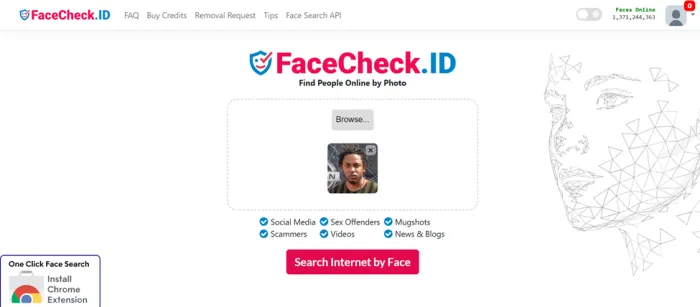
2. Use the free preview as a triage step. It confirms whether matches exist and how confident the engine is, so you only spend credits when there is something worth unlocking.
3. Cross-reference before you believe anything. Open the source links, look for the same face across several independent pages, and confirm details that a look-alike would not share.
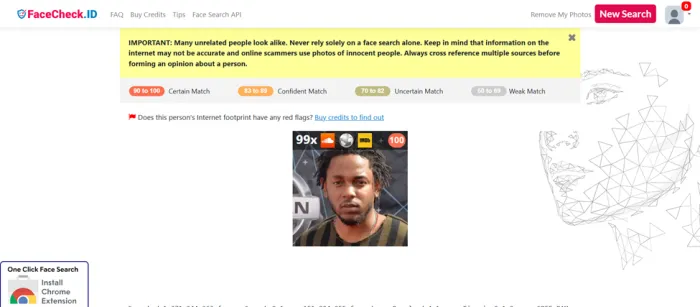
4. Respect the bands. Treat “Certain” as strong evidence that still needs a second source, and anything below “Confident” as a lead only.
5. Do not over-read a blank result. Zero matches can mean a private footprint, a brand-new fake, or simply an index gap not proof the person is fake or, conversely, safe.
FaceCheck ID vs the Alternatives
FaceCheck does not operate in a vacuum. Several mature competitors now compete on accuracy, payment flexibility and legal compliance. The pattern across them is consistent: FaceCheck wins on price-per-search and on difficult images, but trails the leaders on raw accuracy, payment convenience and legal protections.
| Tool | Reported accuracy | Pricing model | Payment | Best for |
|---|---|---|---|---|
| FaceCheck ID | ~67% | Pay-per-credit | Crypto | Hard photos; casual checks |
| PimEyes | ~84% | Subscription, ~$30+/mo | Card | Deep, web-wide image audits |
| Social Catfish | ~82% | ~$20/mo | Card | Dating-scam verification |
| Spokeo | ~79% | Subscription | Card | FCRA-compliant checks |
| TinEye | Pixel match | Free / API | Card | Finding exact image copies |
| Google Lens | Pixel match | Free | Free | Quick, casual lookups |
A few quick distinctions: PimEyes is the closest rival, with higher tested accuracy, a clearer privacy policy and more public reviews, but it runs on subscriptions. Google and TinEye are not really competitors Google blocks face matching and reads visual context, while TinEye only tracks where an exact image has been reused. And Clearview AI is a different universe entirely: a far larger database restricted to law enforcement that ordinary people cannot access.
What Real Users Say
For a tool this widely discussed, its verified-review footprint is surprisingly thin and that thinness is itself a signal. Here is what the main platforms show.
| Platform | Rating | What the reviews actually say |
|---|---|---|
| G2 | 3.7 / 5 | Praise for ease of use, privacy posture, speed and clean API; complaints about cost and occasional wrong matches (small sample). |
| Software Finder | 4.4 / 5 | The friendliest scores, weighted to four stars, with value-for-money the weakest sub-score. Small sample. |
| Trustpilot | 3.3 / 5 | Tiny and polarised; the loudest critic had a heavy real-world footprint that the tool failed to surface. |
| Mixed | Thin and skeptical; hands-on threads stall because the pay-first wall blocks full testing. | |
| Capterra | No listing | No dedicated page despite being a face-recognition product, leaving buyers with little independent signal. |
Several of the higher G2 and Software Finder scores are flagged as incentivised, which tends to inflate averages, so read the warmer ratings with a pinch of salt.
The honest summary holds across all of them: people who use FaceCheck for what it is good at a quick gut-check on a stranger tend to walk away satisfied. People who expect a guaranteed, court-ready answer walk away burned.
Privacy, Safety, and Legality
Using a face-search engine on publicly available images is generally legal in most regions. What you do with the results is where the law turns serious: using matches to harass, stalk, intimidate or discriminate is illegal, and FaceCheck's terms put that responsibility squarely on the user.
What the company claims about your data
FaceCheck's own privacy statements are fairly specific. According to the company, uploaded query photos are not added to the index and the temporary search is deleted within 24 hours; it logs no IP address or HTTP access; it uses no third-party trackers, ad-network or social cookies; and no personal information is required to create an account or pay. It says it stores only low-resolution thumbnails and links to public third-party pages, frames its technology as similarity analysis rather than stored biometric templates, and states explicitly that results must never be used to confirm identity for legal or prosecutorial purposes.
Read these as claims, not audited facts These privacy assurances are self-reported and have not, as far as public reporting shows, been independently verified. Notably, the company states it sets no third-party tracking cookies a point some third-party reviews dispute. The very existence of a photo-removal process also implies that images can persist in the index until someone asks for them to be taken down. Treat the privacy posture as encouraging but unproven. |
The legal layer you are responsible for
Facial recognition is regulated unevenly around the world. Several U.S. states treat biometric data as a special category Illinois' Biometric Information Privacy Act (BIPA) is the strictest and the EU's GDPR places tight limits on biometric processing, with real penalties for misuse. Crucially, FaceCheck is not FCRA-compliant: its own disclaimer states you may not use it to make decisions about consumer credit, employment, insurance or tenant screening. Those decisions require compliant services with formal dispute processes. If your jurisdiction restricts facial-recognition searches, the responsibility to stop using the tool is yours.
A safety note on imposter apps
FaceCheck is web-only. The company warns that any mobile app using the “FaceCheck” name is unauthorised and trades on its brand so if you see one in an app store, treat it as a potential scam rather than the real service.
How to remove your own face from results
If your own face turns up in results you would rather keep private, there is a free removal route:
1. Submit a removal request through FaceCheck's official process and verify your identity as instructed.
2. Provide the exact URLs where your image appears.
3. Contact the original host too. Delisting from FaceCheck does not delete the photo at its source, so it can reappear if the underlying page stays live.
You can start the process on the official removal request page. The company states the removal service is free.
Who Should and Shouldn't Use FaceCheck ID
FaceCheck fits a specific user: someone who needs to verify a face quickly, accepts that results are leads rather than proof, and is comfortable funding a crypto payment. It is a strong fit for:
• Online daters checking whether a match's photos are genuine or lifted from someone else.
• Journalists and OSINT investigators verifying sources, subjects, or the origin of a viral image.
• Parents screening unknown adults who interact with their children online.
• People monitoring their own footprint to see where their face appears across the public web.
• Small businesses running an informal sanity check on a potential partner emphasis on informal.
It is the wrong tool when stakes are high or formal. Because it is not FCRA-compliant, it should never drive hiring, tenant screening, lending or any decision with legal consequences. It is also a poor choice if you cannot use cryptocurrency, or if you need the single most accurate result where PimEyes or Social Catfish pull ahead.
The Verdict
FaceCheck ID earns its reputation in one specific way: its matching algorithm handles bad photos better than almost anything at its price, and per-search costs are low. For fast, casual identity checks on social and news content, it delivers. Weighed up, though, it is a tool of clear strengths and equally clear limits.
| Strengths | Weaknesses |
Best-in-class matching on blurry, angled or partly hidden photos Fast results with direct source links and red-flag warnings Low per-search cost, well under a dollar Free, anonymous searching and a free photo-removal route | About 1 in 4 matches can be wrong nothing is proof Crypto-settled payment, plus hidden exchange and wallet fees No refunds, no official app, and not FCRA-compliant Lower raw accuracy than PimEyes and Social Catfish |
3.6 / 5 Useful, with real caveats FaceCheck ID is a capable, focused tool that works best as one verification step among several, never as the final word on anyone's identity. If you are comfortable funding a crypto payment and you treat a “match” as a starting point, it is worth the few dollars. If you need top accuracy, mainstream payment, or legally compliant results, spend your money on a rival instead. Used as a starting point it is one of the sharpest face-search engines you can buy; used as proof, it is a liability. |
Post Comments
Be the first to post comment!