AI companions went from a curiosity to a crowded market in a hurry, and two names come up a lot when people compare the more permissive options: Pephop AI and Candy AI. Both let you chat with AI characters, both lean into roleplay, and both allow grown up content. So if you are trying to pick one, which is the better use of your time and money?
I dug into both. I went through their features, their 2026 updates, their pricing, and what real users are saying on Trustpilot and the app stores. The short answer is that these two are not really the same kind of product, even though they get lumped together. One is a text first roleplay platform with a giant cast of characters. The other is a multimedia companion built around images and video. Once you see them that way, the choice gets a lot clearer.
Here is the full breakdown, section by section, with where each one wins, where it falls short, and my own pick at the end. I will keep it straight and balanced, and I will flag the privacy and cost issues that matter with apps like these.
The 30 second version
Here is the quick side by side before we get into the detail.
| What we are comparing | Pephop AI | Candy AI |
|---|---|---|
| Type | Text first NSFW character roleplay | Multimedia AI companion (chat, images, video, voice) |
| Owner and launch | PepHop AI HK Limited, Hong Kong, late 2023 | EverAI Limited, Malta, 2023 |
| Characters | Thousands, anime and fantasy heavy, many user made | A curated set, plus a deep custom builder |
| Custom characters | Create your own, plus TavernAI import and export | Detailed builder for looks, personality and voice |
| Underlying model | Reportedly GPT-4 and proprietary models | Proprietary large model, not publicly confirmed |
| Image generation | None | Yes, V2 engine, strong visual consistency |
| Video generation | None | Yes, Live Action up to about 120 seconds |
| Voice | Voice calls on higher tiers | Voice calls and voice messages |
| Memory | Weak, often fades after about 20 messages | Stronger, best on premium plans |
| Adult content | Yes, with an SFW and NSFW toggle | Yes, including explicit images and video (18+) |
| Pricing model | Message based tiers, no tokens | Subscription plus tokens for media |
| Entry price | From about $5 / month | From about $4 to $6 / month on annual billing |
| Apps | Web only, no mobile app | Web, iOS and Android |
| Trustpilot | About 2.9 / 5 | About 3.7 / 5 (and 4.5 on Google Play) |
| Best for | Cheap, unfiltered text roleplay | Visual companions with images and video |
Prices and features in this space change often, so treat these as a snapshot and confirm the current details on each site.
What each tool is built for
These two get compared constantly, but they are aiming at different things, and that shapes everything else.
Pephop AI
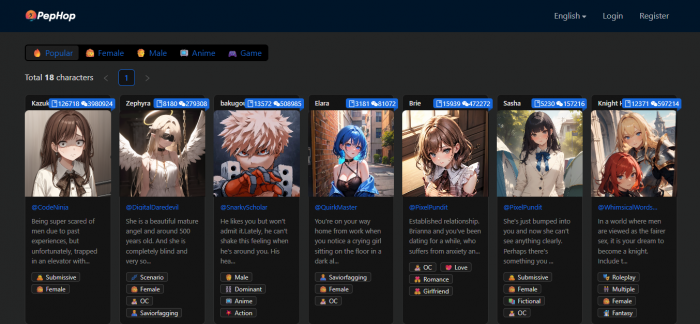
Pephop AI is a browser based character chat platform built around unfiltered text roleplay. Its whole pitch is a massive library of characters, heavy on anime and fantasy, that you can talk to with very few content restrictions. It reportedly runs on GPT-4 and proprietary models, and it leans toward creators and roleplayers who want lots of personas and an open creative space rather than a polished multimedia experience. It launched in late 2023 under a Hong Kong company called PepHop AI HK Limited and grew quickly, though its traffic cooled noticeably in early 2026.
Candy AI
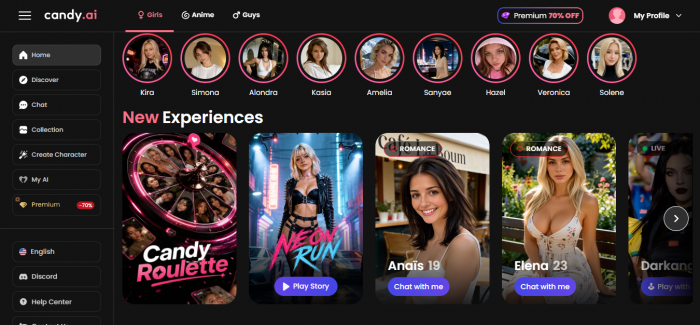
Candy AI is a multimedia AI companion app, and text chat is only the starting point. The experience is built around generated images, voice, and short video of your companion, all inside the same conversation. It offers a curated set of characters plus a deep builder for making your own, and it leans into a visual first, girlfriend or boyfriend style of companionship. It is operated by EverAI Limited, based in Malta, launched in 2023, and has grown into one of the larger players in the space, with tens of millions of registered users and roughly 11.6 million monthly visits.
Characters and personas
If your main interest is variety and creative roleplay, this is a big one.
Pephop AI's headline strength is the size of its character library. It hosts thousands of characters, with a core set of pre made personas plus a large pool of community created ones, and it skews heavily toward anime, fantasy, and roleplay archetypes. You can filter by category and tags, create your own character, and even import or export characters using the TavernAI format, which is a real draw for people who already build characters elsewhere. The trade off is consistency, since user made characters vary in quality.
Candy AI takes a more curated approach. It offers a smaller set of polished, pre built companions across different styles, backed by a deep character builder that lets you shape appearance, personality, voice, and style in fine detail. Reviewers consistently call out its visual consistency, meaning the same companion looks the same across many generated images, which matters a lot if you care about a stable, believable character. So Pephop wins on sheer variety and creator flexibility, while Candy wins on polish, consistency, and depth of customization.
Conversation quality and memory
How good the conversation feels, and whether the character remembers anything, is where a lot of companion apps live or die.
Pephop AI's chat quality is reasonable for short, in the moment roleplay, helped by strong underlying models. Its persistent weak spot is memory. Across reviews, users report that characters start losing track of important details after roughly twenty messages, even on paid tiers, which breaks longer stories. Repetitive phrasing and looping in extended chats come up often too, along with slower responses during busy evening hours.
Candy AI also keeps short conversations in character well, and its memory is stronger, especially on premium, where it holds onto names, preferences, and threads across sessions. It is not flawless, and some users still hit repetition or context loss, but the continuity is generally better than Pephop's. That said, plenty of reviewers feel Candy's conversation depth trails the most text focused companion apps, since most of its energy goes into the visual side. So Candy edges ahead on memory and continuity, while neither is the clear best in the category for pure conversational depth.
Images, video, and voice
This is the clearest split between the two, and for many people it decides the whole thing.
Candy AI is built for this. Its V2 image engine is widely rated as one of the best in the companion space for quality, and especially for consistency. It added Live Action, a mode that generates short animated video clips of your companion up to around 120 seconds, which very few competitors offer at any price. It also supports voice calls and voice messages, though reviewers generally rate the voice as good rather than great. All of this runs on tokens, which is where the cost can climb.
Pephop AI is, for the most part, a text only platform. It has no image generation and no video generation. Voice calls are available on its higher tiers, with the character reading replies aloud, and reviewers describe the voice as clear but a little robotic. If visuals are any part of what you want from a companion, this is the single biggest gap between the two. So if images and video matter to you at all, Candy AI is in a different league here, while Pephop keeps things squarely in text.
NSFW, content rules, and safety
Both platforms are built to allow adult content, so it is worth being clear about how each handles it.
Pephop AI supports both standard and adult modes, which paid users can toggle, and it allows explicit text roleplay within its stated rules. Its published policy draws hard lines around illegal content, including any sexual content involving minors, sexual violence, and similar categories. It asks users to confirm they are adults, though some reviewers feel the age check is light rather than rigorous.
Candy AI leans fully into adult content as well, including explicit images and video, and gates that behind age verification. It is strictly an 18 and over platform, and like Pephop it prohibits illegal content. One thing reviewers note on Candy is that its moderation can feel inconsistent, with some ordinary messages flagged while more explicit ones go through.
Whichever you pick, treat these as adult tools, keep them away from anyone under 18, and never upload images of real people without their clear consent. Reputable platforms in this space ban depictions of minors and other illegal content outright, and that is the baseline you should expect from any service you hand money to.
Privacy and data
With intimate chat apps, privacy is not a side issue, it is central, because the conversations are personal by design.
Pephop AI is the weaker of the two on paper here. Reviewers point out that its privacy language is thin, that it shares data with unnamed third party providers, and that it does not describe strong protections such as end to end encryption. On the upside, it does not require real identity details, so you can use a pseudonym. A simple rule applies: do not type anything you would not want a stranger at the company to be able to read.
Candy AI is based in Malta, which puts it under EU data protection rules, and that is a point in its favor. Even so, your chats, images, and preferences still live on company servers, and some users have reported support and account issues, including trouble after password resets. Both platforms also bill through your card, so a charge may show up on a statement. So Candy has a small edge thanks to its EU footing, but with either one you are trusting a cloud service with sensitive material, and you should treat it that way.
Pricing and value
The sticker prices look similar, but the models behind them are different, and that changes what you really pay.
Pephop AI uses a straightforward, message based model. Its paid tiers, which start at roughly 5 dollars a month and rise from there, give you a set number of messages per month rather than metering every action, and there is no token system layered on top. That makes costs easy to predict. The catch is that the cheapest tier turns off useful features like better memory, the free tier is very limited, and heavy users can bump into the monthly message cap.
Candy AI uses a subscription plus token model. The headline price is low, sometimes around 4 to 6 dollars a month on an annual plan, but that subscription mainly covers text chat. Images, voice, and video all draw on tokens, and the monthly token allowance gets used up quickly. This is the most common complaint about Candy by far, with some heavy users reporting bills of fifty dollars or more in a month, and a few reporting much higher. So Pephop is more predictable and cheaper if you only want text, while Candy can be strong value at the entry price but needs a careful eye on token spending once you use the visual features a lot.
Platforms and access
Where and how you can use each one is a simple but real difference. Candy AI works on the web and has apps for iOS and Android, so you can carry your companion around on your phone. Pephop AI is web only and has no native mobile app, which several reviewers flag as a dated limitation given how mobile first this kind of chatting tends to be. You can still use Pephop in a mobile browser, but it is not the same as a dedicated app. So if phone access matters to you, Candy has the clear advantage.
What real users say
Feature lists are one thing, reputation is another, so here is how each tool lands with the people paying for it.
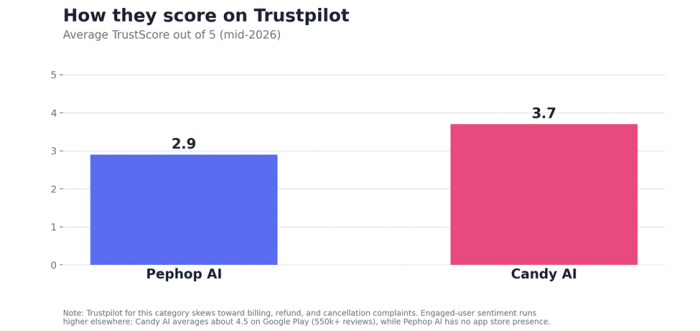
Trustpilot scores for both, with the wider context noted below the bars.

The headline scores look mediocre for both, and that needs context. On Trustpilot, Pephop AI sits around 2.9 out of 5 and Candy AI around 3.7, but the complaints driving those numbers are mostly about billing, refunds, and cancellations rather than the core product. That pattern is common across this whole category, where customers who feel surprised by charges are the most motivated to post. Look at engaged users and the picture brightens. Candy AI averages about 4.5 stars on Google Play across more than half a million reviews, and its Trustpilot distribution is sharply split, with a majority of five star reviews alongside a vocal minority of one and two star ones. Pephop has no app store presence to balance its Trustpilot score, which is part of why its number looks lower. The praise tends to center on the chat experience, and for Candy the images. The criticism tends to center on cost surprises, memory limits, and support. It is a useful reminder to read the distribution, not just the average.
Where each one pulls ahead
To pull it together, here is the quick tale of the tape.
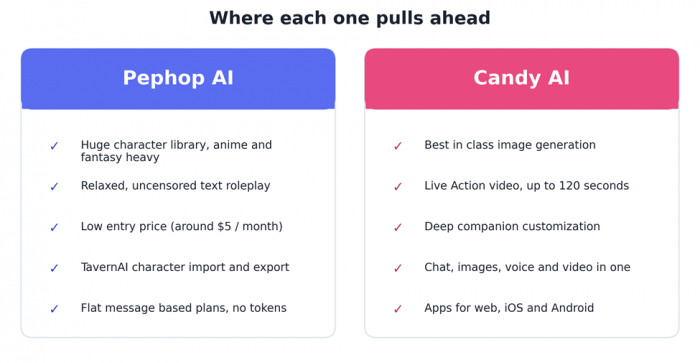
A quick look at where each tool leads.
Pephop AI pulls ahead on the size of its character library, an open and uncensored text roleplay style, a low and predictable entry price, TavernAI character portability, and a simple message based plan with no token metering. Candy AI pulls ahead on image generation quality, its Live Action video feature, depth of companion customization, a true multimedia experience that combines chat with images, voice, and video, and proper apps on web, iOS, and Android.
Where each tool falls short
Neither is perfect, so here is the other side of the ledger.
Pephop AI comes up short on:
• No image or video generation, and only basic voice on higher tiers.
• Weak memory that often resets after about twenty messages.
• No mobile app, plus slower responses at peak times.
• Thin privacy protections and a very limited free tier.
Candy AI has its own rough edges:
• A token system that makes real costs hard to predict and easy to overspend.
• Conversation depth that trails the most text focused rivals.
• Content moderation that some users find inconsistent.
• Reported support and account issues, including after password resets.
Which one should you choose?
Strip away the noise and it comes down to what you want from a companion app.
Go with Pephop AI if your priority is open ended text roleplay, a huge variety of characters, especially anime and fantasy, predictable pricing, and the freedom to import your own characters, and you do not care about images or video.
Go with Candy AI if you want a visual, multimedia companion with strong image generation, short video, voice, and a polished custom character, you want it on your phone, and you are willing to manage token spending to get the full experience.
A note on using these responsibly
A few things are worth keeping in mind with any app in this category, beyond which one has the better features. These are adult products, so they are for verified adults only and should be kept away from minors. Watch the cost, since both can run well past their advertised price once you add tokens or higher tiers. Protect your privacy by using a pseudonym, keeping real identifying and financial details out of your chats, and remembering that conversations live on company servers and may be reviewed. Never upload or recreate images of real people without their clear consent. And it is worth keeping a clear head about the emotional side: these tools are designed to feel attentive and always available, which can be comforting but can also pull you into spending more time or money than you intend. They can sit alongside real world relationships, but they are not a replacement for them. If using one ever starts to feel less like a choice and more like a need, that is a good moment to step back.
My final verdict
So which one would I pick? Here is where I land.
These two are not really competing for the same person, and that is the key to the whole comparison. If I wanted a deep, open ended roleplay sandbox with a huge cast of characters and pricing I could predict to the dollar, I would reach for Pephop AI, as long as I went in knowing it is text only and that its memory will let me down on longer stories. It is one of the cheaper ways into unfiltered character chat, and the TavernAI support is a real bonus for anyone who likes to build.
But if I am asked which is the stronger overall product in 2026, I lean toward Candy AI. It simply does more. The image quality, the Live Action video, the voice, and the phone apps add up to a richer experience, and its memory and customization are a step above. The thing I would watch like a hawk is the token meter, because that is where the friendly entry price quietly turns into a much bigger bill.
My one line take: choose Pephop AI for cheap, unfiltered, text first roleplay with endless characters, and choose Candy AI if you want a polished, visual companion with images and video and you are ready to manage the token costs. Since both have free or low cost ways to start, try each for a day before you commit. Whichever one fits the way you really want to spend your time is the right answer, and that is a test no review can run for you.
Post Comments
Be the first to post comment!